





The European Union has cut its own growth forecast for 2023, blaming the downward revision on a combination of persistently high inflation and weak external demand.
The European Commission’s Autumn 2023 Economic Forecast, published on November 15, predicted that the bloc would expand by just 0.6 percent this year – 0.2 percentage points less than estimated in its Summer Forecast.
The Commission also predicted that the bloc’s growth rate would accelerate only gradually to 1.3 per cent next year: 0.1 percentage point less than previously forecast.
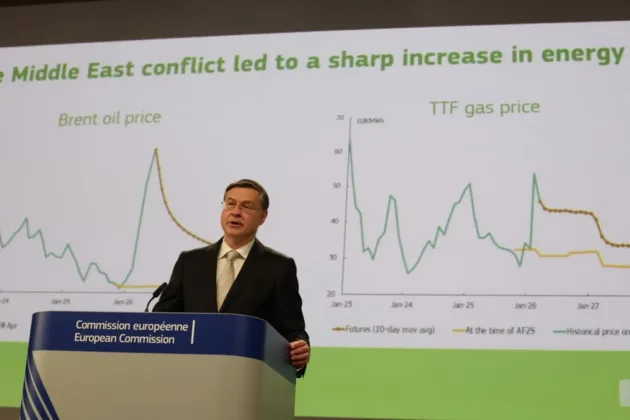
Speaking to reporters, European Commissioner for Economy Paolo Gentiloni noted that 10 of the EU’s 27 member states will experience negative growth this year. This includes Germany, the EU’s largest economy, which is expected to contract by 0.3 per cent.
“We are approaching the end of a challenging year for the EU economy, in which growth has slowed down more than expected,” Gentiloni said.
“Strong price pressures and the monetary tightening needed to contain them, as well as weak global demand, have taken their toll on households and businesses,” he added.
The EU economy has been hit by a series of crises over the past few years. Pandemic-related restrictions wreaked havoc on global supply chains and led the EU economy to contract by 5.6 per cent in 2020.
Russia’s full-scale invasion of Ukraine in February 2022 then sent energy prices soaring, leading to the EU’s headline inflation rate peaking at 10.6 per cent in October last year.
In its attempt to drive down price pressures, the European Central Bank (ECB) has hiked interest rates ten times over the past 16 months, bringing its benchmark deposit facility rate to a record high of 4 per cent.
The tight monetary policy has helped bring inflation down to 2.9 per cent: far below its October 2022 peak, but still above the ECB’s 2 per cent target rate.
Core inflation, which strips out energy and volatile food prices, remains substantially higher than the headline rate, at 4.2 per cent.
Worryingly, Gentiloni also suggested that “heightened geopolitical tensions”, including Russia’s ongoing war against Ukraine as well as the current conflict between Israel and Hamas in the Middle East, have the potential to drive the EU’s growth rate even lower than currently forecast.
“Uncertainty and downside risks to the economic outlook have increased in recent months,” Gentiloni said. “They are primarily related to the evolution of Russia’s protracted war of aggression against Ukraine and the new and tragic conflict in the Middle East.”
He also warned that “the transmission of monetary tightening may weigh on economic activity for longer and to a larger degree than projected in this forecast”.