French President Emmanuel Macron, German Chancellor Olaf Scholz and Polish Prime Minister Donald Tusk have resolved their differences in approach to the Russian assault on Ukraine.
The three leaders agreed to use frozen Russian assets to fund the provision of more weapons and ammunition and to build a coalition designed to deliver long-range rockets for Kyiv’s war effort.
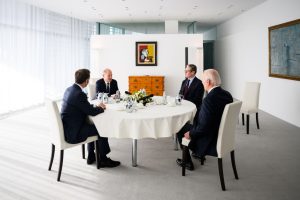
The trio met in Berlin on March 15 to discuss ways of providing greater support for Ukraine. In the German capital, they announced plans to boost military equipment provision for Kyiv, including using frozen Russian assets to finance the acquisition of further weapons and ammunition from around the world.
In February, Tusk had called for the West to use $300 billion of such assets to support Ukraine and had backed the Czech President Petr Pavel’s proposal of buying weaponry on the global market to boost Ukraine’s war drive.
Scholz, Macron and Tusk were meeting under the aegis of the Weimar Triangle, a regional forum that brings their three countries together but which has been suspended in recent years over fraught relations between Poland and Germany
Speaking after the latest meeting, Scholz hailed the agreement as a “symbol of unity” between three countries. He said that, “from the start”, they have wanted “to ensure that Ukraine can effectively defend itself against Russian aggression”.
He was keen, though, to also stress: “We are not at war with Russia.”
Scholz said, in addition to the funding, the trio aimed to help Ukraine boost its own ammunition production and to green-light the purchase of ammunition and arms world-wide rather than just from European Union sources. He also pointed to the intended creation of a coalition to provide inter-continental missiles to Ukraine.
Macron added: “We will do whatever is necessary and for as long as it is necessary to prevent Russia from winning the war with Ukraine.
“We will continue our support for Ukraine and the Ukrainian people for as long as it is needed.”
Tusk welcomed the fact that the three countries were “speaking with one voice” and said “rumours that European capitals differ on important issues were exaggerated”. He announced that the next summit of the leaders would take place in Poland in the early summer this year.
Tusk, together with Polish President Andrzej Duda, met US President Joe Biden at the White House on March 12. There, the Weimar Triangle meeting was billed as co-ordinating efforts of key allies in helping Ukraine at a time when a dispute in the US Congress was holding up American aid for Kyiv.
The latest meeting in Germany was also designed to smooth relations between Berlin, Warsaw and Paris over how to approach the war in Ukraine.
Macron had argued that NATO countries should be willing, if necessary, to send troops to Ukraine on a bilateral basis. Germany opposed any such move and Poland pressed for the allies to concentrate on delivering arms and ammunition now rather than debating if, how and when troops might be sent.
Poland welcomed Macron’s apparent change of heart but insisted Warsaw would not want to see any bilateral action in Ukraine, preferring a NATO option that would involve NATO’s strongest member, the US.
The European leaders’ latest efforts come amid Ukrainian problems regarding declining troop numbers, arms and ammunition, meaning it is increasingly difficult for Kyiv to continue to provide an effective counter to the Russian invaders.