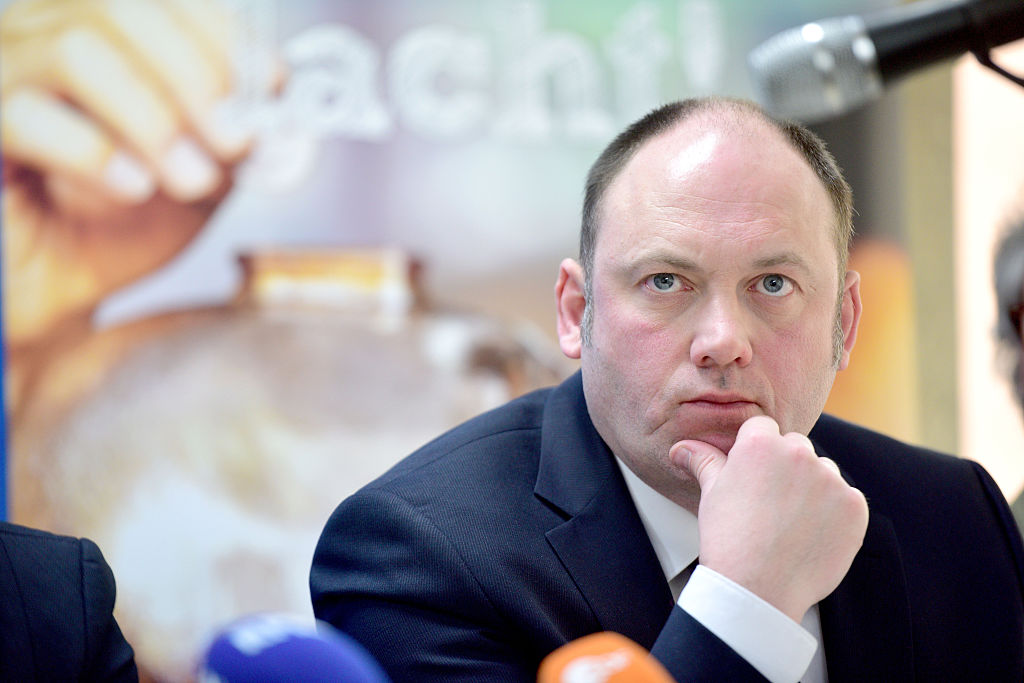
The decision of a major business association to drop its “no contact” policy with right-wing opposition party Alternative for Germany (AfD) is making waves in Germany.
Several companies have announced they are ending their membership with association Die Familienunternehmer (The Family Entrepreneurs, FU) or reviewing it.
Moreover, a prominent left-wing NGO and Germany’s second-biggest union Verdi have started campaigns to put pressure on FU to renounce its decision.

On November 16, FU said it was ending its “ban” on any contact with AfD representatives and would in the future also invite AfD MPs for talks with representatives of its 6,500 members, which are primarily family-owned businesses.
“For us the cordon sanitaire meant that we did not invite AfD MPs to our events out of principle. We have now ended this type of contact ban,” FU president Marie-Christine Ostermann said at the time.
The move to normalise relations with AfD, Germany biggest opposition party that is currently polling at 27 per cent, about tied with the ruling Christian Democratic Union (CDU) of Chancellor Friedrich Merz – has created a storm of moral outrage in Germany’s political and media establishments.
Several organisations from Germany’s big non-governmental sector – euphemistically often referred to as the Zivilgesellschaft (civil society) – are now putting pressure on companies to distance themselves from the business association.
Verdi, Germany’s second largest union with 1.9 million members, has criticised FU’s move and is urging other employers and business associations to distance themselves from AfD.
“FU is finally drifting off towards the Right,” Verdi leader Frank Werneke told media company Funke.
“History tells us how important it is for the business sector to distance itself from right-wing extremists”, Werneke continued, with reference to German industrialists’ support for Hitler’s Nazi party in the 1930s.
Left-wing NGO Campact has vowed to expose all members of FU whom it is accusing of “aligning themselves with a far-right party”.
As the members of FU are not made public, Campact has started to send out letters to companies they suspect of being FU members, urging them to “confirm or deny their membership” by a certain deadline.
The letters close with the line: “If we do not receive an answer from you before the deadline we will assume that your company is a member of Die Familienunternehmer”.
Previously, Deutsche Bank had announced it was cancelling the rental agreement with FU for its events location in Berlin.
Several well-known German companies have now said they are leaving the association, among them drugstore chain Rossmann and household appliances manufacturer Vorwerk, which sells the well-known Thermomix food processors.
“Rossmann does not support the position of the association Die Familienunternehmer and has terminated its membership. We will not comment further on the matter,” a Rossmann spokesperson told Brussels Signal yesterday.
Vorwerk did not respond to a request for comment.
The company told newspaper FAZ yesterday: “In its conduct and some of its political actions, the AfD is fundamentally at odds with fundamental democratic values and the principles of the rule of law.”
Other companies have not made a decision yet but said they are reviewing their membership, including coffeemaker Melitta and construction company Goldbeck.
A spokesperson for Melitta told Brussels Signal: “We have learned about the association’s leadership new stance on AfD from the media. We are very surprised about it and do not condone the decision.
“In principle, we support a dialogue between politics and businesses. However, we do not seek dialogue with parties who are being classified as extremist – even if only in parts.
“Melitta is politically neutral. We have told the association about our position and reserve the right to rethink our membership,” the spokesman said.
Meanwhile, FU stands by its decision. In a statement on November 24, the association wrote: “Discussing with someone who thinks differently does not mean accepting their positions. Talking does not mean working together.
“And those who stop talking altogether have given up on the substance of the debate – it is precisely those people who leave the field open to extremists,” it said.
“Democracy thrives on debate about the best ideas, not on silence.”