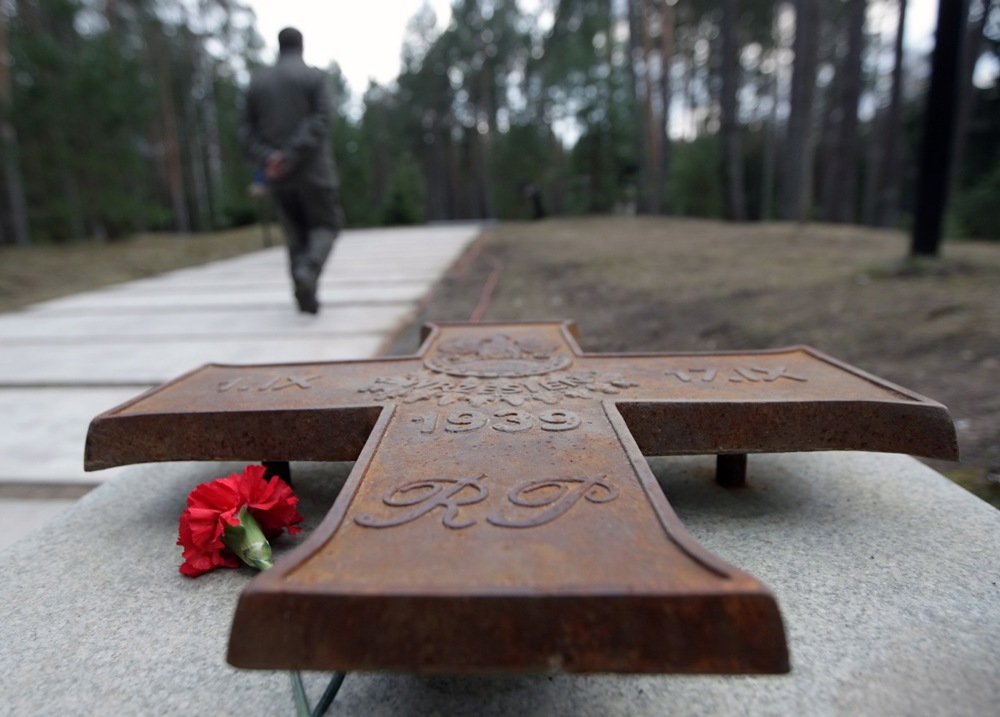
The Russian authorities have removed sculptures of Polish military symbols adorning the graves of Polish officers at the Katyn cemetery in western Russia.
The move has been condemned by Polish authorities as the deliberate desecration of a remembrance site.
The order to dismantle sculptures was issued on November 19 by the prosecutor’s office of the Smolensk region. It argued that they “violated regulations concerning cultural heritage objects and the commemoration of the Russian victory in the Great Patriotic War [Second World War]”.

The move was demanded by Valery Kuznetsov, deputy chairman of the Smolensk regional Duma. He is a member of the Communist Party, which denies the Soviet Union’s responsibility for the Katyn massacre.
Katyn is one of the forest sites where Soviet security forces (NKVD) murdered Polish military officers, police and civilians in 1940, following orders approved by Joseph Stalin.
In May 2025, similar sculptures were removed from monuments in Mednoye, another cemetery for Katyń victims, on the basis of a decision of the Tver regional council.
Katyn cemetery contains the graves of nearly 4,500 Polish soldiers killed by the NKVD out of the 22,000 Polish prisoners of war (POWs) taken after the Soviet invasion of Poland in 1939.
The death pits in Katyn were discovered in 1943 and experts from the International Medical Commission determined beyond any doubt the time of death – 1940 – and the Soviet responsibility for the murder of Polish POWs.
The Soviet authorities denied that and instead blamed the Germans.
The USSR eventually accepted responsibility for the crime in 1990. But under the current Russian President Vladimir Putin, Russia has argued that the killings were a reprisal for the way Soviet prisoners of war were treated by the Poles during the 1920 Bolshevik invasion of Poland, when many died in captivity due to cold and a flu epidemic.
Poland’s Institute for National Remembrance (IPN), the body responsible for investigating and commemorating crimes against Poles during the Second World War and the Communist period (1945-1989) of invasion, issued a statement damning Russia’s desecration of the Katyn site.
“The IPN strongly condemns the act of desecration committed by the authorities of the Russian Federation at the Katyn War Cemetery by removing sculptures depicting the War Order of Virtuti Militari and the 1939 September Campaign Cross,” which are high military honours awarded by the Polish State.
“Contrary to the claims of the Russian authorities that these decorations are ‘Russo-phobic’ – they were created to commemorate specific historical events and the heroism of soldiers.
“Their significance relates to the struggle for Poland’s independence, not to contemporary or ethnic prejudices,” IPN added, before demanding the restoration of the cemetery sculptures.
It also pointed out that Poland maintains and protects graves of fallen Red Army soldiers on Polish territory, although it reserves the right to take down monuments that glorify the Soviet past.
A joint declaration was also issued by the government Office for War Veterans and Victims of Oppression (UDSKiOR) and the Federation of Katyn Families, both demanding the restoration of Polish symbols at the Katyn necropolises and consequences for those responsible for this “act of barbarism.”
“The Polish authorities and families of the victims have been deprived of access to the burial sites of the murdered located on the territory of Russia,” they said.
“The chiseling away of Polish military symbols is yet another act of erasing the memory of this terrible crime, which the Polish authorities and Polish society do not and will not accept.”
In a sign of further deterioration of relations between the two countries, Poland’s ambassador to Russia, Krzysztof Krajewski, was attacked on November 16 in Sankt Petersburg by a group protesting at Polish “Russophobia” and the country’s support for Ukraine.
Krajewski, who has been ambassador since 2021, had been visiting the Catholic Church of St Catherine in Saint Petersburg for a service in Polish. On his way there, he was surrounded by a group of around a dozen protesters carrying banners with anti-Polish and anti-Ukrainian slogans.
According to reports in the Polish media, the group shouted at the Polish ambassador before several of them moved to attack him physically. That was prevented by Polish State Protection Service (SOP) guards accompanying the ambassador.
Poland’s foreign ministry said: “It was the most serious incident of its kind in many years,” adding: “only the intervention of security guards prevented the ambassador from being beaten.”
On November 19, during a meeting with the chargé d’affaires of the Russian embassy informing the Russians about the closure of their consulate in Gdańsk, the ministry expressed its outrage at the incident in Sankt-Petersburg.
The Russian diplomat noted their concern and responded that such situations should not occur.
The closure of the Russian consulate in Gdańsk has come in response to the explosions on railway tracks over the weekend of November 15-16, for which Poland has held Russia responsible.
Relations between Poland and Russia have plummeted since Moscow launched its full-scale invasion of Ukraine in 2022.
Warsaw has been among Kyiv’s staunchest supporters, serving as a key humanitarian and military hub for western military aid bound for Ukraine.