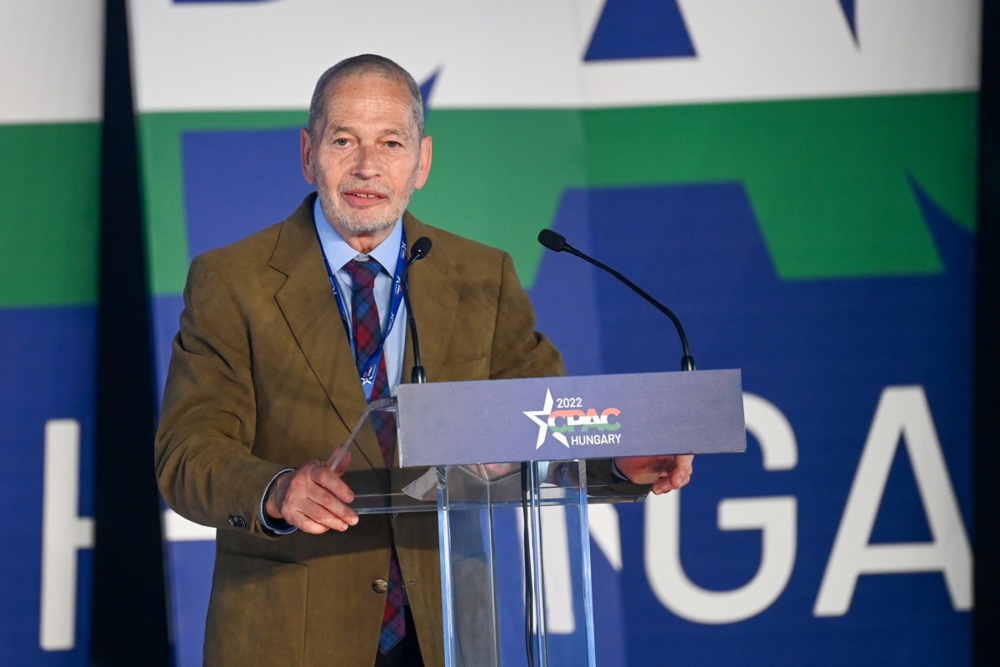
The Brussels Mathias Corvinus Collegium’s (MCC) two-day Battle for the Soul of Europe conference attendees gathered in Brussels yesterday to challenge what they call “the elite”.
As the European Union’s machinery is struggling with scandals, a war and a declining economy, hundreds of conservatives from both sides of the Atlantic are in the EU capital to attend the conference.
The conference will continue today at the Claridge event venue, which hit the headlines in April last year after the local mayor wanted to block another similar event, NatCon, following alleged threats of violence from the far-left.

By returning to the Saint-Josse-ten-Noode district, the mayor of which tried to cancel NatCon, MCC Brussels say they are sending a clear message: The European Right is no longer willing to be pushed to the periphery.
In the meantime, the MCC Brussels appears to have grown into the most prominent conservative think-tank in the Brussels bubble and beyond.
It was able to assemble a wide variety of guests, a mix of academics, intellectuals, politicians, journalists and other public thinkers to discuss the future of Europe, or the way out of today’s Europe, which, according to them, is on the road to ruin.
The organisation was conscious of the biggest pitfall certain conservative and populist events suffer from: Most people agreeing on most things and speakers trying to score points by attacking easy targets such as “wokery”, gender issues or open borders on the one side, and complaining about how bad the current establishment policies are on the other.
Jacob Reynolds, policy director at MCC Brussels, urged attendees to ask harder questions and to move beyond going after the obvious targets, although the battle between elites and the rest of the population remained central.
In particular, what policies and plans need to be unrolled when the populists take power?
On the first day of the conference, the focus was put on “values”, seen as a key element to change the trajectory Europe is on.
Monika Gabriela Bartoszewicz, associate professor in societal security and safety at the
The University of Tromsø – The Arctic University of Norway, warned of the consequences of being led by fear and pushed the importance of cultural regrowth.
She stressed that conservatism as a concept could conserve just about anything but is a “losing ideology” when it limits itself to simply hitting the brakes.
“You cannot keep conserving the outer shell, Europe must rediscover the inner fire and the soul that sustained it throughout centuries”, she said, adding the need for remembering “the truths that make life meaningful: Faith, dignity, transcendence, courage and responsibility”.
It set the tone for the first group of speakers, who focused on the essence of what Europe is, or should be, in an almost spiritual manner.
The next panel zoomed in on how democracy is under attack in Europe, ranging from encroachment from Brussels to censorship and straight-out election interference.
Ryszard Legutko, a conservative Polish philosopher with a prominent career within the Polish Law and Justice Party (PiS), laid out what he said were the inherent biases of the current European system, which he described as an “oligarchy”, bent on forming “an ever closer union” without much democratic backing.
Norman Lewis, visiting research fellow with MCC Brussels, talked about his research on how European institutions, foundations and academic institutions were unaccountable and empowered to decide what truth and disinformation is, and what people can and cannot say.
Lewis warned of plans to “prebunk on scale”, an AI-driven algorithm from Google that detects so-called hate speech and neutralises it with pre-emptive counter messaging. Or, in his words, the attempt “to control what people think before they have a chance to even think it”.
He said this Big Tech plan was not a one off and Europe with its Democracy Shield likewise has ambitions, he feared.
Jerzy Kwaśniewski, president of the conservative Polish Ordo Iuris Institute, painted a grim picture of the poor state of the rule of law in Poland under Prime Minister Donald Tusk, who faces no push back from Brussels regarding his progressive agenda.
Virginie Joron, MEP for the French National Rally (RN) party explained how the French Government and media regulators tipped the scales in her country, steering the public narrative, with full backing from the EU.
Adam Starzynski, editor of the popular Visegrad 24 account/news website, explained how “debanking”, shadow bans and full bans on social media could side-line people completely.
Later, in the panel debate, Starzynski gave a pessimistic warning, noting that once dictatorships were established they can last for a very long time, pointing towards Cuba and Iran.
The US academic Patrick Deneen, who speaks about the post-liberal order, again put the focus on concepts such as dignity and societal interdicts.
He said the old consensus of the seven mortal sins was turned on its head by the liberals, who embraced the ancient interdicts and imposed on people new sins, such as nationalism, colonialism, racism, sexism or Catholicism. In the end, the liberals all shared the common trait of self-loathing, he said.
Another prominent speaker was Václav Klaus, former president of Czechia and professor, who said he did not want a battle over the soul of Europe, stating it did not exist, that Europe was not an entity with a soul and frankly did not need one.
Instead, Klaus wanted a common European denominator, such as freedom.
A last panel, with business strategist Andreas Svanlund, Polish journalist Tomasz Wróblewski and Brussels Signal‘s own Ralph Schoellhammer tackled economic reform, putting their finger on some pressing issues facing the continent that are rarely talked about.
British author Melanie Phillips and Spanish politician Jorge Buxadé Villalba were the last speakers of the first day, warning about what saw as the disastrous consequences of open borders and mass migration.
The full conference was streamed online and can be watched on YouTube.