Poland’s prosecution service has dropped a criminal investigation of a doctor who carried out an abortion on a woman who was in the ninth month of pregnancy.
The right-wing politician who protested against the mother’s decision, though, is facing trial for allegedly assaulting the medic at the hospital.
The case of Dr Gizella Jagielska made headlines earlier this year when right-wing presidential candidate and MEP Grzegorz Braun entered a hospital in which the abortion took place and attempted to perform a citizen’s arrest of the doctor.

According to Poland’s legislation on abortion, a termination of pregnancy is only allowed if the pregnancy resulted from a criminal act such as rape or incest or if it threatens the life or health of the mother.
In this case, the mother learned late in her pregnancy that her child may be suffering from congenital bone fragility.
A hospital in the city of Łódz denied her an abortion on legal grounds and offered to conduct a caesarian birth and to treat the child afterward.
The woman obtained a psychiatric certificate that declared the pregnancy was a risk to her mental health. With the help of a pro-abortion NGO she was transferred to a hospital in the town of Oleśnica in which Dr Jagielska worked.
He agreed to perform the termination and it was carried out in October, 2024.
Prosecutors in Oleśnica launched an investigation to ascertain whether the abortion had been carried out in violation of the law and yesterday announced they had dropped the case.
They gave no details of the basis on which their decision had been made beyond that they had found a “lack of evidence of a prohibited act”.
In cases where the woman’s life or health is deemed at risk from a pregnancy, Polish law does not impose any time limits on abortion.
Despite that, a Constitutional Court ruling in 2020 deemed that termination of pregnancies on the grounds of deformity of the foetus did not qualify as a condition threatening the health of the mother.
Last year, the ruling centre-left coalition led by Prime Minister Donald Tusk was unable to agree on how to liberalise Poland’s legislation on abortion. The justice and health ministers, though, issued guidelines to prosecutors and doctors on how to “take the side of the woman” when reaching decisions on the legality of terminations of pregnancy.
Dr Jagielska herself is reported to be leaving her post in Oleśnica as the hospital there has not renewed her contract. She claims the decision to let her go had been political and said in her 10 years at the hospital in Oleśnica she built “the maternity ward from scratch”.
“For the hospital, it seems that it’s simply more convenient for me not to be there,” she told commercial broadcaster Radio TokFM.
In April, during the presidential election campaign, the right-wing candidate Grzegorz Braun MEP, who later polled above 6 per cent of the vote, entered the hospital in Oleśnica and confronted the doctor.
He attempted to make a citizen’s arrest for the abortion by trying to stop Dr Jagielska from leaving her office until the police arrived at the scene.
Prosecutors have subsequently brought charges against Braun for assault and slander. In November, the European Parliament lifted his immunity so he could stand trial in Poland.
Braun is already on trial for putting out Hanukkah candles during an event in Poland’s parliament, disrupting a lecture that he claimed falsified Polish history and for taking down a LGBT exhibition.
He has focused on anti-Ukrainian, anti-European Union and anti-Israeli messaging and commitment to traditional Catholic values such as opposition to LGBT rights and abortion.
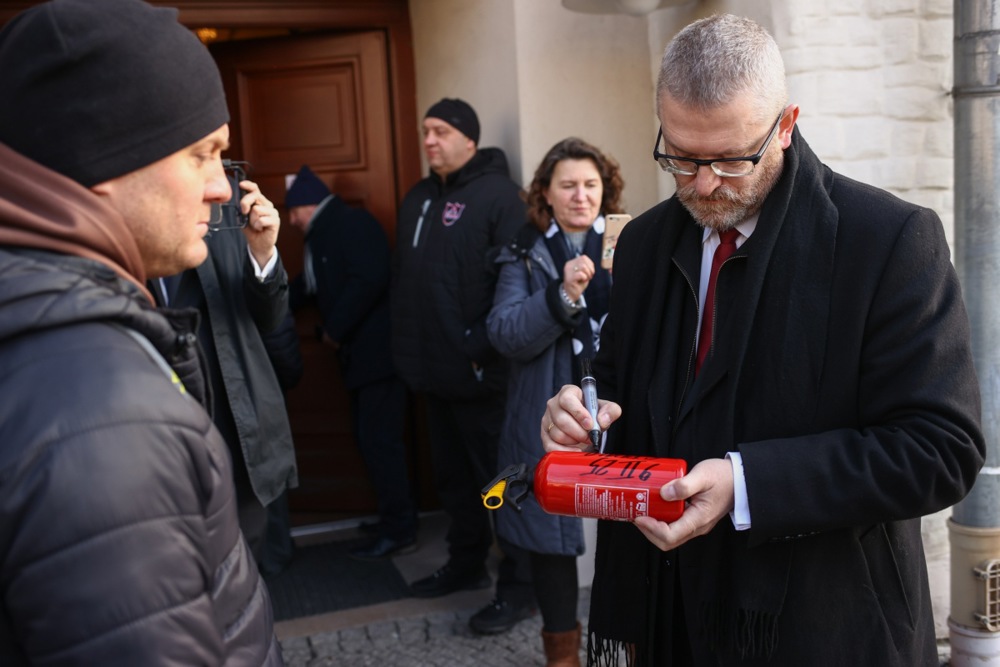
His stunts, such as the dousing of Hanukkah candles with a fire extinguisher, and his strong rhetoric have coincided with his Confederation of the Polish Crown party gaining between 7 per cent and 10 per cent in latest opinion surveys.
The trials he is facing will likely ensure further visibility, as will calls from within the centre-left ruling coalition for his party to be disbanded.