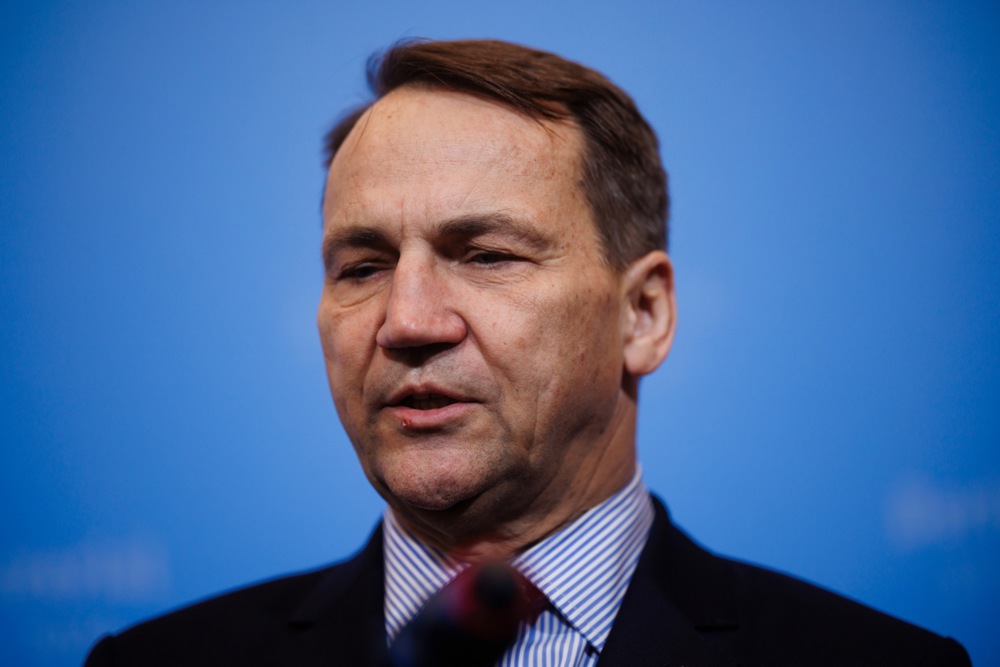
Poland’s top diplomat said creating a European Union army is unrealistic, but suggested member states could form a smaller, brigade-sized “European legion” to address regional security threats.
Speaking to reporters in Brussels before yesterday’s meeting of EU foreign ministers, Poland’s Radosław Sikorski said national armies were unlikely to form a single force.
“Talking about a federal army is pointless because national armies won’t merge,” he said.

“However, we could create what I call a ‘European legion’, meaning, to begin with, a brigade-sized unit,” that would include soldiers from all member states and candidate countries, he added.
Such a unit would be financed from the EU budget and answerable directly to EU institutions, he claimed.
Sikorski admitted that a European legion would not be designed or able to to deter major aggressors but could respond to lower-intensity crises.
“This wouldn’t be a force capable of deterring [Russian President Vladimir] Putin’s Russia, but there are lower-level threats, such as those in North Africa or the Balkans, where we should have the ability to act together,” he said.
He added that the worsening security environment around Europe has made the need more urgent and pointed to the fact that the EU is already engaged in providing instruments for the defence of member states.
“We’re off to a good start with the SAFE [Security Action for Europe] instrument, money borrowed from a joint EU loan facility for defence. It’s €150 billion for the most advanced types of armaments and nearly one-third of that will go to Poland.
“Complementing this instrument with a European military unit would, in my view, be a step in the right direction,” Sikorski said.
The centre-left Polish Government led by Prime Minister Donald Tusk has been presenting Poland’s large EU SAFE programme allocation as a “success” with the PM taking to X to state: “This is what real alliances look like.”
The Conservatives (PiS) led opposition, though, has reminded the public that the financial resources are borrowed and there will be restrictions in the way procurements are made. They must be carried out in the EU whereas Poland over the past decade has been purchasing its military equipment largely from the US and South Korea.
The EU does not have forces of its own and most member states [23 out of 27] are members of NATO, but discussions within the community have accelerated since the dispute with US President Donald Trump over Greenland.
Earlier in January, the European Commissioner for defence and space, Andrius Kubilius, said the bloc should consider establishing a 100,000-strong military force of its own. Kaja Kallas, the EU’s top diplomat, though, questioned the feasibility of such an idea, saying she felt it could undermine NATO.
Speaking ahead of a EU summit yesterday, she said: “If we create parallel structures, then it is just going to blur the picture.”
NATO Secretary General Mark Rutte had earlier said a European army would “make things more complicated” and result in “a lot of duplication”.
Under pressure from Trump, NATO members have agreed to ramp up their defence spending and Poland leads the fray in this regard as its military spending is targeted to reach 4.8 per cent of GDP this year, the highest level in the alliance.
The country already has the third largest NATO army, behind only the US and Turkey.