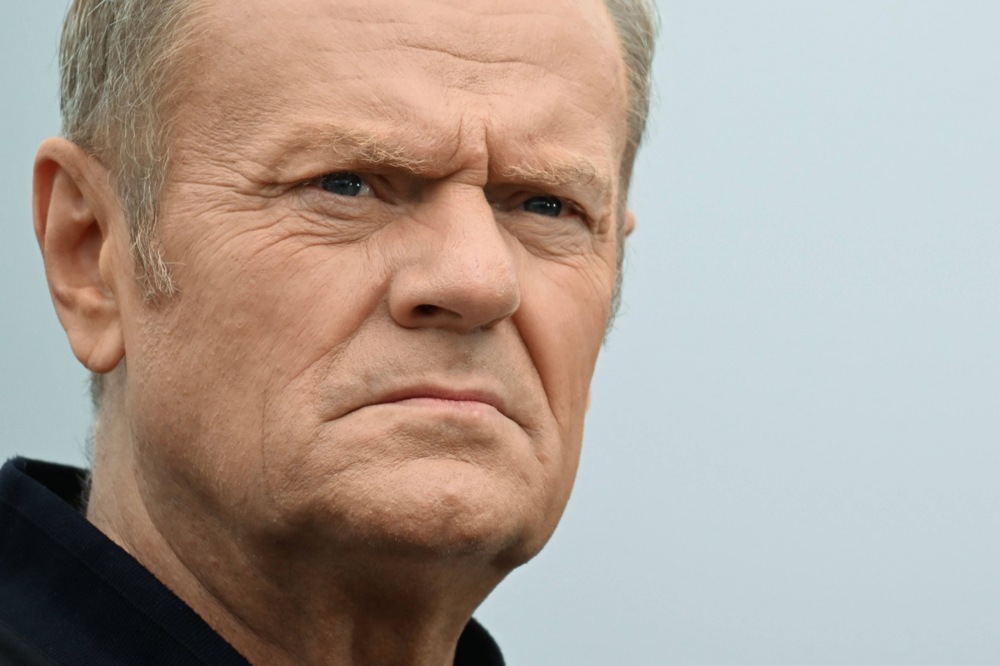
Some of Donald Tusk’s voters who are less familiar with the current behind-the-scenes goings-on may have had the impression that someone mixed up the texts during the recording of the Polish prime minister’s New Year’s address. The recent head of the European People’s Party was apparently given a script stolen from one of the parties so fondly referred to by the left-wing media as “far-right.” It contained almost everything that conservative voters like today.
It emphasised that the world is unstable, that the past year resembled a “thriller movie script”, and that we are facing “the end of the old world”. This is bad news for citizens, but there is also good news, because “the most important thing for us is that even though the world around us is shaking to its foundations, Poland is spreading its wings” and will further protect its borders. What’s more, this Polish strength has its roots in a proud history. “One thousand years of Polish statehood is a commitment. The anniversary of the first Piast dynasty coronation reminds us that there is no point in complaining about difficult times. The state must cope in all circumstances. One thousand years of our own history allows us to draw our own conclusions. Without looking to others,” said Tusk.
Exactly — without looking to others. The European Union, which just a year ago was touted as the most important guarantor of our security and the most important mirror in which we must constantly look at ourselves, making sure that everything in Brussels is to its liking, suddenly is of much less importance. These words are followed by promises: “We must implement our own plan,” which means “accelerating the construction of the strongest army in Europe, major infrastructure investments, re-Polonization, and the reconstruction of industry, including the defence industry.” In public procurement, the “local content principle, i.e. Polish first”, is to become an “iron rule”. We are also to quickly “conquer the Baltic Sea – our Polish Baltic Sea”. In addition, the prime minister condemned excessive individualism and rabble-rousing, announced a tough fight against criminals, suggesting at the same time that the Conservative president also has something on his conscience. We are to remain an “oasis of security”.
Equally important is what was not included in the speech. The term “European Union” was not mentioned once. Neither was the word “Brussels”. The word “tolerance” appeared once, but as part of Poland’s historical heritage. There was no mention of the left-wing social agenda, abortion, LGBTQ+, or minority rights.
A conservative politician I know well wrote to me shortly after the broadcast: “Thief! What are we supposed to do about this?”

Indeed, the audacity of this volte-face is breath-taking. It is worth remembering that Tusk returned to power by ridiculing the concept of defending the border by building a steel protective barrier and deploying troops there, which is what the Law and Justice government did. He said that the storming migrants were “poor people looking for their place in the world”. He scoffed at the historical references that the Law and Justice government often used. He ridiculed the idea of facing threats alone, claiming that only the European community offered hope, including that related to military security. He criticised the building of a strong army, described large state investments in infrastructure as “senseless megalomania”, and considered the promotion of domestic products in public procurement to be a violation of the principles of competition.
The shift is therefore evident, and the New Year’s speech only punctuates a process that began after Tusk lost the presidential election in June. In the media favourable to him, among the avalanche of banal comments lamenting the failure of society and its stupidity, I picked out one in which the author stated: “We must understand that the conservative side has a lasting majority in Polish society.”
Tusk took the defeat hard, disappeared for a few weeks, and then returned. A changed man. He began to show up at the border and praise its defenders, silenced the left-wing radicals in his own camp, and changed the language he uses to talk about politics. He no longer criticises his opponents as ideological right-wing radicals, but as those who are too incompetent to effectively implement right-wing goals.
He knew what he was doing. He quickly noticed that his party’s approval ratings had risen slightly. Satisfied, he told reporters at a press conference that he was willing to bet that he would remain in power after the elections in the fall of 2027.
Tusk is clearly following in the footsteps of Angela Merkel, who was known for loving, as one of her biographers put it, to rummage through her competitors’ “attics with programmes” and choose what might appeal to voters.
But there is also a deeper reason for this volte-face. In the mentioned New Year’s address, there is another sentence concerning the past year. According to Tusk, it brought “the spectre of crisis and collapse to many developed countries”. But nothing like that happened; we have had the same situation in the West for many years. However, it shows us that even Tusk is disappointed by the inertia and the scale of lack of will of European Union leaders to move forward, break out of the cycle of misguided ideas, and build military and economic strength. This great admirer of German economic culture is watching with us as Germany surrenders its automotive industry to China. Already, almost one in ten vehicles purchased in Poland comes from China, and experts say this is only the beginning of a flood. At the same time, Europe is killing off the remnants of European industry with successive leaps of the Green Deal.
“These are just words, without any credibility. His words are not followed by actions. We know how to show this to Poles,” Mariusz Błaszczak, former deputy prime minister and minister of national defence, the second-in-command in Law and Justice, tells me when I press him on how they are reacting to Tusk’s change. He indeed has strong arguments here. On the very days when Tusk was talking about the “local content” principle, a tender for high-speed trains was announced, set up in such a way that Polish companies capable of supplying vehicles capable of traveling at 250 km/h were immediately excluded from it. Trains capable of speeds several dozen kilometres per hour faster were requested, which, although it does not make much sense in Polish geographical conditions, immediately points to suppliers from Germany.
A few days later, it came to light that the government had abandoned the construction of a large container port, and the US ambassador publicly complained that the Polish side was delaying the signing of contracts for the construction of a nuclear power plant. The expansion of the army is continuing, but at a much slower pace than planned. In education, the government is stubbornly trying to implement left-wing ideas, such as the abolition of homework, which initially appealed to some Poles but is now causing outrage because the effects on teaching are disastrous.
And even the celebrations of the 1000th anniversary of the coronation of the first Polish king were simply forgotten by Tusk’s government. They were grand and successful, with a huge joyful march through the capital, but organised voluntarily by people on the Right.
Jan Rokita, a well-known and respected analyst, a decades ago politician in Tusk’s party, now leaning towards the Conservative side, emphasises that Tusk represents a declining European formation. “This is definitely a declining career, because this whole camp is in decline in Europe, still strong but already on the wane,” Rokita tells me, adding that there is no doubt that the right-wing will take power in Poland after 2027, although it is still unclear in what exact party configuration. This is confirmed by all the polls.
And this conclusion seems the most interesting: Tusk’s volte-face is a sign that even he, a faithful son and humble servant of the Brussels machine, has recognised its weakness, decided that it is no longer a source of political strength and, perhaps more importantly, of invigorating ideas. If others recognise this, we may be facing a really big change in Europe.


Return of the Visegrad Four: ‘To stop crazy EU ideas’, everything is going to plan