Pakistan was never supposed to matter to Europe’s Middle East policy. Yet today, it suddenly does. In President Trump’s post-war framework for Gaza, it is not Brussels, Paris, or Berlin that sit at the table, but Islamabad. More precisely, it is Pakistan’s military chief, General Asim Munir, who emerges as a key figure in discussions over a potential stabilisation force for Gaza. This should alarm Europe.
According to Reuters, Munir – arguably the most powerful man in Pakistan – is being courted by Washington as it seeks contributions from Muslim countries for a transitional force in Gaza. Trump’s plan envisages demilitarisation, reconstruction and security guarantees provided not by Western troops, but by forces drawn from the Islamic world. Pakistan is presented as a natural candidate. Europe, by contrast, is absent. Shunned. Again.
Pakistan hesitates – and it is understandable. Munir faces a deeply pro-Palestinian public, a volatile domestic environment and the risk of being dragged into a conflict that resonates globally. Even discussing cooperation with the Israeli side entails political cost in Islamabad. Yet the very fact that Pakistan is being asked, while Europe is not, speaks volumes.

This is not simply about Gaza. It is about power, relevance, credibility. Europe has spent years declaring the Israeli-Palestinian conflict a central concern, issuing statements and warnings, passing one resolution after another, funding and benefactoring the Palestinian government and Gaza. But when the moment comes to shape outcomes on the ground, Europe is nowhere to be found. It cannot deploy a credible force, guarantee security, or impose conditions. Therefore, Washington turns to Muslim military powers, while Europe watches from the side-lines.
Of course, Pakistan is not a neutral stabiliser. It is an Islamist-tolerant state whose security doctrine has repeatedly destabilised South Asia. For decades, Islamabad has played a double game: Presenting itself as a Western partner while tolerating, managing, or enabling Islamist actors at home or abroad. From Kashmir to Afghanistan, Pakistan’s military establishment has treated Islamist militancy not as an existential threat, but as a tool. A Muslim peace force in Gaza led by such actors would most probably operate in a manner fundamentally at odds with long-term stability.
Washington knows all this. And it also knows that since consolidating control over the country’s political system, Munir has turned the army into the undisputed power centre. Civilian politics have been marginalised, opposition has been neutralised and military authority is being further entrenched across institutions. But it is this concentration of power, which does not arise from democratic legitimacy, that makes Pakistan useful according to Washington’s cynical criteria.
All this highlights a failure for Europe. The EU insists on a values-based foreign policy, yet increasingly relies on illiberal, Islamist-friendly agents to stabilise regions that directly affect European security. Turkey is one example. Syria is another one. Gaza, too. Consequences are felt in Europe through migration flows that constitute an invasion, causing radicalisation and unrest. And still, Europe ends up having no seat at the table.
The irony is stark. While Pakistan debates whether deploying troops to Gaza might inflame Islamist sentiment at home, European cities already suffer the repercussions of Middle Eastern conflicts on their own streets. Europe absorbs the consequences while losing influence.
Pakistan’s possible role in Gaza reveals a broader truth: When the West retreats from hard power, others step in on their own terms. A stabilisation force shaped by states like Pakistan will not reflect European priorities, norms, or security concerns. This pattern is familiar. Libya, Syria, Afghanistan, now Gaza, Europe has outsourced influence while taking the cost. Migration pressure, internal security challenges, political radicalisation are treated as domestic issues, disconnected from foreign-policy weaknesses, while they are not.
So there you have it. Pakistan, an Islamist-tolerant, regionally destabilising power, which should not be Europe’s indirect partner for peace in the Middle East, is now a player, while the EU is being side-lined. And if Pakistan’s generals help define Gaza’s future as Europe issues statements, that will not be an accident. It will be the logical result of years of theorising while watching history unfold from afar. Power matters. Presence matters. And vacuums do not stay empty for long.
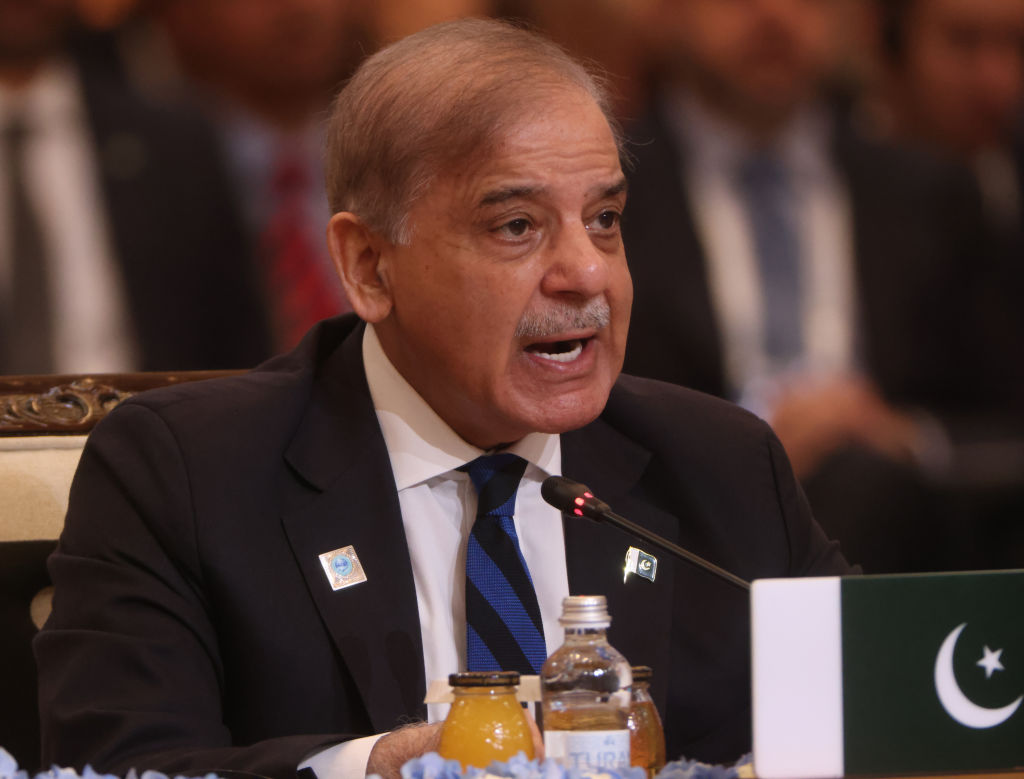


EU handouts fund Pakistan authoritarian power and drive migrant invasion of Europe