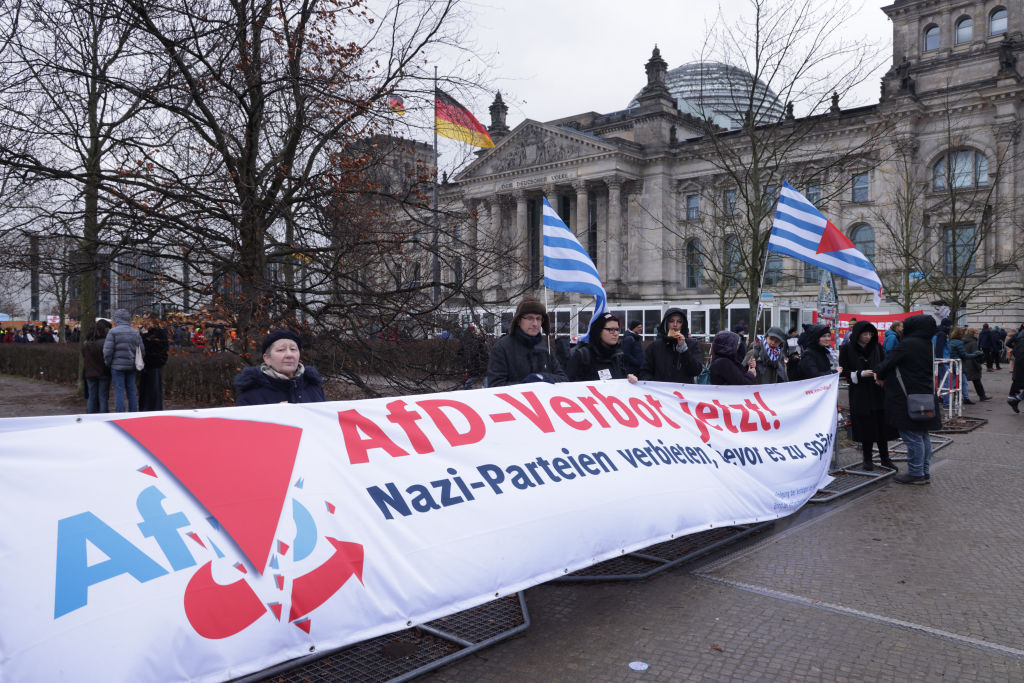
A German administrative court in Cologne ruled yesterday that the country’s domestic intelligence agency may not classify the right-wing Alternative for Germany (AfD) party as a “right-wing extremist” organisation while a legal challenge is pending.
The domestic intelligence agency, the Federal Office for the Protection of the Constitution (BfV), had previously issued such a designation — the most serious classification used by Germany’s domestic security services — which would have allowed intensified surveillance and carried significant political and legal consequences, potentially including a ban on the party.
The Cologne Administrative Court, which handles disputes between citizens and public authorities and whose rulings can have implications across Germany, stated in its decision: “The conditions for classifying and treating the applicant as a confirmed right-wing extremist endeavour are not met.”

In other words, the judges found there is currently no sufficient legal basis to label the AfD as an extremist movement, delaying any immediate prospect of outlawing the party.
The Cologne injunction constitutes a temporary suspension while a broader lawsuit proceeds, meaning the final decision on whether the AfD can legally be considered extremist is still pending.
The larger lawsuit at the centre of the dispute concerns whether the BfV has the legal authority to classify the AfD as extremist. In 2025, the agency moved to designate the party as such, enabling greater surveillance and raising the possibility of legal measures against it, including a ban.
Following that decision, calls intensified within parts of Germany’s political establishment to explore formal ban proceedings — a procedure permitted against parties classified as extremist by domestic intelligence.
Several lawmakers from both governing and opposition parties urged the Bundestag to consider asking the Federal Constitutional Court to review whether the AfD poses a threat to the constitutional order, which could trigger proceedings to prohibit the party.
This type of procedure has no direct equivalent in other Western democracies, as it allows for the prohibition of political parties if domestic intelligence classifies them as extremist, even when their representatives have not broken the law. It is a legacy of Germany’s history, particularly the Weimar Republic period in the 1930s, when the National Socialists gained support through elections and ultimately dismantled democracy by exploiting democratic mechanisms.
Modern Germany was founded in part to prevent such a scenario and, since the post war period, has equipped itself with intelligence tools designed to guard against that risk.
In recent years, the BfV has faced criticism for being politicized and allegedly instrumentalised against the AfD, currently Germany’s largest opposition party and, according to many national surveys, a leading force in public support.
As a government agency, the BfV is supervised by the Federal Ministry of the Interior and must operate within the law and ministerial directives. Critics argue that intelligence tools and definitions of extremism have at times been applied in ways aligned with political objectives rather than purely security considerations.
The AfD challenged the right-wing extremist classification, arguing that there is insufficient evidence that the party as a whole is extremist and that the move unfairly stigmatises a legitimate parliamentary force.
AfD co-leaders Alice Weidel and Tino Chrupalla described the Cologne court’s decision as “a significant success for the rule of law and democratic fairness”. They said the court had followed the party’s “clearly justified legal reasoning” and emphasized: “In a democracy, only the voters decide who is allowed to participate in political competition.”
Following yesterday’s temporary ruling, the AfD’s legal status remains unchanged, but the broader legal process is still underway. The main lawsuit, which will determine whether the BfV can legally classify the party as extremist, could take several months to a year before a final decision. During this period, intensified surveillance and potential legal measures, including a ban, are on hold, while political debates and calls for constitutional review continue.
The ruling carries heightened political significance because the AfD is currently among the most supported parties nationwide. Recent national polling averages place the party at approximately 24 to 26 per cent, running level with or slightly ahead of the governing bloc in some surveys.
In Berlin, the party polls at around 17 per cent, making it the second-strongest political force in the capital and reflecting significant growth compared with previous elections. This trend underscores why the court’s decision — preserving the AfD’s legal status while the broader lawsuit is decided — matters not only legally but also politically, as a party with such strong support is poised to influence upcoming elections and public debate, even as mainstream parties publicly refuse coalition cooperation with it.