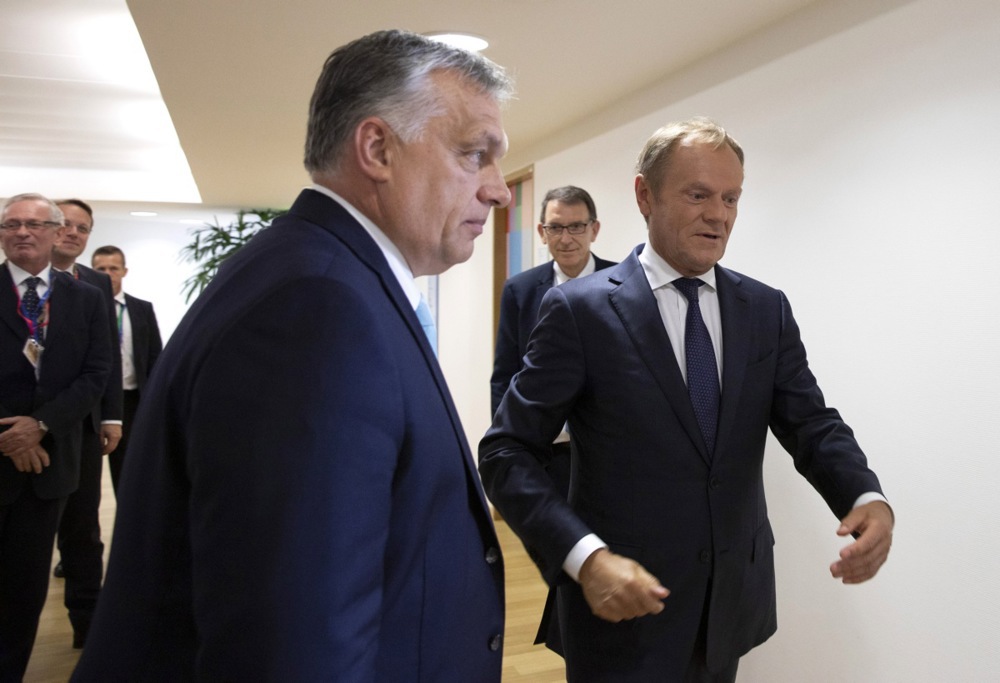
The leader of Hungary’s main opposition party Tisza has promised that if elected into power he would send two Polish politicians granted asylum in his country back to their native land.
Peter Magyar was referring to former Polish justice minister in the last Conservative (PiS) government Zbigniew Ziobro and his deputy Marcin Romanowski who have both been granted asylum in Hungary after their parliamentary immunity was lifted and they were charged with abuse of power.
The Hungarian opposition leader said on February 15 that if he comes to power following April’s parliamentary elections ““we will extradite them on the first day” but did not specify how that would be possible under Hungary’s existing legislation which forbids the extradition of persons granted asylum in that country.

In response Ziobro’s attorney, Bartosz Lewandowski, wrote on social media that “the decision on extradition in Hungary is made by a court, not by a politician”.
Magyar also suggested that both Ziobro and Romanowski may flee to Belarus or Russia before that happens and in an allusion to Hungarian Prime Minister Viktor Orbán’s good relations with Moscow he sneered that “there might be someone else on the plane too.”
Both Ziobro and Romanowski face a wide range of charges relating to their time in office during the lifetime of the last PiS government (2015-2023). They have been accused of steering public funds from the Justice Fund, a financial instrument for helping the victims of crime and for combatting crime, towards Catholic and conservative organisations, constituencies in which their political allies were to be elected and of allegedly illegal spending and on the purchase of the Pegasus spyware system it is claimed was used against opposition politicians.
If found guilty, they could each face up to 25 years in prison.
They both deny the accusations, accusing the current government of using the judicial system for political ends and of accusing them of actions common in all political systems the world over.
The Orbán government in Hungary granted both protection on the grounds that neither were likely to face a fair trial in Poland and that the attempts to arrest them and hold them without trial constituted harassment against the political opposition.
These moves have drawn bitter protest from the present centre-left Polish government led by Prime Minister Donald Tusk, with the Poles withdrawing their ambassador and threatening to take Hungary to the European Court of Justice and to encourage the EC to sanction that country.
Polish prosecutors have, following a court ruling on pre-trial detention of Ziobro, issued a European Arrest Warrant (ENA) for him on the grounds that he is hiding in an EU country “to avoid criminal liability” and claimed his current address is unknown.
However, Ziobro makes no secret of where he is residing and has even attempted, without success, to report his constant details to the authorities.
Magyar had already gone on the record saying that should his Tisza party, which is currently ahead in opinion polls, win the election in Hungary his government would refuse to “provide shelter, let alone asylum, to foreign criminals.”
The Hungarian opposition leader met Tusk during the Munich Security Conference last weekend. Both are allies in the ruling EU European People’s Party (EPP) and have pledged that they want to improve relations between Poland and Hungary.
We held a friendly discussion with Donald Tusk, the Prime Minister of Poland, in Munich. We agreed that both Hungary and Poland must do everything possible to help achieve a Russian–Ukrainian peace agreement as soon as possible.
We agreed that, immediately following the change of… pic.twitter.com/mprf9n7ouw— Magyar Péter (Ne féljetek) (@magyarpeterMP) February 13, 2026
Meanwhile, senior figures from PiS, including former Prime Minister Mateusz Morawiecki, have endorsed Orbán, just as the Hungarian prime minister last year supported the PiS-backed Polish presidential candidate Karol Nawrocki.
Orbán, who was visited yesterday by US Secretary of State Marco Rubio, also has the backing of US President Trump. The two leaders have been allies since Trump’s first term as US President.