A high-profile sexual assault investigation targeting one of Spain’s top police officials has ignited a political firestorm, with opposition parties accusing the PSOE-led government of a deliberate cover-up.
The case, involving allegations of rape against José Ángel González, the former deputy director of operations (DAO) of the National Police Corps, has exposed tensions within the interior ministry and, yet again, raised questions about accountability in a government plagued by scandals.
This most recent one broke publicly on February 16 when media reports revealed that a Madrid judge had summoned González to testify as a suspect in an alleged sexual assault on a female subordinate officer.

The complaint, filed by the officer on January 9 and dating back to events of April, 2025, details an alleged incident at an official interior ministry residence in Madrid.
According to the filing, González – who was in a “romantic relationship” with the complainant – allegedly coerced her into the premises while she was on duty, subjecting her to sexual assault involving penetration despite her “unequivocal, clear and persistent refusals”.
The complainant, seen by news outlet El Mundo, described “a relationship of affectivity” with the DAO that “was characterised from the beginning by a manifest asymmetry of institutional power” given González’s position in the Corps.
The relationship “ended by unilateral decision” of the alleged victim, a “circumstance” that González “did not accept”, it was reported, initiating “from then on an obsessive behaviour of harassment and unwanted contact that culminated in the very serious facts” denounced.
The document cites alleged physical violence, “environmental intimidation”, isolation and González’s physical and hierarchical superiority as aggravating factors.
It also accuses him of coercion, psychological injury and potential embezzlement related to the misuse of official facilities.
The complainant further alleges that a police commissioner pressured and blackmailed her not to report the assault, threatening her career and insisting on silence to protect her superior.
He also reportedly offered “labour compensation as a price for silence”.
An audio recording is reportedly part of the evidence submitted to the court.
A Madrid Court for Violence Against Women accepted the complaint, deeming it indicative of “the possible existence of sexual assault,” and scheduled González’s testimony for March 17, alongside a statement from the alleged victim.
González, the second-highest-ranking officer in the National Police Corps behind Director General Francisco Pardo, resigned immediately after the summons became public, with his departure effective “in the coming hours”.
He was temporarily replaced by Gemma Barroso, the Deputy Director of Human Resources.
Prior to the scandal, the interior ministry had extended González’s term in 2024, despite him reaching retirement age, a decision now scrutinised as evidence of undue protection.
This extension has been controversial as it was based on a decree derived from the aid for the DANA floods modified the Law on the Police Personnel Regime, which many saw as unfair towards other commissioners.
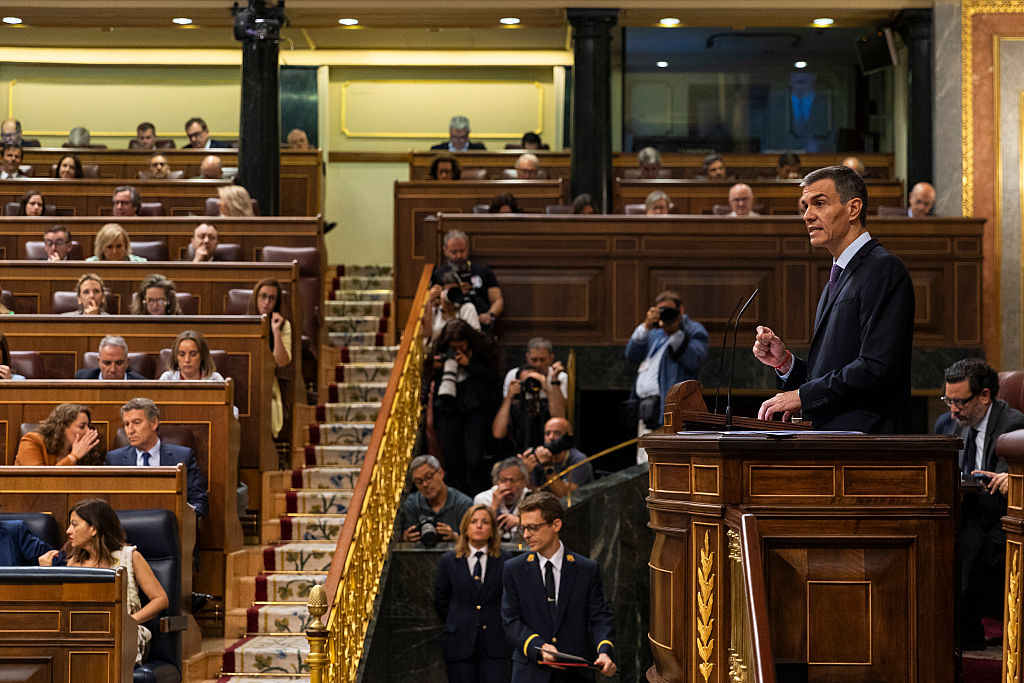
Interior minister Fernando Grande-Marlaska, a judge-turned-politician serving in Prime Minister Pedro Sánchez’s PSOE cabinet, faced intense questioning during a parliamentary session yesterday.
Marlaska insisted he was unaware of the complaint until February 16 and denied any cover-up.
“We knew nothing and, given the seriousness of the situation, we asked him to resign,” he stated, adding that the implicated commissioner would be removed from duties and an internal probe launched.
Marlaska accused the opposition of “unduly instrumentalising the facts”.
He threatened legal action for alleged slander if accusations persisted outside parliament and assured that he would step down if the victim felt unsupported: “If the interior ministry had not acted decisively, there could have been calls for accountability, but the complaint was given credibility and action was taken.”
Sánchez, addressing the issue from India during an official visit, backed Marlaska unequivocally.
“We will not accept lessons from those who cover up these types of cases,” he declared, referencing the opposition Popular Party’s (PP) alleged mishandling of a harassment complaint against its mayor in Móstoles.
Sánchez ruled out further resignations, emphasising the government’s swift response.
The PP seized on the revelations to demand Marlaska’s immediate dismissal, portraying the affair as symptomatic of systemic failures under PSOE rule.
El gran argumento del Gobierno para justificar que un presunto violador estuviera al frente de la Policía Nacional es que se enteraron ayer. Ayer, con una querella presentada el 9 de enero, hace más de un mes, y sobre una agresión del 23 de abril del año pasado.
Más allá de que…
— Alberto Núñez Feijóo (@NunezFeijoo) February 18, 2026
“The government’s big argument for justifying having an alleged rapist at the helm of the National Police is that they found out yesterday. Yesterday, with a formal complaint filed on January 9, over a month ago, and regarding an assault from April 23 of last year,” party leader Alberto Núñez Feijóo said.
“It was he who extended his retirement citing an ‘unquestionable’ profile, so it’s he who has to face the consequences. Out of respect for women and for the entire Police force that does protect us, Marlaska must resign this very morning or Sánchez must sack him this afternoon.”
PP spokesperson Esther Muñoz lambasted the government, saying: “Criminals in the Council of Ministers and criminals in the party.”
The party questioned the plausibility of Marlaska’s ignorance: “Are we really supposed to accept that an entire interior ministry has no idea that his police leadership is committing and covering up crimes?,” the spokesperson said.
Ignacio Gil Lázaro of the right-right Vox party demanded Marlaska’s resignation over the “repugnant scandal of the DAO of the police”, describing José Ángel González as a Marlaska-appointed “man of confidence and his protégé”.
Yolanda Díaz, leader of junior coalition partner Sumar, defended the government while criticising the PP: “Stop treating victims poorly … you are immoral.”
This scandal compounds existing pressures on Sánchez’s administration, already battered by a multitude of corruption probes and internal PSOE sexual harassment allegations in late 2025.
PODCAST: "Corruption is everywhere!"@ThatAlexWoman and @JustinStares are joined by Spanish MEP @HermannTertsch to talk about the prostitution scandal that has hit Spain’s ruling coalition. https://t.co/e5kN9IuuI8
— Brussels Signal (@brusselssignal) June 27, 2025