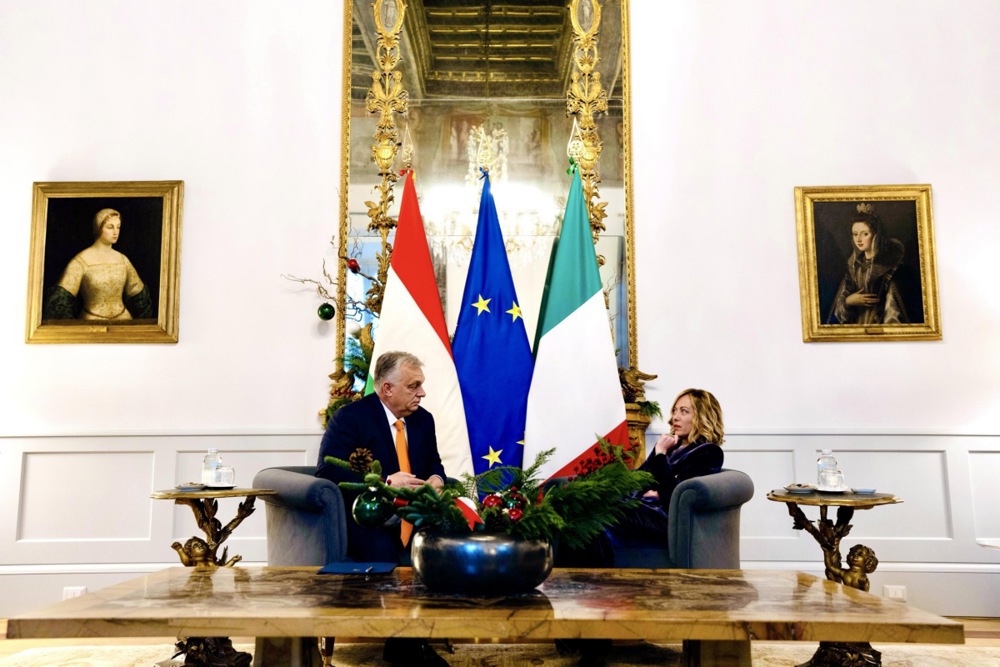
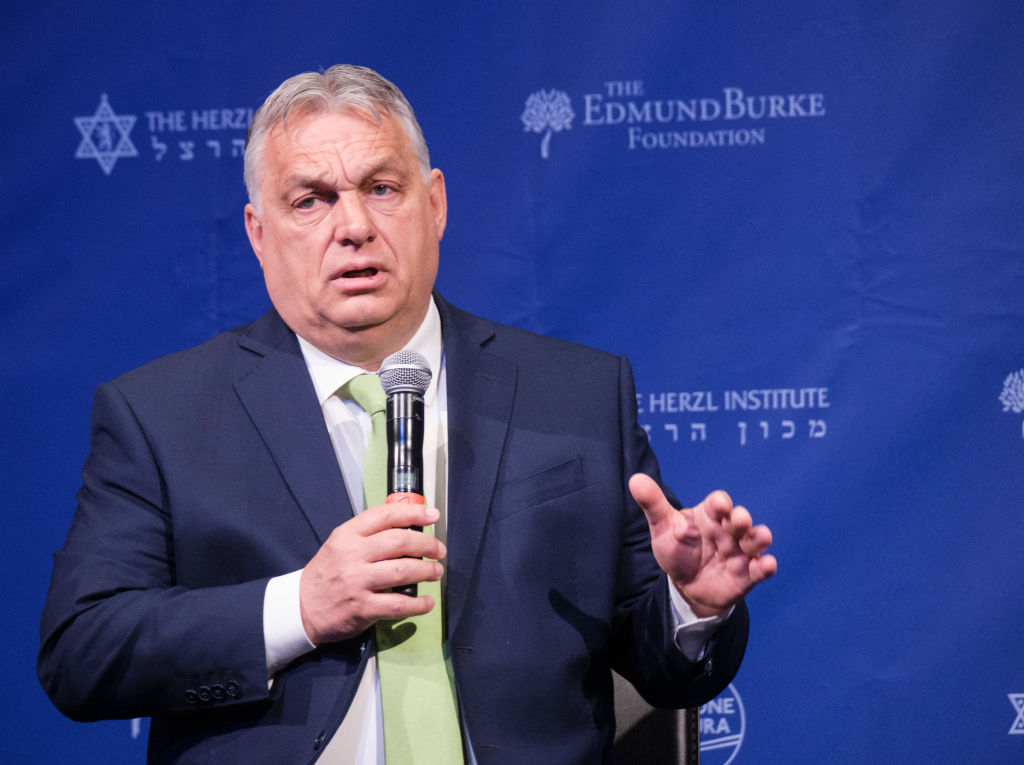
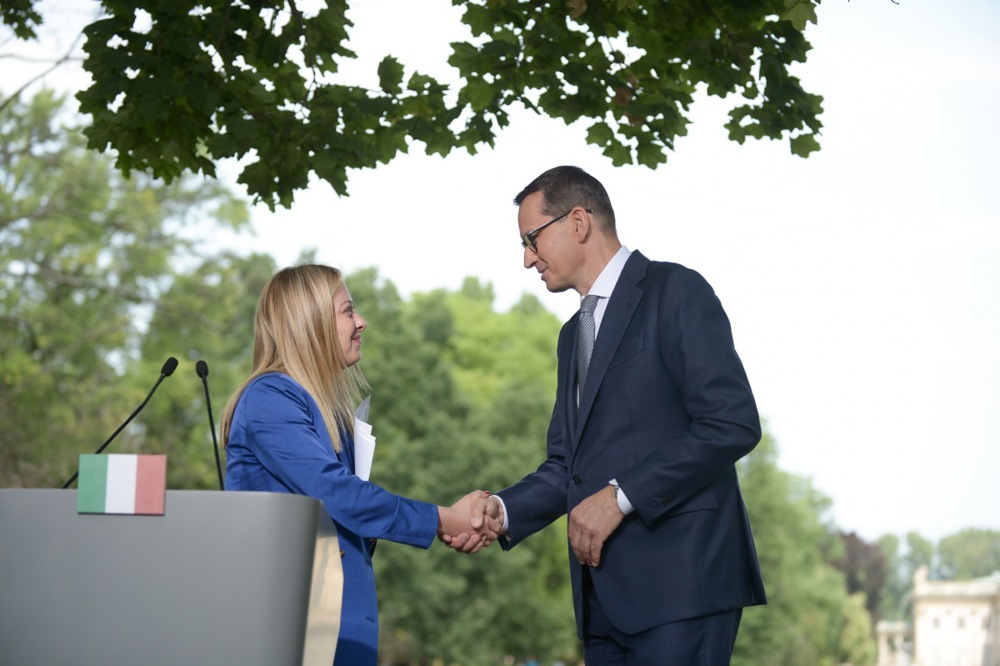
Italian Prime Minister Giorgia Meloni has reportedly expressed understanding for her Hungarian counterpart Viktor Orbán over his stance on Ukraine.
Doing so would highlight underlying disagreements in the European Union’s unified front as relations between Hungary and Ukraine deteriorate.
According to Politico, citing multiple sources familiar with a closed-door discussion at yesterday’s EU leaders’ summit, Meloni acknowledged Orbán’s reasoning for blocking a €90 billion loan package to Kyiv — despite having previously approved similar measures in December.

While Italy has not officially shifted its position, Meloni’s comments mark a notable departure in tone from most EU leaders, who have consistently tried to maintain a firm, coordinated stance in support of Ukraine.
Orbán’s opposition to the package reflects Budapest’s strategic, economic and political concerns over large-scale aid to Kyiv being structured as long-term joint EU debt.
He has warned against deeper fiscal integration without adequate national oversight and has pushed for stronger review mechanisms to preserve veto powers and flexibility.
Tensions between Kyiv and Budapest have escalated in recent months over the Druzhba pipeline, which supplies Hungary with Russian hydrocarbons.
Ukraine has at times leveraged transit flows during the war, prompting Budapest to link its position on EU aid to guarantees of continued deliveries. Relations have also grown more confrontational, with Ukrainian President Volodymyr Zelenskyy making remarks interpreted in Hungary as veiled threats.
At the same time, Orbán has used his veto as leverage in disputes with Brussels, while framing his position as a defence of Hungarian economic interests.
Any indication that a major EU founding member such as Italy may be willing to entertain — or at least understand — these objections is likely to resonate across EU institutions, where maintaining cohesion has become an increasingly delicate task.
Meloni’s office has sought to downplay the reported comments, reiterating Italy’s continued commitment to Ukraine and the broader Euro-Atlantic framework. In practice, Rome has supported successive sanctions packages and endorsed joint EU initiatives since Russia’s full-scale invasion.
Meloni’s engagement with Orbán may reflect a pragmatic effort to preserve channels of communication with a dissenting member state, rather than a substantive policy shift. Still, it illustrates how finely balanced internal discussions have become.
Before becoming prime minister, Meloni was long politically aligned with Orbán. During her time in opposition in Italy, she acted as the main interlocutor for the Hungarian Government in the country, even though their respective parties, Brothers of Italy (Fratelli d’Italia) and Fidesz, belonged to different groups in the European Parliament.
Relations between the two cooled in recent years as Hungary increasingly clashed with the EU while Meloni pursued closer ties with European chancelleries, securing political recognition that sometimes put her at odds with her former ally.
Despite these discrepancies, the two have maintained relations without ever breaking ties. Meloni’s recent stance in his favour represents continuity in this approach: No longer steadfast allies, but not adversaries either — rather, bound by a pragmatic relationship.
For Brussels, the challenge remains not only to sustain support for Ukraine but also to manage diverging perspectives within the EU, without allowing them to evolve into open fractures.
At this stage, there is no sign of an imminent rupture but the incident serves as a reminder that European unity is not a fixed asset; it is a continuous process that may become harder to maintain as the conflict drags on.