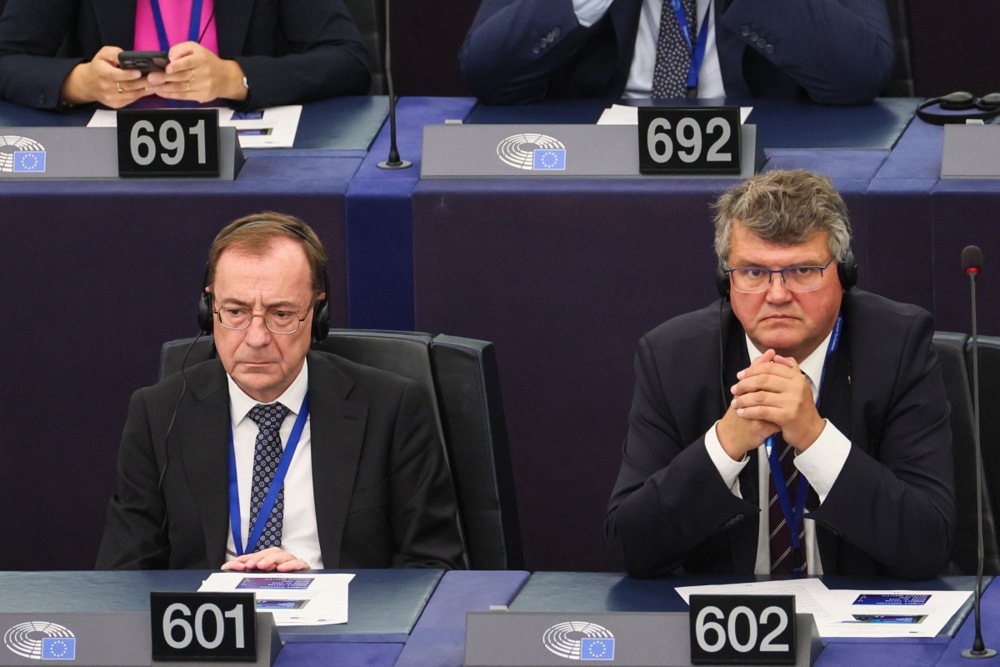
The European Parliament has voted once again to strip the unaligned MEP and Polish right-wing party leader Grzegorz Braun of his parliamentary immunity.
This time it is over allegations that he denied the existence of gas chambers at the Auschwitz concentration camp in southern Poland, and for tearing down European Union, Ukrainian and LGBT flags in public places.
MEPs yesterday decided to side with Polish prosecutors who want to try Braun for his comments in a radio interview in which he claimed: “Auschwitz with its gas chambers is unfortunately a fake.”

It marks the fourth time the European Parliament has voted to remove Braun’s immunity.
MEPs have previously approved similar requests in cases involving the extinguishing of Hanukkah candles in the Polish parliament and an attempted citizen’s arrest of a gynaecologist who had performed an abortion in the ninth month of pregnancy.
Parliamentary immunity protects MEPs from prosecution while in office. Lifting it does not determine guilt but allows national authorities to investigate or bring a case to court.
Braun stood as a candidate in the Polish presidential election last year and polled just over six per cent of the vote. He currently leads the Confederation of the Polish Crown party, which is polling seven per cent to 10 per cent in opinion surveys.
The Polish MEP sits as an independent in the EP because none of the three conservative groupings would admit him into their ranks due to his anti-Semitic outbursts.
No one from outside of his Polish Crown Party has condoned Braun’s comments on the Holocaust or protested about him being sanctioned for them. Leading commentator Robert Mazurek, from popular YouTube channel Kanał Zero, has argued that “while Braun’s words are abhorrent, them being aired is the price we have to pay for freedom”.
Braun has protested about Israel’s treatment of Gaza during Holocaust Memorial day in the EP and recently he visited the Iranian embassy in Warsaw to sign the book of condolence for the death of Supreme Leader of Al Khamenei, who was killed by a US air strike in the first day of the current war in the Middle East.
He condemned the US and Israeli action and expressed Polish solidarity with the people of Iran.
The Polish Crown leader opposes Ukrainian migration to Poland and has called for Poland to normalise its relations with Russia and its President Vladimir Putin.
Braun is a devout Catholic who supports the restoration of Latin mass. He is a fierce opponent of abortion and LGBT rights, a proponent of Poland leaving the EU (“Polexit”) and a supporter of the death penalty.
The main opposition party, the Conservatives (PiS), has ruled out any future coalition with Braun’s party because of its stance on Russia and anti-Semitism.
The MEP’s anti-Semitism has made him persona non grata with US President Donald Trump’s pro-Israeli administration, with which PiS has close links.
Braun was one of the founders of the Confederation party, a federal party made up at the time of three separate groupings: The Nationalist Movement (RN), the New Hope libertarian party led by Sławomir Mentzen and the Confederation of the Polish Crown party led by Braun.
He split off from the Confederation Party after it decided to field Mentzen as its presidential candidate in the 2025 election and stood against his old party in that contest.
Political commentators in Poland believe Braun will use the court cases being mounted against him to keep himself in the public eye, possibly acquiring martyr status should he be sent to prison.
Some analysts note that his emergence is useful for Prime Minister Donald Tusk and his Civic Coalition because it splits the right-wing vote and forces both PiS and Confederation to move rightwards to recover lost support, leaving more space in the centre for the present ruling coalition to occupy.
Most opinion surveys, though, indicate that the three right-wing parties together will hold a majority of parliamentary seats after next year’s general election.