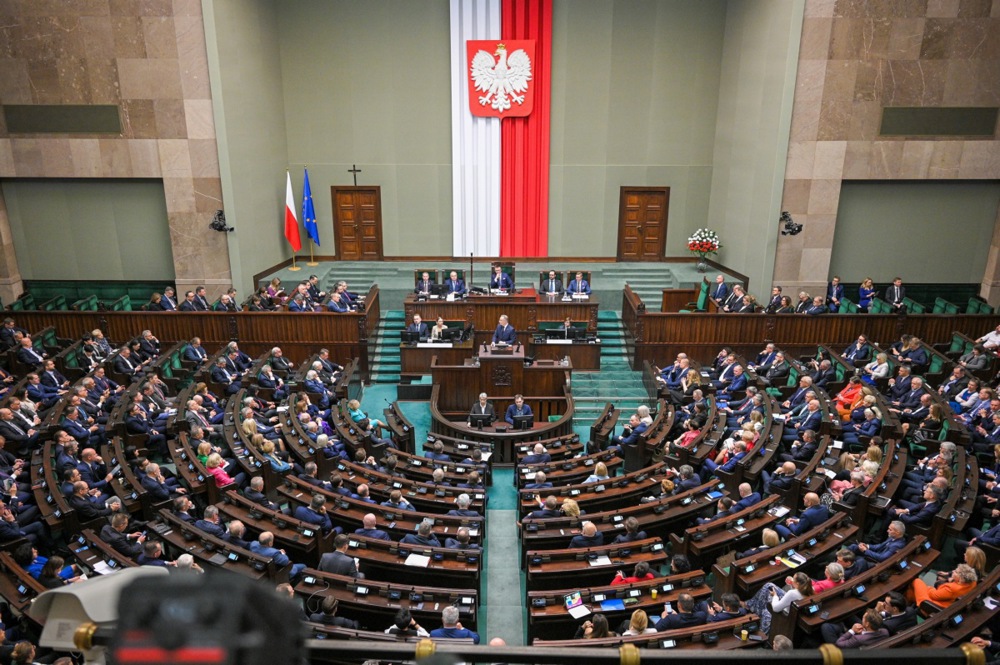
The Polish parliamentary majority that supports the centre-left government led by Prime Minister Donald Tusk has passed a resolution paving the way for it to change the composition of the constitutional court.
The change would allow the election of six judges who had opposed the judicial reforms of the previous government.
The resolution states that the constitutional court has, in the opinion of MPs, “ceased to fulfil its function as an impartial and independent body”. It adds: “It considers it necessary to take steps aimed at shaping the personal composition of the constitutional court in such a way that it meets the requirements of a court established by law.”

It says that assessment has been reflected in rulings by the European Court of Human Rights and the Court of Justice of the European Union, which have questioned the validity of some of the members of Poland’s constitutional court.
As a result, the resolution states, the election of the present and the former chief justices of the constitutional court were invalid.
Poland’s constitutional court consists of 15 justices, 12 of whom are elected by parliament and three nominated directly by the president who has to confirm the 12 members chosen by the legislature.
The court rules on the constitutionality of legislation and government decisions whereas a separate Supreme Court rules on all non-constitutional legal matters.
Today, parliament filled six vacancies in the constitutional court with candidates picked by the parliamentary majority.
All of those elected were active in opposition to the last Conservative (PiS) government’s judicial reforms and are supporters of plans to remove or demote nearly 3,000 judges appointed during the lifetime of that administration.
The PiS aligned-President Karol Nawrocki has in the past said he will not sign any judicial nominations of individuals who challenge the status of fellow judges, meaning he head of state may well refuse to appoint the six judges elected by parliament.
The dispute over the constitutional court has been raging for more than a decade. It dates back to October 2015, when the outgoing parliament elected five judges, two of whom were picked before the terms of office of the people they were to replace had ended.
After PiS won power in the then-new parliament, it declared that election invalid and chose five different judges, arguing that the previous parliament had violated the law by electing judges ahead of schedule.
The then-PiS-allied president Andrzej Duda accepted the view of the new parliamentary majority and appointed the five judges elected by the new majority.
This was never accepted by the opposition, which argued that at least three of the judges elected by the previous parliament should have been allowed to take up their seats on the court.
After coming to power, the Tusk government has decided to derecognise all constitutional court rulings and has refused to publish them in the Journal of Laws, the official gazette in which legal acts are formally promulgated.
The opposition PiS has challenged the election, arguing that parliament should have elected the six justices as vacancies arose over the last two years.
The PiS added the government had no right to suddenly elect six justices wholesale and accused the Tusk administration of paralysing the work of the court through the refusal to publish its rulings.