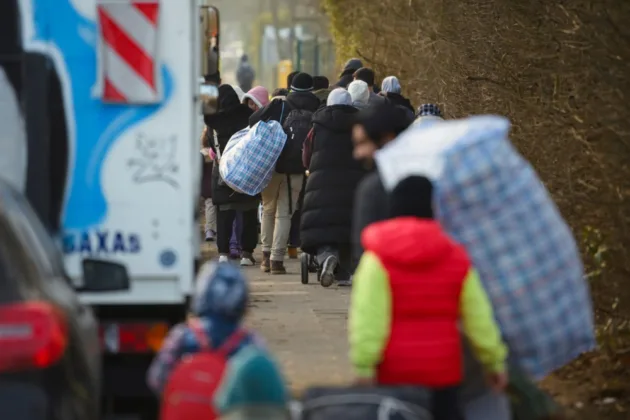







The city administration of Hamburg has spent €593 million between 2022 and 2025 to pay for hotel rooms for asylum seekers.
This was revealed on April 23 following a request for information by the Hamburg section of the right-wing Alternative for Germany party (AfD) to the city government, the Hamburg Senate.
Hamburg AfD fiscal speaker Thomas Reich said: “Whilst the [Hamburg] Finance Senator is promoting refugee hotels as an ‘investment’, the Red-Green coalition’s spending on asylum seekers is creating ever-widening holes in Hamburg’s budget.
“Over half a billion euros has been spent on hotel costs for ‘refugees’ in just a few years. We are witnessing a historic spending spree that has been going on for years and must finally be brought to an end.”
In 2022, following the Russian invasion of Ukraine, the senate started renting hotel rooms and, in some cases, entire hotels to house newly arrived refugees.
For the years before 2022, no information was given.
While the flow of Ukrainian refugees greatly abated by the end of 2022, the costs for the housing programme just started taking off then, rising from €69 million in 2022 to €190 million in 2024.
In 2025, Hamburg still spent €164 million on hotel rooms for asylum seekers.
About 56 per cent of the total were spent on accommodation with the remainder paid for catering services.
On average, the city government currently pays €45 per day for refugees’ accommodation and €38 for catering services.
As of April 23, 2026, the list of so-called “interim facilities” comprises 44 sites with 4,806 places. All but two of the facilities will be in use at least until the end of 2026 with a potential further extension on the horizon.
While Hamburg looks set to continue spending hundreds of millions of Euros on the refugee housing programme, the city’s finances are dire.
In December 2025, Finance Senator Andreas Dressel (Social Democratic Party) announced that the city could have to double its new debt issuance by 2029 to €4 billion per year – as its economy was not growing.
Hamburg has the third-highest debt per capita of Germany’s 16 federal states after Bremen and Berlin.