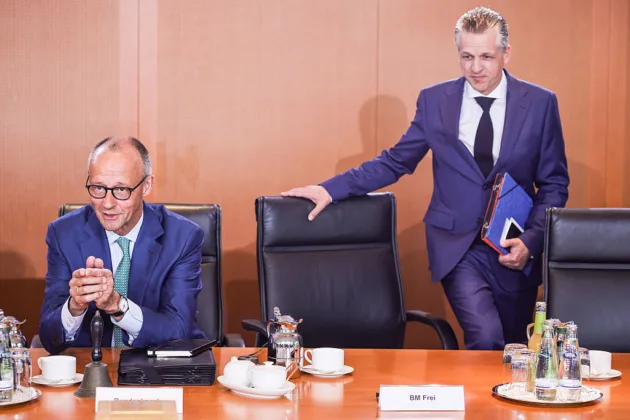












A German MP and his husband have announced the birth of their first child – born in the US, supposedly to a surrogate mother.
The news has sparked a debate on surrogacy in Germany, which has outlawed the practice.
On April 16, Hendrick Streeck, a 50-year-old MP for the Christian Democratic Union party (CDU), confirmed to German media that he and his 48-year-old husband Paul Zubei had welcomed a child into their family.
“We can confirm that we have become parents. We are overjoyed at the birth of our son. All of a sudden there is a new sense of purpose in our lives,” the politician told magazine Bunte.
Streeck, a professor of virology who rose to prominence over the course of the Covid-19 pandemic, entered parliament in 2025 on a CDU ticket. He is also serving as the Commissioner on Narcotic Drugs at the federal health ministry. Zubeil is a leading civil servant at the same ministry.
According to German media, the couple’s son was born in Idaho. Streeck and his husband are currently in the US, waiting for their child’s passport to take him back to Germany with them.
While German newspapers are overflowing with congratulatory headlines, there are also critical tones.
Streeck and his husband declined to disclose how they obtained their son but observers assume that he was born to a surrogate mother, paid to carry the baby to term.
Idaho is one of the US states with the most liberal surrogacy laws. Meanwhile, the practice remains illegal in Germany.
The country’s 1991 Embryo Protection Act strictly forbids surrogacy in all forms, whether commercial or altruistic. Performing an embryo transfer or artificial insemination on a surrogate mother is a criminal offence for medical professionals.
The practice, though, seems to be on the rise among German same-sex couples.
“Many same-sex couples among my acquaintances now have children. Some paid for in-vitro fertilisation and a six-figure sum, then flew to America or Eastern Europe,” wrote feminist writer Melanie Grün for news portal Nius on April 17.
“They came back with broad smiles and a baby carrier … Hendrik Streeck is a man dedicated to science, whose public image is defined by precision and credibility. Isn’t it time for a few clear, honest words?”
She added:“As a woman and a mother, this really bothers me: Where are the feminists who look the other way when women are treated like breeding machines? … Sometimes it is women who simply need the money. It is a business that is all too happily covered in an ideological sugar coating.”
On the same day, Christian Knuth, editor for gay news site Männer.media, criticised that Streeck’s baby showcases double standards – because the CDU has repeatedly come out against liberalising surrogacy laws in Germany:
“Streeck represents a party that only spoke out strongly against any form of surrogacy at its party conference in February 2026,” Knuth said.
“The CDU uncompromisingly rejects the practice, warns against the exploitation of women and describes surrogacy as the degradation of the female body to a service. The party even supports the view that surrogacy should be equated with crimes such as slavery or child trafficking.
“The fact that a prominent Member of the Bundestag from precisely this party is allegedly turning to the liberal market in Idaho to start his own family illustrates a glaring structural dilemma,” he added.
“It is this discrepancy between political action at home and private privileges abroad that fuels criticism of double standards.”