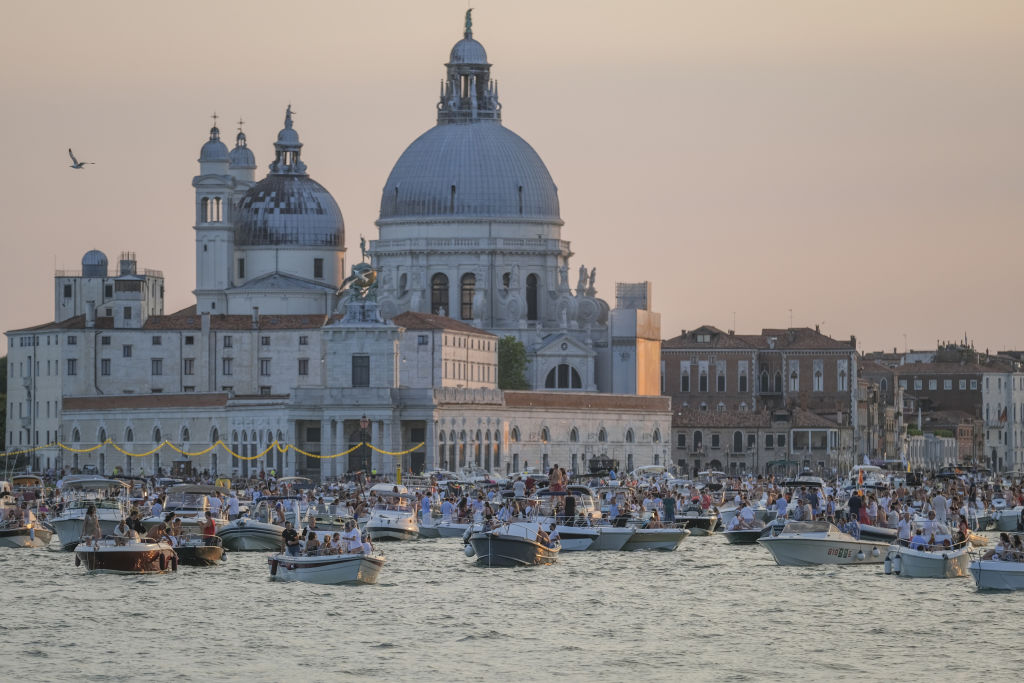
The European Commission has launched a procedure that could lead to the suspension or withdrawal of European Union funding for the Venice Biennale.
That came following the announcement that Russia may take part in the 2026 edition of the world-renowned art exhibition.
The decision was made amid concerns in Brussels that the inclusion of a Russian presence could conflict with EU sanctions imposed after Russia’s invasion of Ukraine in 2022.

The Venice Biennale, held every two years in Venice, is one of the most prestigious cultural events in the world. It brings together countries through national pavilions, serving as a major platform for contemporary artistic production and international cultural exchange.
The institution is partially overseen by Italian public authorities: Its President and several board members are appointed by state institutions, while artistic directors are selected by the governing board on the basis of professional expertise rather than political nomination.
The current President, Pietrangelo Buttafuoco, a journalist and intellectual associated with Italy’s conservative cultural milieu and considered close to Prime Minister Giorgia Meloni, has defended an inclusive approach to participation.
In an interview with La Repubblica in March 2026, he stated: “I open to everyone, I close to no one. There will be Russia, Iran, Israel.
“There will be Ukraine and Belarus. Everyone,” he added, outlining a vision of the Biennale as a universal platform for artistic expression.
He also stressed the role of culture as a space for dialogue, arguing that “where there is art, there is dialogue” and presenting the Biennale as an arena intended to transcend geopolitical divisions.
The planned participation of Russia, though, has triggered a formal warning from Brussels.
In a letter sent in early April 2026 to the Biennale’s leadership by the EC’s Education, Audiovisual and Culture Executive Agency (EACEA), the EU informed the institution of its intention to suspend or terminate its funding agreement if the concerns are not addressed.
The warning concerns a €2 million grant covering the period 2025–2028. The EC has given the Biennale 30 days to respond, either by clarifying its position or reconsidering the decision. Failure to provide satisfactory assurances could result in the suspension of payments or the full termination of the funding arrangement.
EU officials argue that allowing a Russian state-linked presence could be incompatible with the bloc’s sanctions regime, particularly if participation is directly or indirectly supported by government entities in Moscow.
The EC maintains that all EU-funded projects must fully comply with restrictive measures adopted in response to the war in Ukraine.
The move highlights growing tensions between cultural institutions’ traditional autonomy and the EU’s foreign policy objectives.
While the Biennale insists on its independence and commitment to open artistic participation, Brussels is increasingly signalling that access to EU funding is contingent on strict adherence to sanctions policy.
With the 2026 edition approaching, the dispute risks becoming a broader test case for how European cultural institutions balance artistic universality with geopolitical constraints — and how far the EU is prepared to go in enforcing its sanctions regime through cultural funding mechanisms.