





Members of Germany’s ruling Christian Democratic Union party (CDU) in a small town near Frankfurt have caused a nationwide scandal by joining forces with their colleagues from the right-wing Alternative for Germany party (AfD) in a local council vote.
On April 27, Stefan Sauer, a former MP and leader of the CDU in the Great-Gerau district in Hesse, said he had initiated an investigation into the matter.
Sauer told state news programme Hessenschau: “Everybody will have a chance to have their say. We have set tight deadlines. After that, we will take appropriate action in accordance with our party constitution – up to and including expulsion proceedings.”
The General Secretary for the CDU in the state of Hesse, Leopold Born, said he supported the investigation: “It is rightful that immediate and consistent action is taken at local level.”
The scandal had rolled out on April 23 in Biebesheim, a small town of 6,500 inhabitants on the river Rhine.
After municipal elections on March 15, the 31 members of the local council had met for the council’s constitutive meeting.
At the election, the Social Democratic Party (SPD) and CDU had both got 27 per cent of the vote with AfD coming in third at 20 per cent.
In Biebesheim brach die CDU bei der Wahl der Beigeordneten mit der AfD die bisherige Abgrenzung und ermöglichte ihr so einen Sitz im Gemeindevorstand. Der Kreisverband reagierte umgehend mit Parteiausschlussverfahren.https://t.co/3qRd2GTFHc
— Apollo News (@apollo_news_de) April 26, 2026
One item on the agenda was a vote to nominate several honorary councillors. These titleholders serve as deputies to the mayor, such as Mayor Markus Rahner (CDU), for example, filling in for the mayor at representative functions.
Originally, three lists with proposals were submitted – one jointly by SPD, the Greens Party and the Free Voters; one more each by CDU and AfD.
The CDU’s list was disqualified, though, due to formal errors.
After a 10-minute break CDU and AfD councilmen announced that they would submit a joint proposal. Councilman Ulrich Harth (CDU) said this step was taken to ensure that AfD would get at least one out of six honorary councillors. Otherwise, the right-wingers would have been left without any representation.
The joint list caused an uproar in the Biebesheim council, leading to tumultuous discussions and drawing the meeting out to four hours’ length.
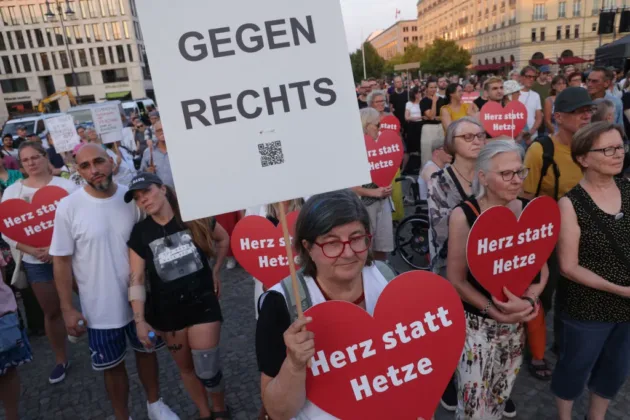
The reason for this is the cordon sanitaire (brandmauer, or firewall) – a vow by all German establishment parties to shun any co-operation with the right-wingers, even at the lowliest municipal level.
Mayor Rahner himself later referred to the joint list as a “first-rate faux-pas” and “communal politics hara-kiri”. He later vacated his post as CDU leader in Biebesheim in response to the joint list, even though he said he had nothing to with the decision.
SPD councillor Thomas Schell criticised the “unnecessary procedure”, which had “caused a lot of damage, especially for the municipality’s public image”.
Despite the heated debate both lists were ultimately accepted by the council, giving SPD two honorary councillors and one each for the other parties.
Ingeborg Horn-Posmyk, speaker of the district AfD, said that every councillor was legally bound solely by his conscience:
“In our eyes, the Biebesheim CDU has acted absolutely correctly,” she said.
Political scientist Christian Stecker told Hessenschau that the Biebesheim case showed that the cordon sanitaire was “putting enormous pressure on CDU”, adding: “The cordon sanitaire does no good to any democracy. At a local level, it is even more difficult, especially when it is imposed from above.
“People know each other from the sports club and so on, and now they’re supposed to completely avoid one another … that just can’t work. That sort of thing should be left to the local people.”