
Italy’s Senate President Ignazio La Russa said that, in the context of this year’s Liberation Day celebrations on April 25, it would be appropriate to also commemorate the fallen of the Italian Social Republic (RSI), alongside the anti-fascist partisans.
The RSI was the Nazi-backed regime established by Benito Mussolini in northern Italy after 1943, during the final phase of World War Two**, and** La Russa’s statement has triggered strong criticism from opposition parties on the Left.
The remarks were reported on April 21 by ANSA, Italy’s main news agency. According to the agency, the Senate President said that, when he was defence minister, between 2008 and 2011 in the then-Berlusconi government, he used to privately pay tribute both to fallen partisans and to the dead of the RSI.
He described this gesture as one of “reconciliation” and respect for those who lost their lives in the conflict and added that it would be appropriate to do so again today.
April 25, known as Liberation Day, is a public holiday marking the end of fascist rule in Italy in 1945 and the collapse of the Italian Social Republic. It commemorates the armed resistance movement — the partisans — who fought against fascism and contributed, alongside Allied forces, to the country’s liberation. The date has since become one of the foundational symbols of the Italian Republic.
Over the decades, though, Liberation Day has also taken on a strong political identity. While officially a national holiday, it has increasingly become associated with the Italian Left and with explicit anti-fascist messaging.
Ceremonies and public discourse around April 25 often emphasise resistance to fascism not only as historical memory but also as a contemporary political value. For critics on the Right, this has frequently included calls to actively fight today’s right-wing political forces, which in recent years have secured significant electoral support in Italy.
This interpretation is in turn criticised by parts of the Right, which consider it divisive and not representative of contemporary Italian society.
A frequently cited poll on this issue is one conducted by SWG in 2024–2025. It showed that a significant share of Italians holds an “ambivalent” view of Fascism.
In particular, around 50 per cent to 60 per cent of respondents agreed with the statement that fascism “also did some good things”, especially in relation to infrastructure and public order. Higher percentages among centre-right voters expressed positive views on aspects such as Mussolini’s “charisma” or certain policies of the regime.
As a result, Liberation Day is often framed less as a unifying national commemoration and more as a politically charged event, celebrated mainly by part of Italians.
La Russa’s statements have therefore reignited a sensitive political debate, especially within opposition parties on the Left. They argue that placing partisans and RSI soldiers on the same commemorative level risks creating a moral equivalence between those who fought for liberation and those who remained loyal to Mussolini’s final regime under German protection, supporting a vision in which the Italian Republic is seen as the result of a clear victory of one side over the other rather than a process of national reconciliation.
La Russa is one of the most prominent figures of Italy’s conservative Right. Active for decades within the post-fascist political tradition, he later served as defence minister and has remained a leading figure in right-wing politics.
His career has often been controversial, with critics pointing to his ideological background and past symbolism, including the presence of a bust of Mussolini in his private office. This was widely reported by Italian media in September 2022 during the period surrounding his election as President of the Senate.
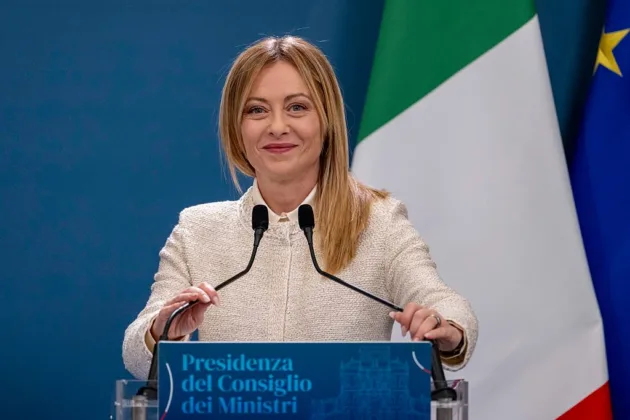
Today, under the government of Prime Minister Giorgia Meloni, La Russa serves as President of the Senate, one of the highest institutional offices in the Italian Republic. He is widely regarded as a central figure of Italy’s post-fascist Right and as one of the political actors who has accompanied Meloni’s political rise within the governing coalition.
Although Meloni has repeatedly distanced herself from extremism, she has not explicitly defined herself as anti-fascist, a position that continues to fuel political debate in Italy.