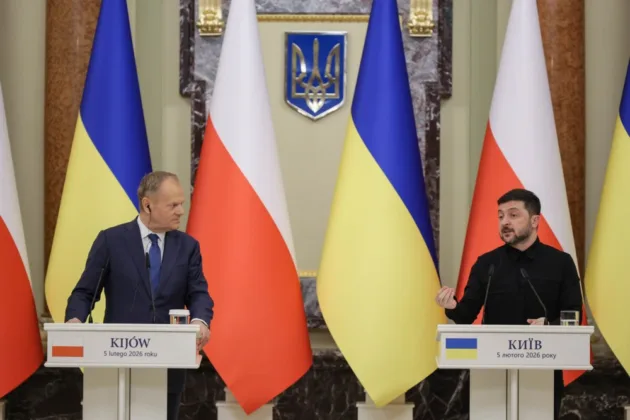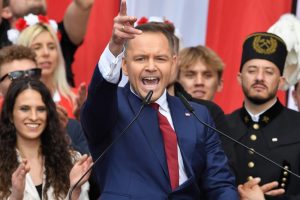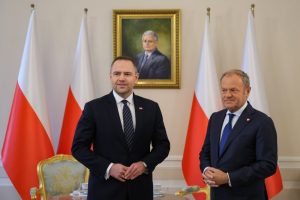






He did so yesterday, after Prime Minister Donald Tusk, who heads Poland’s centre-left coalition government, made it clear he did not wish the French head of state to meet the opposition conservative PiS-aligned Nawrocki.
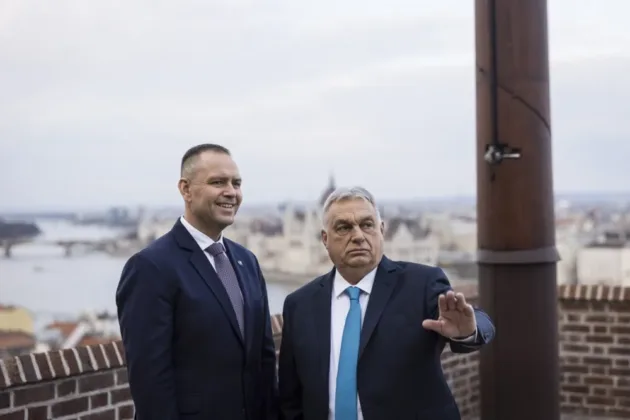
Unattributable sources close to the head of the government said that both Tusk and Macron wanted to demonstrate their disapproval of the fact that Nawrocki chose to visit then-prime minister Viktor Orbán in Budapest in the days leading up to the Hungarian general election.
The official government position was that the Gdańsk visit was for an inter-governmental meeting and that the President in Poland is not the head of government. Therefore, Nawrocki’s presence was not part of the protocol for the visit.
The Polish President’s Chancellery, though, did not hide that it had sought a meeting between Nawrocki and Macron in Gdańsk and blamed the government for blocking the meeting.
It is standard diplomatic practice for a visit by a head of state to involve a meeting with the sitting president of the host country.
Nawrocki’s press spokesman Rafał Leśkiewicz told reporters: “PM Tusk was very determined to avoid any meeting between the two Presidents. This is why he was insistent that Macron should visit Gdańsk rather than Warsaw,” he said.
“This is yet another example of the way the government treats the President, disregarding and dividing Poles. Using visits by foreign heads of state for internal political infighting weakens Poland on the international stage,” added Leśkiewicz.
Last year Tusk and Nawrocki had initially agreed they would work together on foreign and security policy matters despite differences on domestic issues, but that has long since broken down and relations between the two men have deteriorated markedly.
Conservative commentator Łukasz Warzecha echoed the President’s spokesman, saying that Tusk’s actions were “an example of irresponsible behaviour in which Poland demonstrates how easily it can be played through its internal political divisions, which are becoming infantile in the way they are being expressed”.
Macron visited Gdańsk for talks with Tusk and to attend a Polish-French intergovernmental summit, the first such event since the two countries signed a treaty on enhanced cooperation and friendship in May last year.
The agreement includes mutual security guarantees and expanded co-operation in defence, industry, agriculture, science and culture.
Discussions at the summit focused on security and nuclear co-operation in light of the US’ changing strategy towards Europe, the Middle East and the war in Ukraine.
Ahead of the talks, France and Poland announced that a telecommunications satellite for the Polish military will be constructed.
French Thales Alenia Space, Airbus Defence and Space and Poland’s RADMOR will jointly develop a satellite in geostationary orbit, which will support military communications for Poland’s armed forces.
The initiative is part of the European Commission’s flagship Readiness defence plan to get the continent prepared to defend itself by 2030, with Europe seeking alternative homegrown satellite services to counter global rivals and reduce reliance on Starlink, managed by US tech billionaire Elon Musk.
Macron’s visit to Poland also highlighted Warsaw’s search for partners to build its second nuclear power plant.
Poland’s first plant on the Baltic coast is moving ahead with US-based Westinghouse and Bechtel in northern Poland. The government is also preparing an updated nuclear strategy that will shape the next stage of its atomic programme.
EDF, France’s state-backed energy group, is promoting its EPR2 reactor design for potential projects in Poland as part of Macron’s wider drive to revive and expand the French nuclear sector. The Poles are open to discussion following the Tusk government’s decision taken last year to cancel a nuclear power project involving the South Koreans.
But Tusk’s meeting with Macron followed his visits earlier this month to Japan and South Korea, both of which signed enhanced co-operation agreements with Poland and expressed interest in future nuclear energy cooperation.
Tusk was also keen to discuss how the country can benefit from France’s intent to offer other European states protection under the French nuclear umbrella, as he is a believer in Macron’s desire to build European strategic autonomy in defence.
With regard to nuclear deterrence, Tusk joked: “Frankly, I would not want French Rafale fighter jets carrying nuclear bombs flying over Poland,” before adding: “I know you do not have such plans.” He went on to say that any discussions over nuclear security co-operation would remain “discreet”.
Nawrocki, though, is of the view that it would be better for Poland to seek protection from the stationing of US nuclear weapons on Polish soil and has made the preservation and expansion of the US military presence one of the key objectives of his presidency.