





A widely shared story by left-wing investigative outlet Correctiv in Germany, which claimed that at a “secretive” gathering ahead of the 2024 elections in Germany, several right-wing politicians and others discussed the possible deportation of two million migrants, was “plucked out of thin air”, according to a Berlin court.
Shortly after the judgment’s reasoning was released, the press lawyer acting for Gerrit Huy, the AfD MP who brought proceedings, said Correctiv had “lied and exaggerated”.
The reasoning of the ruling, handed down by the Landgericht Berlin II on March 17, was made public today.
Published originally in January 2024, Correctiv described a private meeting held in Potsdam in November 2023 attended by members of the Alternative für Deutschland (AfD), right-wing activist Martin Sellner and other figures.
Correctiv portrayed the gathering as the hatching of a “masterplan” for the mass expulsion of German citizens, including the revocation of citizenship from dual nationals and a scheme to circumvent several articles of the German Constitution.
It also claimed that Sellner had presented ideas involving the denaturalisation of citizens and that AfD Bundestag member Gerrit Huy had proposed stripping dual citizens of their German passports.
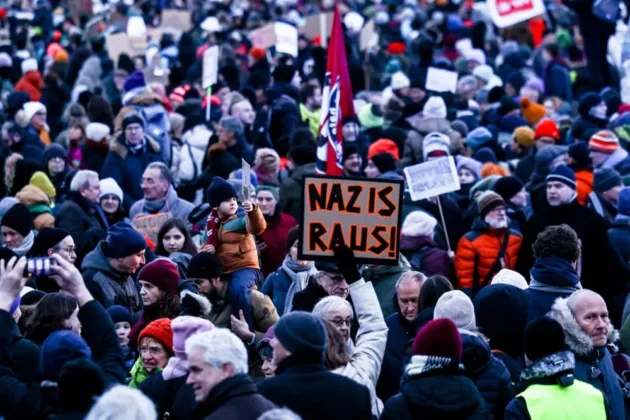
The story, which drew explicit parallels to the 1942 Nazi Germany Wannsee Conference, generated intense media coverage both in Germany and abroad. It helped spark huge protests involving hundreds of thousands of people across Germany in the weeks that followed.
Politicians from the Christian Democratic Union (CDU), Social Democratic Party (SPD), Greens and Left party took part, framing the alleged plans as a threat to democracy. The demonstrations occurred in the run-up to European Parliament elections and various state polls in 2024.
AfD MP Gerrit Huy, who attended the Potsdam meeting, brought proceedings against Correctiv and several named journalists, including editor-in-chief Justus von Daniels and lead reporter Marcus Bensmann.
Represented by press lawyer Carsten Brennecke of Höcker Rechtsanwälte, she sought an injunction against the specific claims.
In a detailed written judgment published earlier this week, the Landgericht Berlin II civil court ruled that the core assertions were not protected opinion but factual claims that failed on the evidence.
The court found there was no “masterplan” for the expulsion or forced removal of German citizens discussed.
Sellner explicitly stated during his presentation that people holding German citizenship could not be formally or forcibly obliged to leave the country.
Correctiv omitted this clarification, rendering its reporting “not only essentially untrue but also unclear, imprecise and incomplete”, according to the court.
The judges described the omission as material because it gave the entire story “a completely different weight”.
The characterisation of the discussion as a plan to undermine the Constitution was plucked “completely out of thin air” and lacked any factual anchor, the ruling found.
Furthermore, the claim that Sellner had floated a “denaturalisation idea” for citizens was untrue; the meeting records showed no such proposal.
The allegation that Huy had recommended revoking German citizenship from dual nationals was also false. The court prohibited dissemination of the statement.
Correctiv, the non-profit investigative newsgroup that broke the story about a “conspiratorial” Alternative für Deutschland (AfD) gathering, turns out to have had secret meetings with the Federal Government, including the German Chancellor. https://t.co/J4ExJCZet8
— Brussels Signal (@brusselssignal) February 15, 2024
The judges stressed that even if the passages were treated as value judgements rather than facts, they remained impermissible because they had no factual basis in what actually occurred at the meeting.
Correctiv’s defence – that it had merely expressed an opinion – was rejected outright.
The court ordered Correctiv and the individual journalists to refrain from repeating the prohibited statements.
The organisation and the reporters have appealed to the Kammergericht (Berlin Higher Regional Court), making the ruling not yet final.
The Potsdam meeting focused on the concept of “remigration”, the voluntary or incentivised return of non-citizens or non-assimilated foreigners to their countries of origin, a policy long discussed in conservative and right-wing circles but distinct from the forced expulsion of German citizens.
The Landgericht Berlin II noted that participation in a meeting without plans to deport citizens is “not, or at any rate far less, defamatory” than participation in one that did include such plans.
Brennecke, posting on X shortly after the judgment’s reasoning was released, described the outcome as “devastating” for Correctiv, arguing that “after the injunction, nothing of substance remains of the report”.
“Correctiv lied and exaggerated; that has been judicially confirmed. Correctiv has been unmasked as one-sided opinion-makers, as manipulative political activists who have nothing in common with journalism.
“The damage caused extends far beyond Correctiv: The credibility of the media that unverified spread the false legend has been damaged.
“It is now up to these media to regain credibility. That includes a self-critical approach to the hasty, unverified dissemination of news.”
German non-profit news group Correctiv has apparently backtracked on its report about a “conspiratorial” AfD meeting where several politicians and others allegedly discussed the deportation of two million migrants from Germany. https://t.co/NY6To0rlI1
— Brussels Signal (@brusselssignal) January 29, 2024