Hungary’s Péter Magyar has recorded the lowest attendance rate of any MEP in the current parliamentary term, showing up for only 1.85 per cent of votes.
The high-profile leader of Hungary’s opposition Tisza party only voted 36 times, out of the 1,945 total roll call votes held in the last 180 days.
The data are from the independent European Parliament attendance tracker WheresMyMEP.eu, which monitors all roll-call votes in the plenary sessions.

The site does not examine participation in committee work. In plenary sessions, it counts members abstaining from votes as present, and a failure to vote counts as absent.
On average, MEPs have attendance of between 82 and 87 per cent, varying slightly depending on their political group.
Magyar, who sits with the centrist European People’s Party (EPP) group, is not alone among Hungarian MEPs in recording strikingly low attendance.
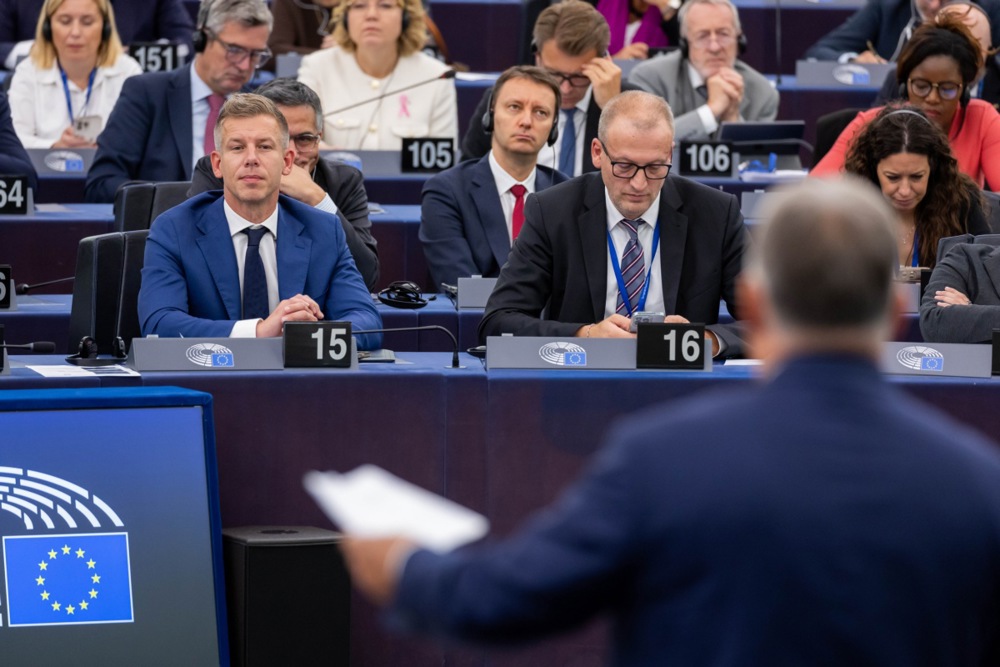
Members of his Hungarian Christian Democratic party generally have attendance scores of 20 per cent, or one in five votes. Magyar himself attends fewer than one vote in fifty. (story continues under the photo)

Four of the ten worst-attending MEPs are Hungarian members of the EPP, all members of the Tisza party.
The top five poorest performers come from the EPP (three), the Greens/EFA (one), and The Left (one).
Overall averages by political group in this legislative session so far show The Left at the bottom, with 83.4 per cent.
Second from the bottom are non-attached members (84.5 per cent), while the EPP comes third-worst at 87.5 per cent, ahead of the Greens on 89 per cent.
The individual worst performers are heavily concentrated in EPP ranks among the Hungarians.
Leading the pack at the other end are Robert Biedroń, a Polish MEP from the Socialist and Democrats (S&D) Group, and Kai Tegethoff, a German MEP from the Greens. Both have a perfect voting records of 100 per cent.
Preceding Magyar and his fellow party members, in the previous legislature, the lowest attendance from the class of 2024 was that of Greek neo-Nazi figurehead Ioannis Lagos.
Still, he missed only 62 per cent of roll-call votes in plenary after being condemned to 13 years in prison in 2020 for running a criminal organisation, the extreme-right Golden Dawn party.
His immunity was lifted in 2021, but he continued to work from prison.
Romanian social-democrat MEP Claudiu Manda missed 43.6 per cent of plenary votes due to a criminal trial over corruption charges.
Eva Kaili, Marc Tarabella and Andrea Cozzolino, all members of the S&D bloc, also missed votes due to being in jail over Qatargate in 2024.
Hungary’s chief prosecutor has asked the president of the European Parliament to suspend the parliamentary immunity of Prime Minister Orbán’s main political rival, MEP Péter Magyar. https://t.co/IJN7AGhp0x
— Brussels Signal (@brusselssignal) September 27, 2024
The data also show group cohesion is strongest among left-wing parties.
Group Cohesion Scores measure how often a political group votes as a bloc. A group is considered to have voted cohesively on a given vote if at least 80 per cent of its voting members chose the same option.
The group cohesion score of the S&D is 96 per cent in this session, and that of the Greens is 92 per cent.
Behind them are the European Conservatives and Reformists (ECR), who only score 70 per cent, and the Patriots for Europe (PfE) with 64 per cent.
The most frequent group alliances are between the EPP and Liberals of Renew, who vote together in 92 per cent of the cases. This is closely followed by Renew and S&D, voting together 91 per cent of the time.
S&D and Greens voted together 87 per cent of the time.
Alliances are scored by how frequently the plurality of two political blocs vote the same way.
Conversely, the groups most opposed to one another were Greens and the hard right Europe of Sovereign Nations (ESN).
Those two blocs voted against each other 79 per cent of the time, followed by Renew and ESN, at 78 per cent of the time.
The most contested votes, where the European Parliament has been most closely divided, were the Gender Equality Strategy of 2025 and the EU enlargement strategy.
There are also large differences in country behaviour,.
Some countries show very strong national cohesion, meaning MEPs from the same country tend to vote together. Others are very divided.
MEPs from the smallest countries appear particularly likely to vote the same way.
Malta, with MEPs for the EPP and S&D, scores 98 per cent in national cohesion.
Luxembourg, with a more divided political landscape but also small, scores 95 per cent.
Both countries have six MEPs.
Romania, with 33 MEPs, still scores 94 per cent.
At the absolute bottom of this national cohesion score stands France, with a score of 53 per cent. Slovakia follows at 55 per cent and Italy scores 64 per cent.


From Warsaw to Budapest: How Péter Magyar repeats Donald Tusk’s political scenario