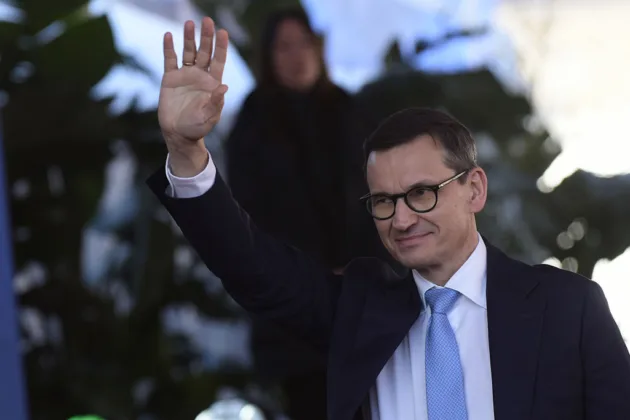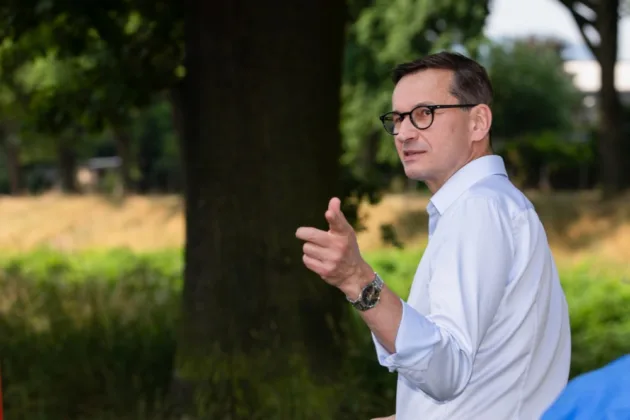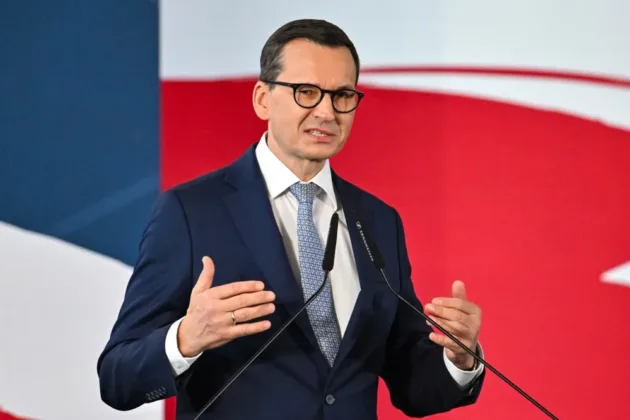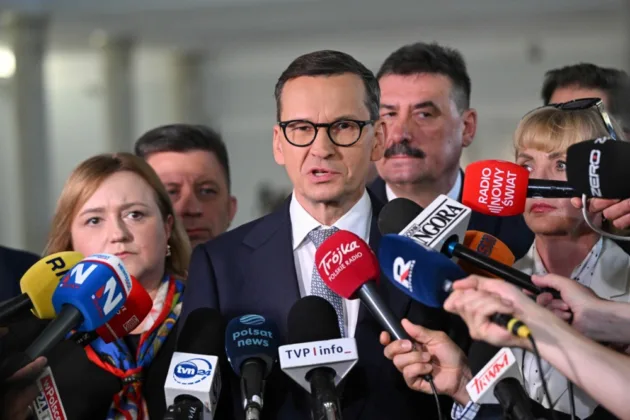








Appearing at a joint press conference the leader of the main Polish opposition Conservatives (PiS) and the former PiS prime minister Mateusz Morawiecki have announced that they have reached a compromise that will enable the party to stay united and prepare for next year’s parliamentary election.
During today’s event, Kaczyński revealed that, as a form of “compromise”, the association Morawiecki had founded against the will of the party leadership would operate within a new “expert council” that was being established by the party.
Morawiecki, who was the PiS prime minister between 2017 and 2023, said the decision would help PiS to “focus on fighting the government’s lawlessness, lack of ambition and gigantic budget deficit”.
He was referring to the centre-left government led by current Prime Minister Donald Tusk. Since coming to office in late 2023, he has attempted to purge the judiciary, delayed major capital investment projects such as the mega airport project in central Poland and has presided over the European Union’s second-fastest growing budget deficit – behind only Romania.
The press conference followed a meeting yesterday between Kaczynski and Morawiecki, arranged by Adam Bielan MEP, the head of the PiS in the European Parliament. That led to an agreement being thrashed out that averted a potential split in the party.
On April 16, dozens of PiS parliamentarians had joined a new association, titled Development +, founded by Morawiecki. It represents those PiS politicians and supporters who want the party to concentrate on economic and social development issues rather than to move in the direction of opposing EU membership and accentuating opposition to abortion and LGBT rights.
Morawiecki and his supporters fear the PiS, in pursuing the votes it has lost to the more right-wing parties such as Confederation and Grzegorz Braun’s Polish Crown, is in danger of losing centre-right voters who, he argues, want to see more focus on economic and social matters.
Morawiecki argued that he and his allies intended to work within the PiS to broaden the party’s appeal. That did not convince a majority of their colleagues, who suspected the former head of the PiS government was testing the waters for creating a new breakaway party.
After the PiS executive meeting, Morawiecki and his supporters were warned that membership of the association could be deemed to be a violation of the party’s charter and could result in disciplinary measures being taken against them.
In an attempt to stop Morawiecki dead in his tracks, Kaczyński suggested “there will be no places on the PiS electoral slates for the people involved” in the former PM’s association, arguing that the party cannot allow ”another to grow out of it”.
Internal tensions have erupted within the PiS because of a sharp decline in support for it in opinion polls – from around 35 per cent in the summer of last year to around 25 per cent today, the lowest level recorded by that party in 14 years.
Polling analysis showed that the party was losing support not to Tusk’s ruling Civic Coalition (KO) but to the Confederation and Polish Crown parties, both of which are critical of Ukrainian migration to Poland and Polish membership of the EU.
In March of this year, it looked as if the leader of the party, Jarosław Kaczynski, had decided in favour of the case for attempting to recover support from the two more right-wing parties rather than to seek support in the centre. In doing so, he appointed former education minister Przemysław Czarnek as the party’s candidate for Prime Minister ahead of the parliamentary elections.
Czarnek, a close ally of the Polish Catholic Church, is a fierce critic of any legislation on LGBT rights and of renewable energy initiatives. He is associated with identity politics rather than economic and social policy.
Since Czarnek’s elevation, though, there has been no significant boost to the party’s poll ratings. In some surveys it has actually continued to decline. This led Morawiecki to intensify his efforts to move the party towards the centre, which in turn caused internal friction.
Jan Rokita, political commentator for Poland’s most popular current affairs internet broadcaster Kanal Zero, has said Morawiecki “looks to have succeeded in building a faction within PiS, which means the leadership has to compromise with him or risk a split”.
Rokita also said, though, Kaczynski having threatened members of Morawiecki’s association with removing them from the party’s election slates means they will, by the spring of next year, have “to seek cast-iron guarantees for their safety and if these are not available, to seek to set up their own entity ahead of the autumn’s parliamentary election”.