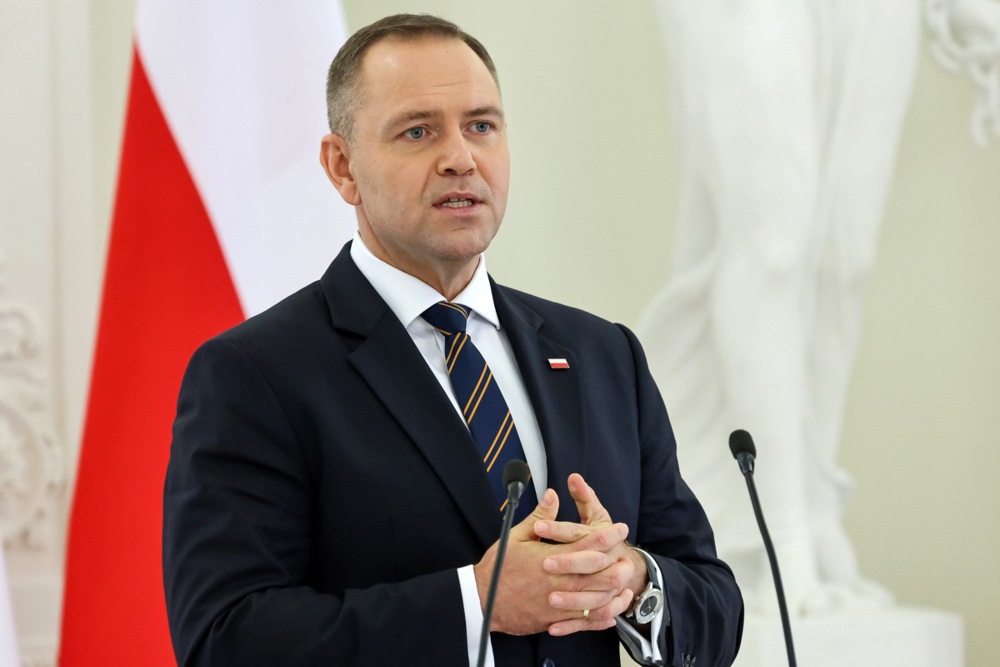
Poland’s Prime Minister Donald Tusk has accused the country’s President Karol Nawrocki and right-wing opposition parties of being part of a “Putinist front”, hostile to democracy, serving Russian interests and undermining links with the European Union and Ukraine.
Tusk, speaking at his party’s rally in Warsaw on April 11, claimed that Russian President Vladimir Putin has a five-point plan for Poland that involves “weakening and breaking up the EU”; “dividing Poland from Ukraine”; “setting Poland against Germany”; preventing Poland from bolstering its military readiness and said his opponents at home were in league with the Russian President.
“I don’t need to convince anyone that we see actors of this scenario in Poland every day,” he said, adding that such actions amounted to “a betrayal of national interests,” he said.

Tusk called his opponents “Russian collaborators”.
“We must eliminate everything that reeks of betrayal — everything that constitutes collaboration with those who threaten Poland’s independence and Europe’s unity,” he added.
Tusk claimed that, across Europe, in the actions of right-wing and far-right leaders one can see “a Putinist front – and here we see Jarosław Kaczyński [Polish opposition PiS leader], President Nawrocki and the Confederation party joining in this Russian activity in Europe”.
Although the PiS and Nawrocki have been critical of both the European Union and Germany, they are both strongly anti-Russian and have been so for much longer than has Tusk. He was an enthusiastic backer of then-US president Barack Obama’s “reset” with Russia in the 2000s.
The PiS has also consistently attacked Tusk for allegedly representing Russian interests, pointing to his close relations with Moscow during his first term as prime minister from 2007 to 2014. Then, he and Putin met frequently and the Russian foreign minister Sergey Lavrov even addressed an annual gathering of Polish ambassadors in Warsaw.
In 2023 a commission initiated by the PiS to investigate Russian influence in Poland recommended that Tusk should not be allowed to hold public office because of his failure to counter Russian influence over Polish ministry counterintelligence service.
The PiS opposition has also attacked Tusk over the fact he failed to hold an independent international investigation into the air disaster in Smolensk, Russia, in 2010 in which then-Polish president Lech Kaczynski and more than 90 officials perished.
The enquiry was held by the state Russian air investigation body MAK and the PiS to this day suspects its findings were a whitewash to absolve Russia of any responsibility.
Nawrocki is on Russia’s wanted list for his efforts to demolish Soviet era monuments in Poland and when in government, the PiS strongly supported Ukraine and ended all Russian energy imports.
But when confronted with such facts, Tusk simply brushed them aside and said he was “totally uninterested” in whether members of the Polish Right were working in Russia’s interests consciously or simply through “stupidity”. “What truly matters is the consequence of their actions,” he said.
When asked to give examples of how the PiS aligns with Russian interests Tusk cited the fact that PiS MPs went to Budapest to support Hungarian then-PM Viktor Orbán during the election campaign.
The PiS remains sympathetic to Orbán’s views on the EU but strongly disagrees with him about Russia. In addition, PiS MEPs are members of the European Conservative Reformers grouping in the European Parliament and not Orbán’s Patriots caucus.
Tusk in his speech also pointed to the fact that the PiS, Confederation and Nawrocki have prevented the government from introducing tough restrictions on the operation of the crypto currency markets, which he claimed are used by Russia to channel “dirty money” in Europe, including to fund sabotage in Poland.
He did not explain, though, why Estonia, one of the fiercest critics of Putin, hosts crypto platforms and has not introduced restrictions Tusk wanted to introduce and which were opposed by the Right and Nawrocki.
Tusk presented next year’s parliamentary elections as a “final battle for Poland’s independence, security, unity, and position in Europe”, and “a confrontation between good and evil, east and west, and between two different civilisations”.
He presented himself as a defender of democracy and judicial independence but his opponents have pointed to his attempt to overturn last year’s presidential election which his camp lost. They also accuse him of persistently failing to recognise court decisions he does not accept as evidence of his allegedly authoritarian tendencies.