











The European Union’s foreign-born population reached approximately 64.2 million in 2025, according to the latest CReAM report from the Rockwool Foundation Berlin, marking a near-doubling since 2010 and highlighting both sustained growth and significant geographical imbalances.
Published on Wednesday, the CReAM report shows that the number of foreign-born residents has grown by roughly 24 million, or 60 per cent, since 2010, when the figure stood at around 40 million.
Between 2024 and 2025 alone, the EU added about 2.1 million foreign-born individuals, representing a 3.4 per cent increase, although this was slightly lower than the 2.6 million rise recorded the previous year.
Germany continues to host the largest share, with nearly 18 million foreign-born residents, an increase of around 70 per cent since 2010.
Spain and France follow, with approximately 9.5 million and 9.6 million respectively.
Spain, in particular, saw the fastest recent growth, adding roughly 700,000 people in the latest year and accounting for about one-third of the EU-wide increase, while its foreign-born population rose by 8 per cent.
In absolute terms, inflows in 2024 were heavily concentrated. Spain received around 1.22 million immigrants and Germany 1.03 million, together absorbing nearly half of all arrivals into the bloc. Italy and France trailed with 410,000 and 353,000 respectively.
On a per-capita basis, however, the picture shifts dramatically. Smaller member states faced far greater relative inflows, with Malta recording 57 arrivals per 1,000 inhabitants, followed by Cyprus (39) and Luxembourg (36).
The EU average stood at roughly 12–14 per 1,000. The overall foreign-born share of the population reached 14 per cent EU-wide, but ranged from over 50 per cent in Luxembourg to below 5 per cent in several eastern European countries.
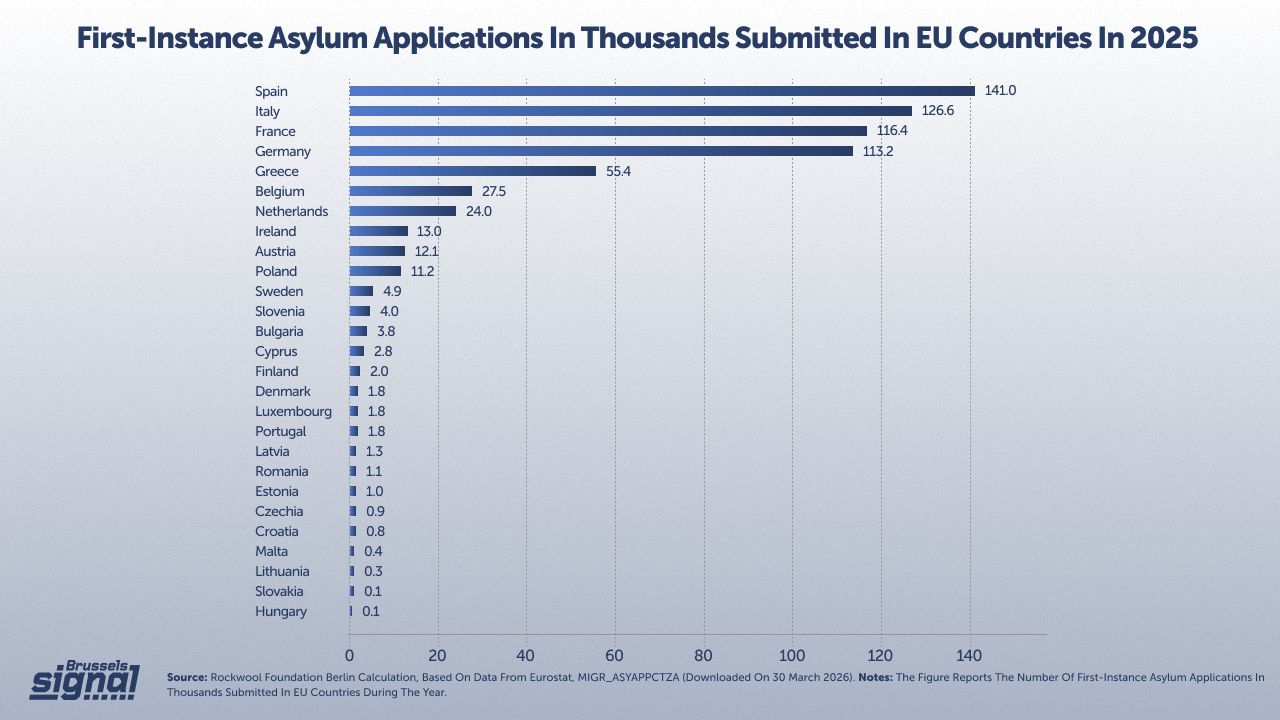
Asylum applications also reflected this pattern. In 2025, first-time claims totalled 669,365, a 26.6 per cent decline from the previous year, with Spain (141,000), Italy (127,000), France (116,000) and Germany (113,000) accounting for 74 per cent of the total.
Origins varied sharply by destination: Venezuelans dominated applications in Spain (around 60 per cent), while Afghans and Syrians made up 42 per cent in Germany.
The stock of refugees and those under temporary protection showed similar asymmetries.
Germany hosted the largest absolute number at 2.7 million, but Cyprus bore the highest relative burden at 4.8 per cent of its population, followed by Czechia (3.5 per cent) and Germany (3.2 per cent).
Around 4.35 million Ukrainians remained under temporary protection across the EU by late 2025.
The report notes that 76 per cent of the foreign-born population is of working age (15–64), with even higher proportions in Spain and Italy.
It highlights the persistent gaps between absolute and relative burdens, warning that these “translate into very different administrative burdens, political dynamics, and policy constraints” across the bloc.
The authors argue that Europe’s migration system combines long-term growth with structural imbalances shaped by geography, historical ties and economic conditions.
They call for a more differentiated and coordinated EU approach that looks beyond aggregate figures to address local pressures.
COMMENT: Europe's current migration crisis is closely tied to a political and ideological project in which the Brussels bureaucracy seeks to transform the bloc into a post-national space, writes @RomanowskiPL. https://t.co/JmgYgdMKft
— Brussels Signal (@brusselssignal) December 11, 2025