




Spanish society is slowly splitting into two groups: Those who own everything and those who own nothing.
Since the 2008 crash, property in Spain hasn’t been redistributed, with a new report showing a surge in multi-property ownership and a rise in households with no homes.
According to a report commissioned by the Spanish Ministry of Social Affairs and published yesterday, the housing system in Spain serves to concentrate wealth.
“The data show that property concentration is increasing, and that this concentration intensifies as the number of properties held by a single owner grows. Far from facilitating access, the functioning of the market has reinforced existing wealth inequality,” the report explains.
The number of households that own two or more properties rocketed by 54 per cent in Spain between 2008 and 2022, while those who do not own any homes increased by 63 per cent, and those who own one home decreased by 22 per cent.
In the last 14 years, the percentage of homeowners has fallen from 79 per cent to 63.9 per cent. During the same period, the percentage of renters has risen from 11.9 per cent to 19.2 per cent.
At the same time, landlords have gone from representing 3 per cent to 9.8 per cent of the total.
By 2025, for the first time, timeshare ownership was the dominant pattern within the homeownership structure in Spain.
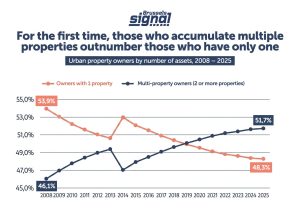
The structure of access to property is becoming polarised.
This traditional Spanish model was based on the socially accepted premise that people with stable employment and salaries could aspire to acquire a home to live in but today this model is weakening.
Spain’s high homeownership rates were partially shaped under Franco’s dictatorship, which enabled middle and working-class people to access homeownership by building and selling them on the market.
As the late Spanish leader Franco’s housing minister José Luis de Arrese said in the 1950s: “We don’t want a Spain of proletarians but of homeowners.”
This model was compromised after the subprime crisis in 2008. Data show that now the group of households with a single property, which for decades was the most common way to access housing in Spain, is shrinking.
“If this trend continues, housing will cease to function as a mechanism for security, social integration, and access to well-being, and will increasingly become a source of persistent inequality,” the report warns.
Across several European Union member states, numerous reports have been drawing attention to mounting housing crises at the national level.
Dan Jørgensen, European Commissioner for Energy and Housing, said in February: “Europe is in a housing crisis, and the consequences are already reshaping lives. Millions of people across Europe are struggling to pay their bills. Millions cannot find a place to call home.
“Young people are stuck in their parents’ houses, unable to move, study, or work where opportunities exist.”
According to Eurostat, the EU’s statistical office, in 2024 housing costs in the EU exceeded 40 per cent of disposable income for almost 10 per cent of households in cities and 6.3 per cent of households in rural areas.
On average, house prices increased by 53 per cent between 2015 and 2024.
Rents are rising across EU capitals, too and the situation is being intensified by the growth of short-term rentals.
Many homeowners can now earn more from short-term lets than from long-term tenants, further tightening the housing market.
“In coastal cities and tourist destinations, the housing shortage can also be partly explained by an increase in short-term rentals. As this market has mushroomed in recent years, a share of houses and flats have been diverted away from potential long-term residents,” Eurostat reported in March.
The Belgian region of Flanders was not doing enough to address the affordability of housing for vulnerable groups, according to a ruling by the European Committee of Social Rights. https://t.co/iKW50MnMc0
— Brussels Signal (@brusselssignal) March 19, 2025