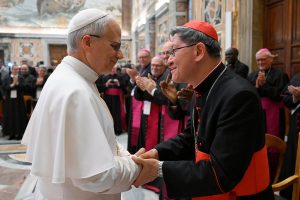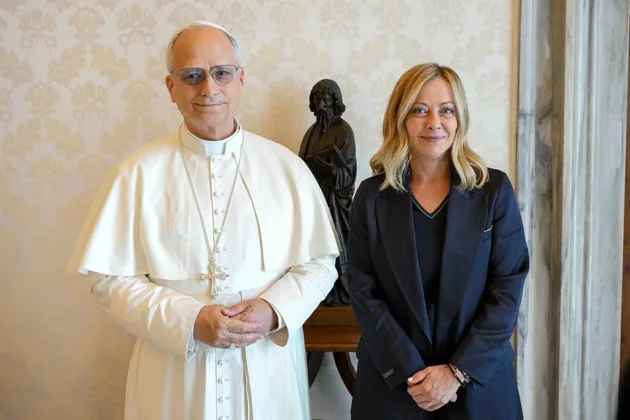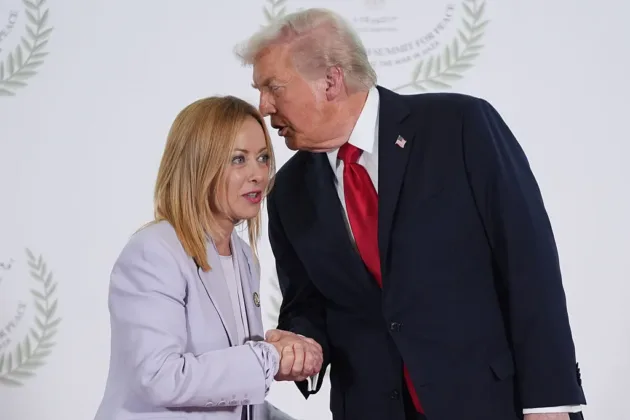





President Trump’s recent attack on Pope Leo XIV has caused consternation and not a little surprise in some quarters of elite opinion as well as among many Christians – not only Catholics, and not only American. From a certain historical perspective, however, this was less unexpected. Indeed, it was an almost overdue moment in Trump’s career, which parallels Henry VIII’s to such a remarkable degree.
Half a millennium apart, and operating in vastly different worlds and conditions, king and president are nonetheless uncannily similar – quarrels with the pope included. As evidence of the applicability of this analogy accumulates, it is worth considering what insights might Henry’s final period yield for what is to come of Trump’s presidency in the years ahead.
While comparing these two figures is not a novel idea, this exercise now takes on a deeper meaning as Trump has passed new milestones in his own “reign”. On a personal level, the similarity with Henry VIII has long been a matter of evidence, with the English monarch presenting the same charismatic, larger-than-life persona, with an expensive taste for buildings and furnishings – especially valuable tapestries in his case – and with an extreme vision of his own grandeur and self-worth.
Where Henry claimed descent from Constantine the Great and King Arthur, Trump sets himself even higher – most recently, according to his social media posts, in the same rank with Jesus. As he tried to extract himself from the Jesus-meme imbroglio, Trump suggested that he can heal people, presumably like a doctor, but using powers of a different order. This, too, he has in common with King Henry, who also claimed to have the “royal touch”, a form of divine healing.
The pursuit of glamour and even the use of hyperbolic language is a striking commonality to both characters. Many of Henry’s things, like the Field of the Cloth of Gold and his Nonsuch Palace, are matched, in value and spirit at least – if not in taste – by Trump’s golden opulence and his constant “there’s nothing like it” rhetoric about everything from his new White House ballroom to US Air Force bombers.
Then there are a variety of smaller details, such as the use of sports and athletics by both for enhancing their political image. Henry was an actual athlete in his youth, fond of jousts, hunting, tennis and other sports; while Trump, aside from golf and despite occasionally taking to the wrestling ring himself, for the show, has been more indirectly but extremely closely associated with sports and sports people.
In affairs of state, again, the parallels are obvious. Henry expanded royal power and ruled as a strong, indeed authoritarian monarch – he believed in the divine right of kings – directing an increasingly centralised, personalised “government”. Accounting for the different circumstances, there is hardly any fundamental difference on these points – perhaps not even on the divine question – when it comes to the US president. And like Henry’s turn against the supranational authority of the papacy, Trump has also denounced the detrimental influence of international institutions, including the UN, and the globalism epitomised by the Davos Set.
In Henry’s time there was also, of course, an actual royal court, while his key decisions came to be taken in an increasingly tight Privy Council. Likewise, judging by observable behaviours of those around the president, the White House often seems to consist of modern equivalents of sycophantic courtiers rather than public servants, with an inner circle responsible for key policy calls.
Their “management style” seems remarkably similar as well. The Eighth Henry cycled, ruthlessly, through a number of chief ministers and advisers – from Cardinal Wolsey to Thomas Cromwell – who were dismissed, not to mention a great many other persons of note executed for treason or heresy. Trump, while not resorting to executions, is otherwise well known for firing even close associates and turning on them rather quickly and unexpectedly, like Henry.
Then, there are the parallels in policy. A telling one is that Henry founded the Royal Navy, which went on to make such distinguished military history; while Trump founded the US Space Force which will likely prove at least as influential upon global affairs and humanity’s future on Earth and beyond. The king undertook a major effort to fortify the southern coast with towers and forts against a foreign (French) invasion. The president built his great wall on the southern border to keep out migrant “invaders”.
Another policy instinct they both share is that for expanding the geographic reach of “national” authority. Henry formally annexed Wales to England and engaged in the “Rough Wooing” of Scotland – a years-long low-level war aiming to impose a dynastic union on his realm’s northern neighbour. Trump, too, has designs to the north, on Canada and Greenland. And in economic policy, while Henry replenished his coffers with money from the dissolution of the monasteries during the Reformation – assets that were technically within reach of his power – Trump has used debt (money printing) and wide-ranging tariffs to fund some of his spending.
It is in military affairs where the two great personages of history have generally been considered, until recently, to differ the most. Henry had a famous desire to gain glory on the battlefield, and thought of himself as a warlike prince – though his resources often put a check on his martial ambitions. Trump, on the other hand, while being a great proponent of a strong US military, has always lacked a personal interest in military exploits and, politically – as well as “philosophically”, as far as we can tell – has consistently argued against war as an instrument of policy and has always campaigned for “peace through strength”.
Now he is confronted with the greatest international test of his presidential career, the Iran war. What appears to be a complete reversal of one of Trump’s most important policy and political principles – that it is a very bad idea to start a war, especially in the Middle East – can be read, in fact, as his inner “Henry VIII instinct” being finally released. It is perhaps not a deviation from his longstanding principles, but a correction to a longstanding divergence from that close parallel with King Henry that seems to define so much of Trump’s life.
Should this be so, what, then, can we expect from this Iran adventure based on Henry’s own experience? Again, uncannily, it turns out that Henry, too, undertook a major campaign at the twilight of his career in 1544, like Trump is doing now, two years before the end of his presidency. Henry launched one last war against the French, in alliance with the imperial troops of Charles V, looking to capture Boulogne. Trump attacked Iran, alongside a powerful Israel led by Benjamin Netanyahu. The king assembled one of the largest English armies of the period, supported by a large fleet and heavy siege artillery; Trump has also concentrated a massive US military force in and around the Gulf, at levels unseen since the Iraq War.
Both Boulogne and Iran were subjected to heavy bombardment, with great expenditure of military supplies and ordnance by the English as well, 500 years later, by the Americans. Henry eventually took the city but, with his army exhausted and the economic cost of the war escalating, could not pursue the rest of the campaign. A peace was signed two years later, with Henry agreeing to return Boulogne to the French after eight years, for a sum of money.
It was a fleeting victory, and, overall, an effectively pointless and ruinous campaign that did nothing to curb French power. Henry died the following year and his realm was thrown into factional strife for a number of years. Eventually, Elizabeth I, the last of the Tudors, ascended to the throne. Her reign was remembered as the original “Golden Age” – a prominent term in the president’s lexicon as well – and set England on course to imperial greatness. Given how closely Trump’s career has so far tracked with Henry VIII’s, we may now venture a pretty good bet on how the story ends, and what future it might open up. No one else knows any better anyway.