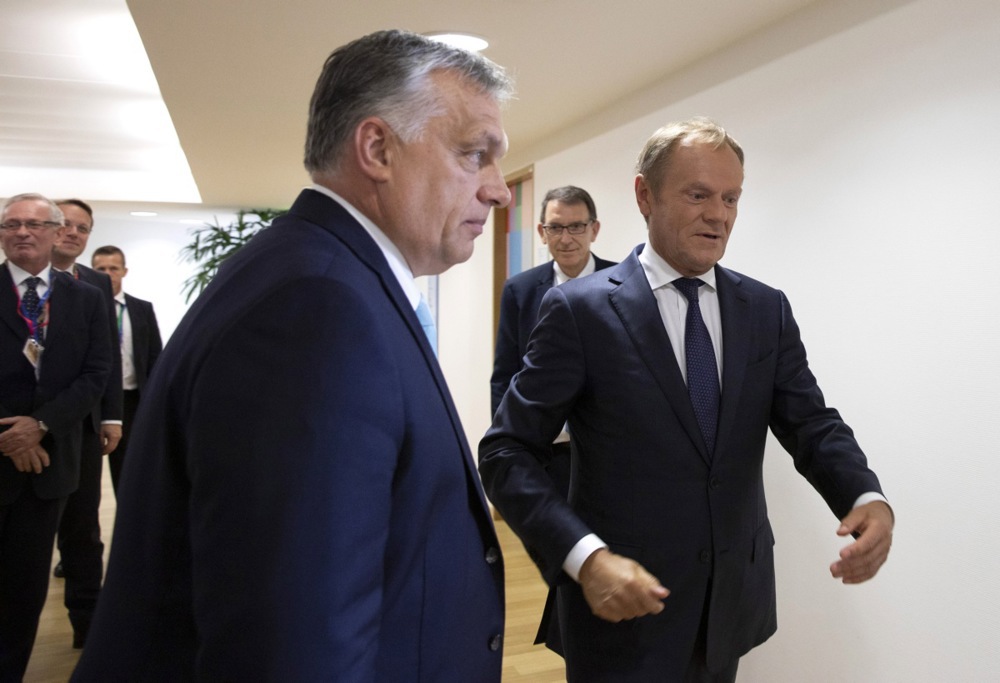
Peter Magyar, the leader of the Tisza party which won the Hungarian parliamentary election yesterday, has confirmed that he intended to make Warsaw the first international visit of his reign as Prime Minister.
Magyar met Polish Prime Minister Donald Tusk weeks before the Hungarian election and promised him that on his first day in office, he would extradite two Polish opposition Conservative (PiS) MPs, the former justice minister Zbigniew Ziobro and his deputy Marcin Romanowski, who have been indicted for alleged abuse of power during their time in office.
Both Tusk and Magyar are members of the European People’s Party, the grouping that leads the centre-left majority in the European Parliament.

After casting his own vote yesterday, Magyar told the media that if he emerged victorious, “my first trip abroad will be to Warsaw, as agreed with Donald Tusk”.
The Polish PM arriving in Seoul, South Korea expressed his joy at Magyar’s victory saying that it was important for Poland “for many reasons”, citing the release of funds for Ukraine and what he perceived as resistance to an “authoritarian trend” in Europe.
He said that he had already spoken with Magyar to congratulate him and briefly discuss his visit to Warsaw. Tusk shared a video of part of the call on social media, in which he was heard telling Magyar: “I think I’m happier than you, you know.”
One of the key expectations the Tusk government will have of Magyar is for the new Hungarian PM to deliver on his promise to attempt extradition of ZIobro and Romanowski back to Poland. There they have been indicted for more than a dozen alleged offences, including participation in a criminal group, using crime as a source of income and authorising illegal purchase of spyware which was used in surveillance against opposition politicians.
The two PiS MPS deny the charges, arguing that a group of state officials taking decisions on funding for NGO’s and localities in line with the procedures and who did not materially benefit from the decisions cannot be convicted and that the charges are an act of “political revenge”.
The two politicians were granted asylum by Hungary on the grounds that they would not face a fair trial in Poland.
The Hungarian decision to grant asylum led to a diplomatic bust-up with Poland with the latter recalling its ambassador in Hungary and threats to take Hungary to the European Court of Justice over breaches to international agreements.
No Polish court has as yet issued a European Arrest warrant against Ziobro, although one has now been issued against Romanowski. According to Hungarian law no one who has been granted asylum may be deported, regardless of the existence of an international arrest warrant for their detention.
Magyar’s government, when it arrives in office in a month’s time, will have to change the law to be able to extradite Romanowski and Ziobro. It could, though, attempt to detain them awaiting extradition proceedings.
Romanowski commented publicly on his case to conservative broadcaster TV Republika yesterday by saying that Magyar’s attempt to portray extradition as a government decision was wrong because it will be “up to a court to decide”.
He also told Brussels Signal that he was not worried about the situation he was now in.
“Everything is under control. It is Hungary that is primarily at risk, and indeed all of Europe. I am of course taking action, but please understand that, for obvious reasons, I cannot comment on the measures being planned,” he said.
Magyar’s victory has prompted division among right-wing Polish politicians, with some reassessing their support for deposed prime minister Viktor Orbán while others reaffirmed their backing of the outgoing leader.
Among the most prominent voices, Sławomir Cenckiewicz, head of Poland’s National Security Bureau of PiS-allied President Karol Nawrocki, issued a critique of Orbán’s allies. He said elements of the Polish right had wrongly “relativised” Orbán’s ties to Russian President Vladimir Putin and foreign minister Sergey Lavrov, calling it a strategic mistake and pointed to Hungarian dependence on Russian energy and lukewarm support for NATO.
Cenckiewicz, wrote on social media that, while Orbán had been an ally against the “cosmopolitans and centralists in the EU”, in others areas, particularly on Russia and energy, he was “completely at odds with our interests”.
But other figures in Poland’s conservative camp signalled continuity rather than rejection.
PiS MP Janusz Kowalski reaffirmed his support, posting a photo with Orbán and writing: “Thank you, Prime Minister Viktor Orbán, for supporting Poland for years. We will never forget that.”
As a party, though, the PiS does not sit with Orbán’s Fidesz in the Patriots for Europe caucus in the European Parliament, preferring to maintain membership of the European Conservative Reformers group. It has consistently taken a different view on Ukraine and Russia from that of Orbán’s preference for maintaining close ties to Moscow.
However, PiS politicians were united in supporting Orbán over Magyar during the run-up to Sunday’s election because of a commonality of interests on European Union matters such as opposition to the Migration Pact and faster integration of the bloc.