
Armenian human rights activists accuse the EU of hypocrisy and double standards, saying it raises human rights concerns against adversaries like Russia while overlooking similar issues in politically aligned partners such as Yerevan.
“It is hypocritical for the EU to support democracy, human rights, and a dignified life for Ukrainians in their own country, but not for Armenians. This is why we are very frustrated,” said Artak Beglaryan, former ombudsman of Nagorno-Karabakh, who fled the region with around 100,000 Armenians after Azerbaijan’s takeover in 2023.
He says Armenia is undergoing an authoritarian drift driven by the government — a trend he argues is largely overlooked by the EU, which continues to support Yerevan due to its geopolitical shift away from Russia.
The ombudsman is an independent role tasked with safeguarding the rights of a specific group of citizens. Beglaryan stepped down after being displaced from Nagorno-Karabakh to continue his human rights work in Armenia. His position has been taken by Gegham Stepanyan, who focuses primarily on the rights of displaced persons who fled to Armenia and shares his views.
“In Armenia there are political persecutions, very strong pressure against opposition leaders and members. What is happening has nothing to do with democracy,” said Gegham Stepanyan.
Armenian activists accuse EU of “hypocrisy” over biased human rights stance favouring pro-EU allies.
👉 “In Armenia there are political persecutions, very strong pressure against opposition leaders and members. What is happening has nothing to do with democracy,” said… pic.twitter.com/vTGBo2r3Xt
— Brussels Signal (@brusselssignal) May 6, 2026
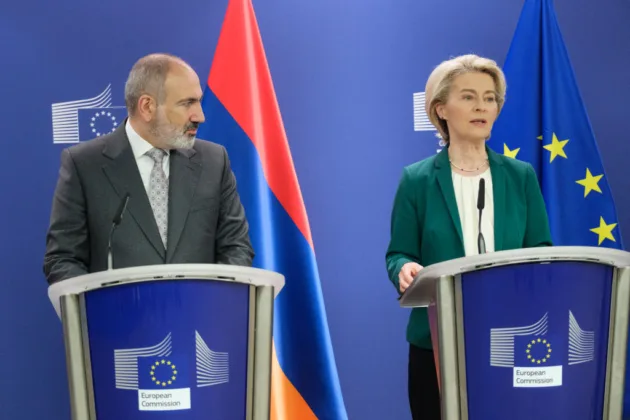
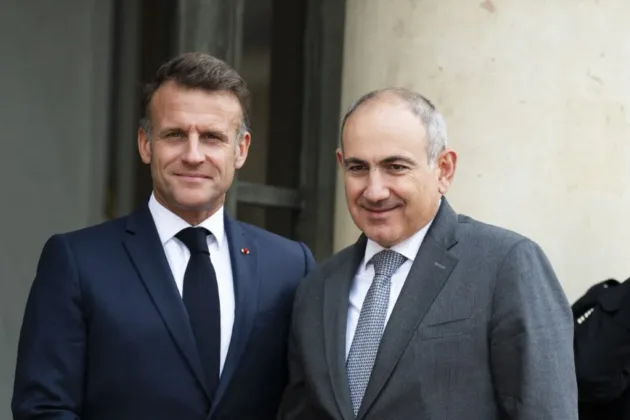
Beglaryan and Stepanyan conveyed these views to Brussels Signal on the sidelines of a protest they organized outside the venue hosting the European Political Community (EPC) summit in the Armenian capital. The EPC is a pan-European forum bringing together leaders from EU member states and partner countries outside the bloc, including European Commission President Ursula von der Leyen, French President Emmanuel Macron, and Ukrainian President Volodymyr Zelenskyy.
At the entrance, groups of protesters — mostly displaced persons from Nagorno-Karabakh — held signs calling for greater attention to their rights and to the broader human rights situation in Armenia. Many placards also accused the Armenian government of authoritarian drift.
Beglaryan reportedly attempted to enter the venue to deliver a letter to European leaders outlining these concerns, but was prevented from doing so by the authorities.
Born in Nagorno-Karabakh in the late 1980s, he has lived through all the wars in the long-disputed region between Armenia and Azerbaijan. The latest conflict in 2023 led to the mass displacement of the Armenian population and the complete transfer of control of the region to Azerbaijan. Since then, he argues, human rights conditions in Armenia have deteriorated sharply.
According to him, the authorities led by Prime Minister Nikol Pashinyan are pursuing a strategy to stay in power at any cost despite past foreign policy failures, combining a shift toward the EU with a push for peace with Azerbaijan, even if it means accepting most of Baku’s conditions.
This has included effectively shelving the Nagorno-Karabakh issue and treating it as “an exclusively Azerbaijani matter,” while increasing pressure on those who continue to advocate for displaced Armenians, the right of return, the release of prisoners and the protection of Armenian cultural heritage of the region.
Beglaryan says that “talking about Nagorno-Karabakh is now seen as an obstacle to peace agreements,” and those who do so increasingly face pressure. Over time, he adds, this pressure has expanded beyond the Nagorno-Karabakh issue itself, reaching broader voices perceived as opposing the government’s political line.
Since 2023, the Armenian government has carried out the arrest of at least forty individuals considered politically hostile, with charges ranging from terrorism to other serious criminal accusations, including opposition party leaders, prominent figures among Nagorno-Karabakh’s displaced community, and members of the clergy.
Some international observers have denounced these developments, including Kenneth Roth, former executive director of Human Rights Watch. Beglaryan argues that many of these cases are politically motivated and fabricated, while the government maintains that the proceedings are based on legitimate legal grounds.
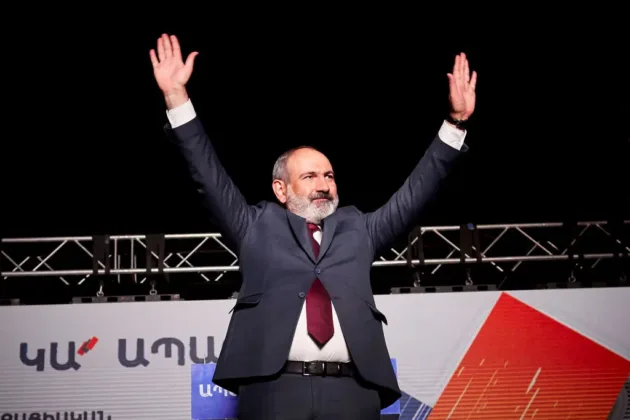
A month from now, Armenia will hold elections seen as decisive for whether the current government stays in power or is replaced. Most opposition forces want to return the Nagorno-Karabakh issue to the political agenda, a move that would likely strain relations with Azerbaijan and complicate prospects for peace.
The government, meanwhile, frames its approach as a choice between peace and war, while also pointing out that some opposition groups are seen as aligned with the Kremlin.
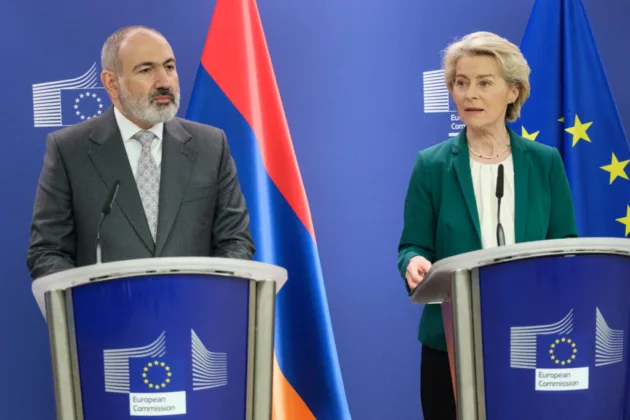
In the days surrounding the European Political Community summit in Yerevan, several other diplomatic events are taking place, including the EU–Armenia Dialogue — a framework for political engagement, reforms and bilateral relations between Brussels and Yerevan. Some observers see their timing as a de facto endorsement of the Armenian government, without sufficient attention to internal human rights concerns.
Armenian activists accuse EU🇪🇺 of “hypocrisy” over biased human rights stance favouring pro-EU allies
👉 “At this moment, I observe that for European leaders these values seem to matter only when they are used as a tool to pressure countries with different geopolitical… pic.twitter.com/knCgiJNgev
— Brussels Signal (@brusselssignal) May 7, 2026
“I have long believed in European values, in the idea that when the EU speaks about freedom and democracy, it truly means it,” Beglaryan said. “But at this moment, I observe that for European leaders these values seem to matter only when they are used as a tool to pressure countries with different geopolitical agendas. I would be happy to have a country with genuine European and democratic values and institutions, as well as just, dignified, inclusive and sustainable peace with Azerbaijan.”