
Mohamed Bakkali, convicted in France as a central figure in the logistics of the November 13, 2015 Paris attacks that killed 130 people and injured hundreds more, has been granted multiple temporary prison leaves by a Belgian court.
The Brussels Tribunal d’Application des Peines (TAP) approved six penitentiary leaves of up to 36 hours each for the 39-year-old, a Moroccan-Belgian national who is serving his sentence in Ittre prison, a high-security facility in Walloon Brabant.
He has already benefited from several short permissions since July 2025.
Bakkali was sentenced in France to 30 years in prison for his role in the Paris attacks. The verdict was handed down in June 2022 at the conclusion of the so-called V13 trial, the longest criminal proceedings in modern French history, which involved 20 defendants over almost 10 months.
Prior to this, he received 25 years for his role in the foiled Thalys train attack in August 2015, when a heavily armed gunman boarding the high-speed service from Amsterdam to Paris was overpowered by passengers.
He rented safe houses in Belgium for the terror cell and provided logistical support. The same network was later behind the March 22, 2016 Brussels bombings at Zaventem airport and Maelbeek metro station, which killed 32 people and wounded more than 300.
The French authorities decided to merge his sentences to the maximum of 30 years, Belgian news agency Belga reported.
Following an agreement at the time of his extradition, he is serving his sentence in Belgium rather than France.
Under Belgian prison rules, convicts can qualify for temporary leaves and conditional release after serving only one-third of their sentence. That is a much more lenient regime than in France, where a two-thirds safety period would have kept him behind bars far longer.
News outlet La Capitale reported he already was granted five periods of day release since July 2025.
This year, he applied for prison leave.
On May 11, 2026, the Sentence Enforcement Court approved the application, despite a negative recommendation from the Public Prosecution Service, allowing Bakkali to apply.
The same court said Bakkali had taken sufficient steps to find work and accommodation and had behaved “calmly and respectfully” in prison.
He has also already met with some of the victims, which, according to them, indicates his desire to rebuild his ties with society.
The Sentence Enforcement Court reportedly sees no reason to fear that he would harass the victims.
His theoretical release date remains 2040, but he became eligible for conditional release as early as February 2024.
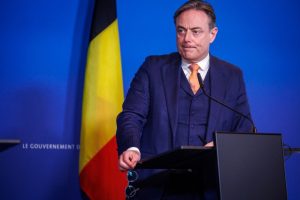
In a reaction to Brussels Signal, N-VA MP Sophie De Wit said it was “difficult to comprehend” that Bakkali is set to be granted prison leave as early as 2026, despite a negative recommendation from the public prosecutor’s office. N-VA is the senior partner in the federal coalition led by Prime Minister Bart De Wever.
“Cases of this calibre are not about the standard enforcement of sentences, but about a very concrete assessment of the risk to society. When the public prosecutor’s office itself issues a negative recommendation, serious alarm bells should certainly be ringing.
“At the same time, the figures show that this is not merely a theoretical debate: in 2025, 434 prisoners failed to return from prison leave on time. This underscores the fact that any decision regarding such leave poses a real security risk and must therefore be taken with the utmost caution.
“Furthermore, the Belgian government wishes to tighten the conditions for prison leave and temporary release permits and to monitor more strictly the granting and eligibility for these forms of sentence enforcement. This must be handled with particular care, especially in cases involving serious terrorism.”
De Wit said her party had “serious questions” about the decision.
“In terrorism cases, the bar must be set very high, and any doubt must be resolved in favour of the victims and public safety, rather than in favour of the detainee. Furthermore, the question arises as to what extent the victims in this case were actually informed and involved in the proceedings. In such serious terrorism cases, this is not a mere detail, but an essential element of trust in the justice system.”
Vlaams Belang MP Alexander Van Hoecke, from the opposition in the Belgian federal parliament, said it was “completely incomprehensible and outrageous, especially given the negative advice from the Brussels public prosecutor’s office”.
“This concerns a terrorist and a mass murderer. If the justice system cannot manage to punish someone like this in the harshest possible way and permanently remove him from our society, what trust can we still have in justice and the government? Who is going to explain this to the victims? The fact that this is even possible is a gap in the legislation that must be closed.”
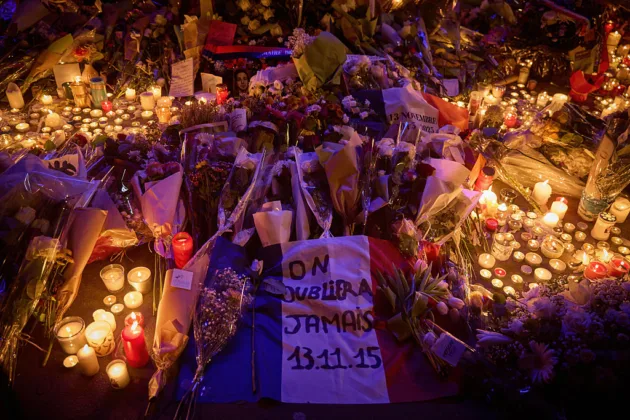
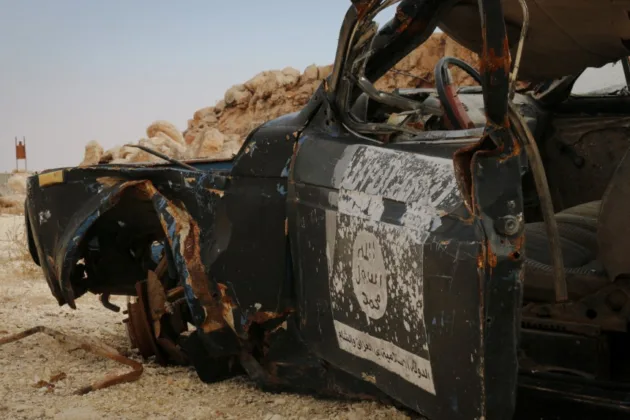
On the evening of November 13, 2015, Islamist terrorists from the Islamic State carried out a series of coordinated attacks across Paris.
In just over three hours, they killed 130 people and wounded more than 400, many of them critically.
The deadliest assault occurred at the Bataclan concert hall, where three gunmen burst in during a rock concert by Eagles of Death Metal and massacred 90 people.
They fired Kalashnikov rifles into the trapped crowd at close range for over two hours, executing victims one by one and throwing grenades. Survivors described scenes of extreme cruelty.
Simultaneously, suicide bombers struck outside the Stade de France during a football match attended by 80,000 people, including then-president François Hollande, while other attackers carried out drive-by shootings on crowded restaurant and café terraces in the 10th and 11th arrondissements.
It remains the deadliest terrorist attack in France since the Second World War.
Police narrowly foiled a suspected terrorist attack in Paris early Saturday morning, amid ongoing security concerns across Europe. https://t.co/AmEARRNX8b
— Brussels Signal (@brusselssignal) March 30, 2026