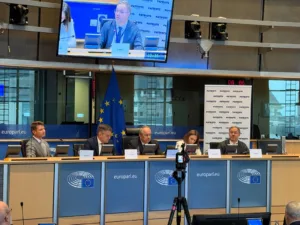






The European Parliament has approved a reform of European Union foreign investment screening rules designed to allow closer scrutiny of money flowing into sensitive sectors from non-EU countries such as China and Russia.
Meeting in plenary in Strasbourg, eastern France, on May 19, MEPs backed the new regulation by 508 votes to 64, with 90 abstentions. The text obliges member states to vet incoming investments in areas considered critical to the bloc’s security.
The sectors covered include defence, financial services, semiconductors, telecommunications, transport and raw materials. Parliament described the framework as essential to safeguarding Europe’s economic security.
The rules will also apply to transactions inside the EU when the entity behind the deal is ultimately controlled by individuals or companies based in a third country. That provision is aimed at preventing investors from circumventing the screening regime by routing capital through European subsidiaries.
Under the reform, every member state will have to put in place a screening mechanism, with national rules brought into closer alignment. It also sets a minimum list of sectors in which all EU countries must examine foreign investments and extends oversight to European investors backed by non-EU money.
In a statement accompanying the vote, MEPs warned that further measures at European level would be needed to address security risks linked to foreign investment. They pointed to the industrial acceleration law presented by the European Commission in March, which sets specific conditions for foreign capital entering strategic sectors.
The Commission has been pushing for years to give Brussels more leverage over takeovers and acquisitions that could hand sensitive technology or infrastructure to geopolitical rivals. Concerns about Chinese State-linked entities buying into European ports, energy grids and chip manufacturers have intensified since 2022, when Russia’s invasion of Ukraine reshaped the bloc’s approach to economic dependencies.
The new framework still requires formal approval from the Council of the European Union, where the 27 member states are represented. Once endorsed, the regulation will enter into force and start applying 18 months later.
National governments will use that period to set up or upgrade their screening systems before the rules take effect. The European Commission has said it would work with member states to ensure consistent implementation across the bloc.
Around two-thirds of EU countries already have some form of investment screening in place, though Parliament has argued that the patchwork of national approaches has left gaps that hostile actors could exploit.
The reform forms part of a wider push in Brussels to reduce strategic dependencies on countries such as China and to align trade and investment policy more closely with the EU’s security interests. It also reflects growing unease in several capitals about foreign acquisitions of European technology firms during periods of market weakness.