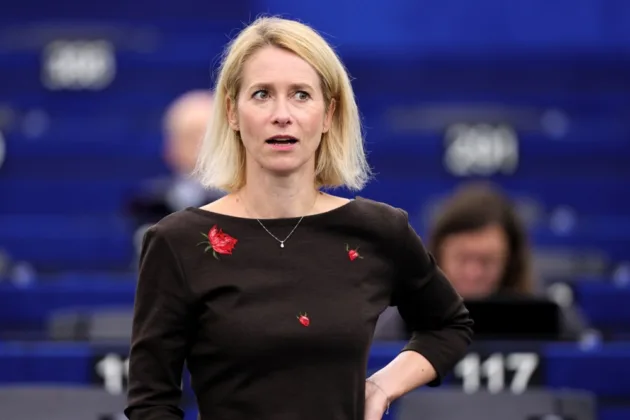

EU High Representative for Foreign Affairs and Security Policy Kaja Kallas has described Europe’s economic relationship with China using strong and graphic language, comparing the challenge posed by Beijing to a “cancer” that requires decisive treatment rather than temporary relief.
Speaking at the annual Lennart Meri Conference in Tallinn, Estonia, the EU’s chief diplomat said Europe has “a very clear understanding of the diagnosis of the disease” when it comes to China’s coercive economic practices, unfair competition, and dominance in critical sectors such as batteries, chemicals, shipbuilding and raw materials.
“If you have a very difficult disease, if you have a cancer, you have two choices. Either increase the morphine or you start chemotherapy,” Kallas said.
“Increasing morphine is not painful, but chemotherapy is,” she said, meaning that some countries wanted to avoid painful decisions and preferred handing out subsidies for European companies to compete with China.
Kallas said this did not address the underlying problems of China’s policies.
Against this, she said that Europe has the tools such as investment screening, public procurement rules, export controls and supply chain diversification. This approach, she warned, would be painful and provoke retaliation from China.
She expressed concern that many member states prefer the easier subsidies route, noting that even rich countries could eventually run out of taxpayers’ money without tackling the root issue.
EU imports from China reached €517.8 billion in 2024 against €213.3 billion in exports, leaving a trade-in-goods deficit of €304.5 billion, according to Eurostat. China was the bloc’s largest source of imports, accounting for 21.3 per cent of all goods coming from outside the EU.
Kallas made the remarks amid broader warnings that the United States, China and Russia all prefer a divided Europe because a united EU acts as an equal power on the global stage.
She has consistently taken a firm line on China, viewing it as a systemic rival engaged in economic coercion. The ‘systemic rival’ label was first set out in a 2019 European Commission strategy paper and has since guided how the bloc approaches Beijing, alongside the parallel descriptions of ‘partner’ and ‘economic competitor’.
The former Estonian prime minister has repeatedly drawn criticism for undiplomatic language, particularly towards Russia.
In 2022, she faced backlash after remarking that she supported the idea of “dismembering” or breaking up Russia into small states, reflecting her strong anti-Kremlin stance.
She has also advocated banning Russian tourists from the EU, stating that “travel to the EU is a privilege, not a human right.”
In September 2025, Kallas said it was “news” to her that China and Russia were among the victors who defeated Nazism and fascism, a remark that drew particular attention given the Soviet Union’s central role in the defeat of Nazi Germany during the Second World War.
She characterised the Chinese as “very good at technology but not that good in social sciences, while the Russians are super good in social sciences but bad at technology.”
At the beginning of this year, Kremlin spokesman Dmitry Peskov has categorically ruled out any negotiations with Kaja Kallas or the European Union’s broader leadership, describing them as “incompetent” and lacking vision for the future.
According to the Russian interior ministry’s website, Estonian Prime Minister Kaja Kallas is “wanted under the criminal code”. https://t.co/tati6cdjc6
— Brussels Signal (@brusselssignal) February 13, 2024