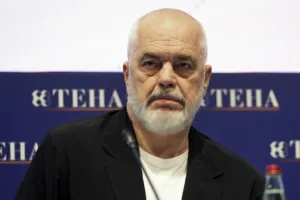

A fierce free-speech controversy has erupted in Germany after senior Social Democrat leader Saskia Esken called for what she described as an effective “blacklisting” of a popular podcast called Ungeskriptet.
Her comments came following its interview with Björn Höcke of the Alternative for Germany (AfD) party, referring to him as a “fascist”.
Esken ia co-leader of the Social Democratic Party (SPD) — a partner in Chancellor Friedrich Merz’s coalition along with his Christian Democratic Union (CDU).
She argued that Höcke should not be given a public platform to spread his ideas and called on advertisers to stop supporting media outlets that provide extensive exposure to what she considers extremist political actors.
In a video published on her social media channels yesterday, she explicitly endorsed economic pressure on the podcast, stating: “I’ll say it clearly: Blacklisting helps.”
Ungeskriptet is a rapidly growing German podcast hosted by Benjamin Berndt. It is known for long-form, largely unedited interviews with politicians, influencers and public figures across the political spectrum.
On May 4, it released an almost four-hour conversation with Höcke, one of the most prominent and divisive figures within the AfD.
The party is currently the leading opposition force and topping polls in national surveys.
Höcke, the regional leader of the party in Thuringia, is widely regarded by critics and much of the German media as a leading figure of the far-right and a key influence on the AfD’s ideological direction, often described as a driving force behind its radical positioning.
Therefore, many argue, granting him extended, unmediated exposure risks amplifying extremist positions. Mainstream German media outlets typically avoid long-form interviews with Höcke, instead favouring formats that present him through a strongly negative framing.
“This approach is called Haltungsjournalismus [attitude journalism],” said Vadim Derksen of the conservative German newspaper Junge Freiheit, who in the past was a member of the AfD youth wing.
“It is a style in which journalists do not necessarily pursue neutrality but instead openly align reporting with what they see as the defence of democratic values,” he added.
“This means actively framing, challenging or even manipulating certain political actors rather than providing them with neutral, uninterrupted exposure.”
In this context, Derksen also noted that Höcke is a recurring subject in mainstream media: “In their narrative, Höcke has become the great fascist of contemporary Germany, attempting to destroy democracy through the AfD.”
Against this backdrop, the podcast interview attracted significant attention. The long conversation saw Berndt ask Höcke a series of in-depth questions on themes including German identity, immigration and integration policy, criticism of mainstream institutions, and Höcke’s claims about restrictions on free expression.
It was not a critically adversarial interview but rather one aimed at providing a platform in which the interviewee could extensively present his views.
Within hours of its release, the episode reportedly reached millions of views, becoming one of the most widely discussed political media events of the year so far in Germany.
“This interview was a breaking of a taboo,” Derksen said.
“For the first time, a widely followed media outlet not affiliated with any political camp such as Ungeskriptet allowed Höcke to present himself without filters.
“The image that emerged for those who watched him is not that of a monster but that of a person who holds ideas that may or may not be appealing, and which thus reached hundreds of thousands of users across all political orientations who would otherwise not have followed him,” he stated.
The publication triggered strong reactions from political and media figures. As the podcast’s online popularity surged, traditional media outlets began to attack it, which in turn seemed to contribute to further amplification.
Esken called for such exposure to be countered through advertiser pressure. In her statement she said: “To give a fascist like Björn Höcke a four-hour platform – unedited and unchallenged – can quickly generate millions of views online and quite substantial advertising revenues.”
She further argued that “companies whose advertising is played in a podcast should consider how to stop that”.
“One should not have to tolerate a fascist, financed by a company’s advertising budget, speaking unchallenged about the planned murder of the German people,” she added, calling for economic pressure on Ungeskriptet to prevent it from providing space to what she described as “undesirable voices”.
“These reactions are particularly strong both in media and political circles” Derksen said, “From a media perspective, mainstream outlets fear that the internet has eroded their former monopoly over public discourse and the narratives that reach the population.
“From a political perspective, a normalisation of Höcke is seen as highly damaging for traditional parties, as the AfD continues to strengthen further in the polls,” he said.
Recent polls from Germany in late April and early May 2026, including INSA on May 2, and Forsa and YouGov surveys conducted in April, show the AfD reaching around 25 per cent to 28 per cent, placing it around the first party nationally.
INSA’s survey put the AfD at about 28 per cent, ahead of the CDU/Christian Social Union (CSU) coalition government at approximately 24 per cent.
“This strong electoral result shows how increasingly large sections of the population regard the issues raised by the AfD — particularly immigration — as common sense rather than extremism, as they are often portrayed in mainstream media,” Derksen claimed.
“If Höcke’s image as an extremist and enemy of democracy is weakened, then one of the key mechanisms through which parties and media attempt to contain the AfD begins to lose its effectiveness,” he concluded.