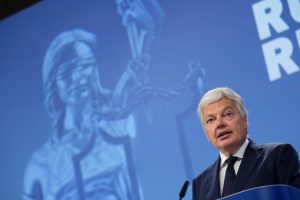












ING Belgium has avoided a criminal trial by paying a €1.6 million settlement to the Brussels public prosecutor over its handling of accounts belonging to former EU Justice Commissioner Didier Reynders.
The move does not amount to an admission of guilt by the bank.
Prosecutors and the National Bank of Belgium investigated ING over its alleged failure to promptly flag between €700,000 and €1 million in cash deposits made by Reynders, as well as large lottery ticket purchases later credited back to his accounts.
The bank only filed a formal suspicious activity report in late 2023, five years after first internally questioning the transactions, fuelling suspicions that it may have sought to shield the former EU Commissioner for Justice.
In a statement, the Brussels prosecutor said the criminal investigation conducted by the Public Prosecutor’s Office’s Central Anti-Corruption Service had “confirmed the findings of the National Bank”.
The office said that “the facts under investigation lend themselves to this [settlement] approach because they are of a financial nature, do not involve any serious breach of a person’s integrity, and the law in any case only permits a financial penalty”.
The prosecutor added: “Money laundering can only be combated seriously and effectively if banks, without any special privileges and regardless of the client’s status, comply with their anti-money laundering obligations as laid down by law.”
“Banks must exercise even greater vigilance when dealing with public figures holding high-level positions. Failure to report instances of money laundering allows such activities to continue and aids the perpetrators in committing the offence,” the statement continued.
The €1.6 million settlement was the maximum amount the prosecutor could seek under Belgium’s Criminal Code for the alleged money-laundering failures.
Two former ING executives were also questioned. A decision on whether they will face prosecution has yet to be made.
The settlement closes the case against the bank itself while the one focusing on Reynders and his associates continues.
Reynders, who was formally charged with money laundering in late 2025, continues to deny any wrongdoing. He maintains that the funds came from legitimate sources, including the sale of art and antiques.
According to the prosecutor, Reynders carried out 245 cash transactions between 2001 and 2017, Belgian State broadcaster VRT reported. They were worth €836,500. He also reportedly made 779 e-Lotto transactions between 2017 and 2024, worth more than €200,000.
ING was allegedly aware of possible issues surrounding his finances as early as 2018 but reportedly did not pursue the matter. The National Bank of Belgium was only informed in 2023.
By then, a judicial investigation was already under way, triggered by alerts from the National Lottery and Belgium’s Financial Intelligence Processing Unit.
Reynders is one of Belgium’s most prominent political figures. He served as finance minister, foreign minister and, from 2019 to 2024, European Commissioner for Justice, a role in which he was responsible for rule-of-law issues across the European Union.
In its own reaction, ING said it wanted to “close this chapter from the past” and “move on”.
“Today’s ING is not the ING of the past. Over the years, our approach, governance and control environment have been fundamentally strengthened and further embedded, with clear lines of responsibility right up to the highest level. We continuously monitor regulatory developments and are constantly refining our processes and controls,” the bank said.
The Brussels Public Prosecutor’s Office has confirmed that a Brussels antique dealer’s premises were raided over suspected money laundering in connection with former European Commissioner for Justice Didier Reynders. https://t.co/w87pqfuAAZ
— Brussels Signal (@brusselssignal) July 15, 2025