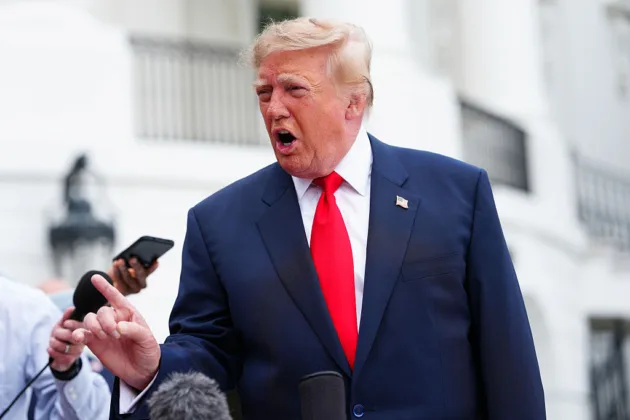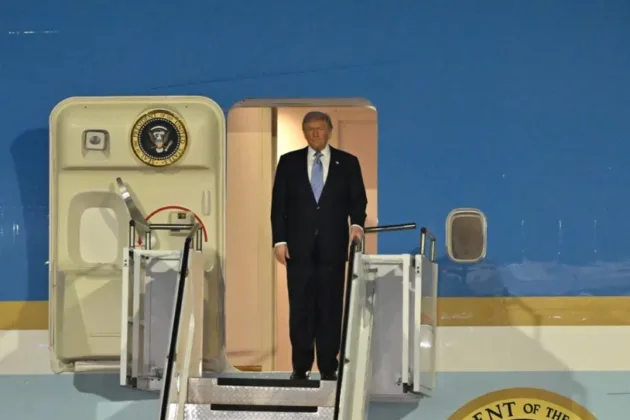







As Donald Trump lands in Beijing to face Xi Jinping, the air is thick with the scent of a historic showdown. On one side, we have the American president, a man who views geopolitics as a series of tactical deals and immediate shows of force – a true disciple of Thucydides (or, rather, of what the great historian attributes to the Athenians), believing that the strong do what they can and the weak suffer what they must. On the other side, we have the quiet emperor, who thinks in centuries, playing a game that is far more patient and lethal.
While the cameras capture handshakes, witty exchanges and grand banquets, we must look at the strategic ghost haunting the room. There is an ancient Eastern proverb, often misattributed to Sun Tzu but rooted deeply in the Chinese strategic mind, which suggests that if you sit by the river long enough, you will eventually see the bodies of your enemies float by. This is the essence of modern China. They are not in a rush to go to war; they are waiting for the West to drown in its own decadence, its own debt, and its own ideological civil wars.
China is not just a competitor. It is a predator that has mastered the art of winning without fighting. While we in the West have spent decades obsessing over “globalisation” and “liberal reform”, Beijing has been sitting on the riverbank, watching our industrial base float away to their shores. They have watched our energy security vanish because of green virtue and the war against Russia, and they have watched our social cohesion dissolve into the tribalism of identity politics. For Xi, the decline of the West is not a goal. It is simply something that he watches unfold.
The juxtaposition is terrifying. Thucydides warns us of the “trap” where a rising power creates such fear in an established one that war becomes inevitable. But even if Xi chooses to bring this trap up, the wisdom of the East offers a different path: The total subversion of the enemy from within. Why risk a hot war over Taiwan when you can simply own the infrastructure, the rare earth minerals, and the digital data of your rivals? Why fire missiles when you can turn off the lights of a European port from a keyboard in Shanghai?
Trump’s presence in Beijing is an attempt to steer a turbulent relationship through sheer personality and economic pressure. He understands, perhaps better than the Brussels bigwigs do, that China only respects strength. But even if a deal on trade or a temporary truce on Taiwan materialise, they will not be reversing the flow. China’s global expansionism – its bid to control European trade routes and African mines – is not a series of arbitrary business moves. It is the steady construction of a world where the West becomes a historical relic.
From the corona virus to the dystopian Social Credit systems, Beijing has shown us exactly what their version of the future looks like. It is a world without the individual, a world where the State is the only god. While the EU issues strategic autonomy memos that nobody reads, China is busy ensuring that every solar panel and every electric car battery in Europe is provided by their Communist Party. They are waiting for us to become so dependent that “sovereignty” becomes a word with no meaning.
If we wish to stop being the bodies floating down the river, we must no longer pretend that China is a partner that can be charmed or a guest that can be manipulated. We are in a civilisational struggle between the Thucydidean reality of real-time hard power and the Eastern reality of playing a long game of dependency and attrition. If we do not re-industrialise, secure our own energy and minerals, and defend our own borders, culture and demographics, we are simply waiting for the current to take us.
As Trump and Xi lock horns, for Europe, the choice is simple: Do we find our own spine and stand as a third pole of power, or do we continue to splash around in the shallows while the river is pulling us in? Let us urgently note that Sparta ultimately won the Peloponnesian war because it sided with the Persians, eventually became richer than Athens, built a stronger fleet and choked the enemy’s economy. This is no time to just go with the flow. The bodies are already starting to float by, and some of them look remarkably like us.