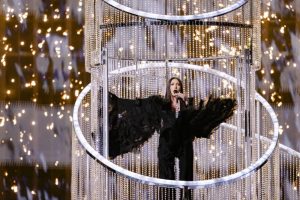









Public broadcasters in Spain, Ireland and Slovenia have confirmed they will not air this year’s Eurovision Song Contest, escalating a wider protest at Israel’s participation in the event.
The three broadcasters said on May 11, 2026 that their schedules would carry alternative programming during the contest, which begins on May 12, 2026 with the first semi-final at the Wiener Stadthalle in Vienna.
Slovenia’s RTVSLO has said it will air a thematic series titled Voices of Palestine between May 10 and May 20. “For the next 10 days, instead of the Eurovision circus, the national television programme will be coloured by the thematic programme series Voices of Palestine,” the broadcaster said.
Ireland’s RTÉ has confirmed it will broadcast the 2023 film That They May Face the Rising Sun in the slot usually reserved for the Eurovision final on May 16, 2026. Spain’s RTVE has opted to air its own home-produced musical variety show in the Saturday Eurovision slot, with the broadcaster noting the date coincides with the International Day of Living Together for Peace.
The three are part of a group of five countries — alongside Iceland and the Netherlands — that have withdrawn their entries in protest at Israel’s continued participation amid the Gaza war, according to the European Broadcasting Union (EBU). It is the largest boycott in the contest’s history since 1970.
The decisions have followed an EBU general assembly in December 2025, at which members voted to retain Israel as a competing nation while approving new safeguards on the televoting system. Spain’s RTVE board had voted by absolute majority in September 2025 to withdraw if Israel were allowed to compete, becoming the first “Big Five” broadcaster to take such a step, citing the war in Gaza.
It is the first time Eurovision will not be broadcast in Ireland since 1963, in Slovenia since 1985 and in Spain since 1961. The absence of Spain also means the contest’s “Big Five” lineup will be incomplete for the first time since Italy joined the group in 2011.
While Iceland and the Netherlands have withdrawn their entries, their public broadcasters are still airing the contest. Slovenia and Spain have gone further by neither competing in nor broadcasting it.
The EBU has defended its decision to keep Israel in the line-up. Eurovision director Martin Green said he hoped boycotting countries would eventually return to the competition in future editions, with organisers pointing to the contest’s “United By Music” slogan.
A total of 35 countries will compete in the 70th edition of the contest, two fewer than in 2025 and the smallest field since 2003. The final is scheduled for May 16, 2026.