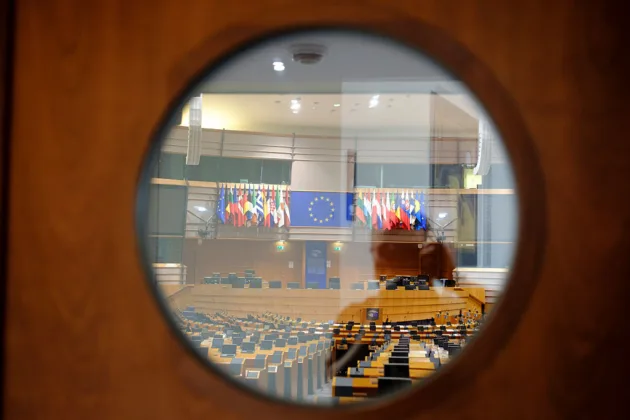






The European Parliament hosted a conference called EU Sanctions: Rule of Law and Fundamental Rights under Attack, organised by MEPs Ruth Firmenich, Michael von der Schulenburg and Danilo Della Valle.
The May 7 event focused on the concern that the European Union’s growing use of sanctions is quietly undermining press freedom and basic rights — especially when people challenge the bloc’s official line on foreign policy issues such as Gaza, Ukraine and Africa.
The speakers included German journalist Hüseyin Doğru, sanctions expert Dr Alexandra Hoffer, lawyer Juan Branco — who works on WikiLeaks founder Julian Assange’s team, represents Cameroonian-Swiss activist and businesswoman Nathalie Yamb.
Branco is planning to run in the 2027 French presidential election.
Doğru, a German citizen, journalist and father of three, was hit with EU sanctions on May 20, 2025 under the Russia-related measures. He is currently stuck in legal limbo, waiting for his case to be heard by the EU General Court.
MEP Ruth Firmenich tried hard to get him to Brussels in person: She made more than 50 phone calls to request an exemption from his travel ban but got no real answers and found no one willing to take responsibility.
The sanctions came without any trial, hearing, or even prior notice. Doğru was listed after covering pro-Palestine rallies and the situation in Gaza. Curiously, the official EU sanctions list describes him as Turkish, even though he is German and holds no dual nationality. Germany, in particular, has been aggressive in cracking down on public expressions of support for Palestine.
In practice, the sanctions mean he cannot leave Germany, he is barred from working as a journalist, and both his and his wife’s assets are frozen — what he calls collective punishment.
Even simple, everyday help from friends could land them in prison for up to 10 years. Doğru says he feels like an exile in his own country, cut off from normal life and with very few places to turn except his lawyers, who are also fighting an uphill battle.
The evidence file against him runs to 38 pages, mostly made up of his own journalistic posts and political comments, labelled as disinformation. Although he is accused of threatening EU stability and being a Russian mouthpiece, the documents never once mention Russia or any funding from Moscow.
The EU insists sanctions are only preventive but many wonder whether they are really being used to pressure people like Doğru until they stop questioning official narratives.
Ah he put it, regimes that decide guilt without going through courts are not protecting democracy — they are digging its grave.
While the EU criticises other countries for censorship, it is increasingly using tools like the Digital Services Act to regulate content and directly sanction journalists who step out of line.
Yamb, well known for her strong criticism of neo-colonial policies in Africa and French actions in Central Africa, is in a similar position.
Sanctioned on June 26, 2025 while she was in Kenya, she too is waiting for her day in the General Court. The restrictions stop her from flying over EU airspace, which means she cannot return home to Switzerland. Her assets were also frozen after she spoke at a conference organised by an NGO.
Branco, who represents her, pointed out that these sanctions are often tougher than criminal convictions. People lose basic rights without knowing exactly why, for how long, or how to effectively challenge them.
In exclusive comments for Brussels Signal yesterday, Branco explained what he sees as the worrying expansion of this system: “A rather strange progressive expansion of the scope of action means that governments and ministers of the European Union can deprive citizens — first foreigners, then EU citizens — of access to their resources and even their right to enter the European Union, simply for taking public positions on the EU’s foreign policy, for example the conflict in Ukraine.
“This is a very ‘innovative’ situation where, with no respect for fundamental rights, people can find themselves unable to exist in their own country.
“These measures follow wartime dynamics, with deprivation of fundamental rights and access to courts completely set aside,” he said.
Regarding what he sees as the loss of real democratic control, he said: “In reality, the 27 member states must vote together on sanctions. If the heads of state opposed them, the sanctions would fall. Countries are renouncing their national sovereignty but the real loss is for citizens. People are deprived of their rights by mechanisms that have no judicial control and no respect for fundamental rights.
‘There is no media or political debate. No one talks about it.”
And on the risks of speaking about Russia, he added: “Talking about Russia can destroy your life, especially if you are a public figure. The theoretical goal is to prevent external interference, but in reality the line is very thin.
“A simple trip to Russia can put you in this situation. This might be understandable in a declared war but we are not theoretically at war. There is no parliamentary control.”
Hoffer said these practices trace back to UN terrorist lists, where political favours often led to arbitrary designations. The EU is now widening its own criteria, using ever vaguer language and giving almost no detailed reasons for its decisions, he aadded.
Many feel the cases of Doğru and Yamb show a clear and disturbing pattern: The EU using sanctions as a weapon to enforce agreement with its foreign policy while bypassing normal legal protections and press freedom.
Most citizens still have no idea these tools even exist or how far they reach. The EU claims to be defending democracy but observers claim stories like these suggest it is steadily undermining the very values it says it stands for.