


The European Union has openly predicted that Germany’s economy will end 2023 in recession, with Eurocrats shrinking growth estimates for the entire bloc on September 11.
European Commissioners had previously predicted that the EU’s largest economy would grow slightly this year, forecasting a rise of 0.4 per cent rise overall for 2023.
It is now taking a more bearish approach to the overall EU’s economic outlook, lowering the estimate for growth to 0.8 per cent – down from 1 per cent it forecast in May.
Things are looking worse for Germany, with Eurocrats now expecting the country’s economy to shrink by 0.4 per cent this year.
Commissioners have attempted to put a brave face on the figures, with economy tsar Paolo Gentiloni praising the EU for having so far avoided falling into recession.
“The EU avoided a recession last winter – no mean feat given the magnitude of the shocks that we have faced,” he said.
“This resilience, most evident in the strength of the labour market, is a testimony to the effectiveness of our common policy response.”
Gentiloni added that the EU now faced “multiple headwinds” over the coming months in the form of inflation and the effects of Russia’s war in Ukraine.
Almost a third of businesses operating in Germany are moving operations out of the country in response to its “green” agenda, research has found. https://t.co/PRIGbdUnmM
— Brussels Signal (@brusselssignal) August 30, 2023
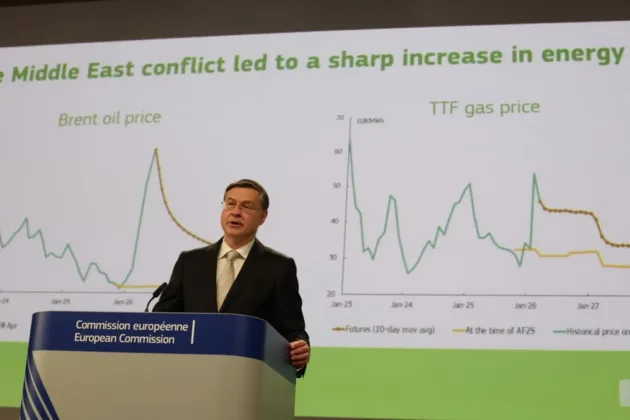
Valdis Dombrovskis, the bloc’s Executive Vice-President for an Economy that Works for People, said the financial pressure on Europe had “taken its toll” but insisted that the EU would likely see some bounce-back in 2024.
“After a period of weakness, growth is expected to rebound mildly next year, underpinned by a strong labour market, record-low unemployment and easing price pressures,” he said.
Dombrovskis added that “uncertainty remains high” within the EU, economically speaking, and he refused to rule out further shocks in the coming months.
The EU’s decision to downgrade Germany’s forecast has been seen as further evidence that the country is now the “sick man of Europe”.
Numerous businesses there have said they are planning to reduce their operations, move abroad, or close entirely due to a mix of negative economic factors hammering the country, much of which have been the direct result of multiple centrist governments.
Demographic change, energy instability and excessive bureaucracy have all been cited by firms as reasons they want to abandon the German market.
The country’s “green” policies have also been scaring away businesses, with more than half of companies operating in Germany saying they have been negatively impacted by the government’s climate reforms.
Germany has long been regarded as the engine of the European economy but that engine is sputtering and the “Sick Man of Europe” label is starting to stick. https://t.co/qzaQsHznz9
— Brussels Signal (@brusselssignal) August 2, 2023