
Differences between French President Emmanuel Macron and German Chancellor Olaf Scholz are too deep to vanish easily, warn observers of their recent ‘fence-mending’ Berlin summit.
“Time will tell whether this unity is permanent or just a temporary façade,” says Krzysztof Bielejewski, a senior partner in the Warsaw-based Independent Expert Group think tank.
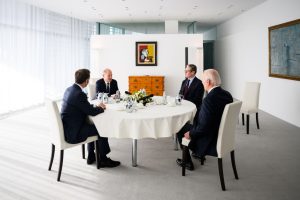
Macron and Scholz put on a show of unity on March 15 by meeting in Berlin and announcing a joint proposal, involving using profits on frozen Russian assets to finance arms purchases for Kyiv.
It came after a frayed relationship grew worse when Germany shot down Macron’s suggestion that a western troop deployment to Ukraine should not be ruled out.
Macron doubled down on the suggestion in a 30-minute prime time interview March 14.
France should “supply more weapons” instead, deputy chancellor Robert Habeck replied curtly.
The spat between the EU’s two largest members caused the opposition CDU’s foreign affairs spokesman Jürgen Hardt to ask if their two leaders have seemingly ditched their practice of “avoiding arguing in public”, or was this just a series of “one-off gaffes”?.
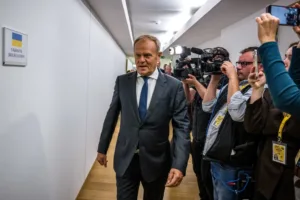
Polish PM Donald Tusk, acting as relationship counsellor, joined the two in an attempt to paper over their differences.
“The reports of Weimar Triangle’s death are greatly exaggerated,” claimed Donald Tusk in a tweet after the three met.
The “Weimar Triangle” refers to trilateral summit meetings between Poland, Germany, and France which began in 1991 as Poland was emerging from Communist rule.
The reports of Weimar Triangle’s death are greatly exaggerated.?????? pic.twitter.com/9aPnEoKUcL
— Donald Tusk (@donaldtusk) March 15, 2024
While they achieved a measure of unity during their love-in, it was superficial, warn several observers.
Macron’s reversion “to lowest-common denominator ‘Russia must not win’ and ‘as long as it takes’ Scholz-isms was not encouraging,” said Benjamin Tallis from the German Council on Foreign Relations.
Similarly, Macron was “really channelling his inner Scholz,” agreed Oliver Moody, journalist in residence at WZB, a Berlin think tank.
Part of their difference is political, with domestic politics pulling Macron in a hawkish direction, but making Scholz dovish.
Macron trails badly in the polls: his Renaissance party and its partners in the Ensemble Citoyens coalition poll just 19 per cent, against 28 per cent for Marine Le Pen‘s Rassemblement National.
He hopes to boost his fortunes by calling for a parliamentary vote on France’s military support for Ukraine, praying this will provoke an uncomfortable showdown for Le Pen’s party.
Only 5 per cent of her voters believe France should increase its military support to Ukraine.
Scholz, for his part, also trails: his Social Democrats fetch 16 per cent, against 29.5 per cent for the CDU/CSU, and 19.5 for the AfD.
The German leader is now “avoiding escalating the conflict in Ukraine over fears that it will boost support for Germany’s far right and far left”, says Oxford Analytica.
With domestic politics pulling the two leaders apart, Paris-Berlin tensions on Ukraine “will be tough to mend”, it concludes.
But politics aside, the two leaders are very different: Macron is fond of tabling big ideas to disrupt conversations and move them forward, whereas Scholz is cautious and older.
“It’s not much of a secret that Emmanuel Macron and Olaf Scholz don’t get along,” says Henning Hoff, who edits the German Council on Foreign Relations’s Internationale Politik Quarterly.
Their deepening rift “is damaging the Franco-German relationship—and Europe”, Hoff says.
Still, Macron’s approach is not entirely without its fans.
“Macron may be unpleasantly divisive and unhelpfully clumsy: but he is changing Europe’s strategic paradigm for the good,” says François Heisbourg, a researcher in European security at London’s International Institute for Strategic Studies and Paris’s Fondation pour la Recherche Stratégique.
“Biden’s self deterrence and Scholz’s muddled pacifism are on the back foot,” he adds.