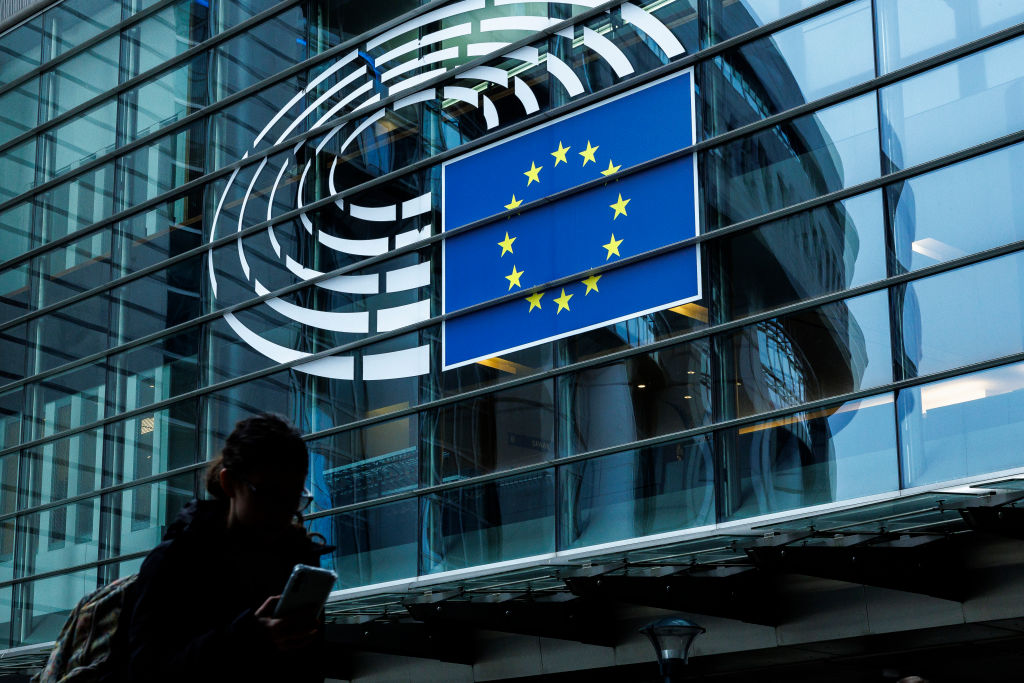
Pakistani blasphemy law victim Shagufta Kausar thanked both God and the European parliament for her release from a Punjabi prison while in Brussels yesterday.
Kausar, a Christian sentenced to death by authorities in Punjab, Pakistan in one of many reported cases of religious persecution, said she would not have found freedom without the Parliament’s emergency resolution from 2021.
She told a seminar organised by the Alliance Defending Freedom International that she and her husband had been tortured while in custody, leaving their young children, who witnessed beatings, traumatised. Authorities had, she said, threatened to throw her naked into the street unless her husband confessed to sending blasphemous messages. She was also urged to convert but refused, she told the Parliament seminar.

“I’m very thankful to God that God has used the European Parliament for my freedom,” Kausar told Brussels Signal.
Tehmina Arora, ADF International’s director of advocacy in Asia, said religious persecution was on the rise in south Asia alongside the growth of nationalism. Seminar attendees heard that minorities, whether Christian, Muslim, Hindu or Buddhist, were increasingly under pressure by those professing the dominant religion, despite constitutions in almost all of the region’s nations that protected them.
“Every South Asian country barring the Maldives has the freedom of religion, the freedom of conscience, the right to practice, profess, even propagate in some constitutions built into their constitutions as a fundamental right, guaranteed by the constitution, protected by the constitution,” Arora told this website.
“However, sadly it plays out very differently on the ground. So even though you have this constitutional protection on the ground… religious minorities in particular face extreme violence in many parts, but also hostile government policies on the ground. So the experience on the ground is very different sadly from the constitutional protections.”
Asher John, a Pakistani journalist specialised in Christian persecution, said Pakistani blasphemy laws, which date back to the 1980s, were difficult to repeal because for many they were considered “divine laws”.
“The blasphemy laws were weaponised in the 1980s,” John said. “The law relating to the disrespect of Prophet Muhammad, this was incorporated in the penal code in the 1980s. So that perception has strengthened over the years.”
Religious feeling in Pakistan “goes wild”, he said, “because those people think that these laws are divine and you can’t really amend them.”
Thanks in part to pressure applied by the European Union and out of fear of losing trade privileges, Pakistani authorities had however in recent months begun to roll back the legislation — despite sometimes heavy opposition — leaving what he said was reason for optimism. “I’ve been reporting on these issues for over two decades now. It’s only in the last few months that there has been change and effort.”
Matej Tonin, a Slovenian MEP from the European People’s Party group and one of the seminar hosts, said he was astonished that widespread reports of religious persecution across south Asia were ignored by mainstream media. “I have to admit that it was some kind of a cultural shock when I came to the European Parliament,” he said. “I’m a Christian, I’m practicing religion back home, and I [had] never heard reports nor seen [on] the Slovenian news that Christians are persecuted.”
“I would say the problem is increasingly getting worse because of the flux, the political flux in the region that always has a repercussion on religious minorities, the poor rule of law and also growing religious nationalism on the ground,” said Arora. “You are seeing this in all countries, Pakistan, India, Nepal, Sri Lanka, Bangladesh, everywhere you see this increasingly a problem, the religion mixing with politics and the fact that it plays out on religious minorities.”
Brussels Signal is preparing a video explainer on the above topics.