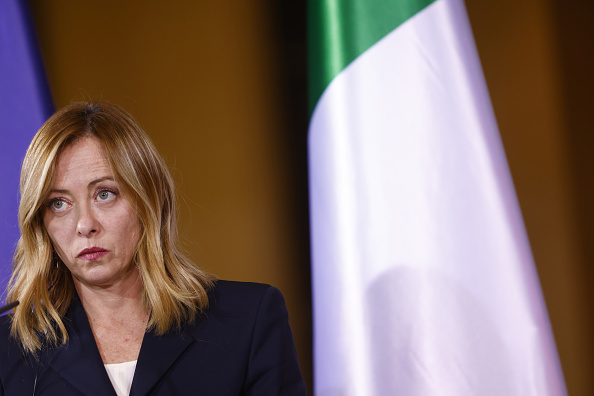
Italy’s Prime Minister Georgia Meloni is reportedly trying to persuade Ukraine President Volodymyr Zelensky to accept a compromise over territory in a peace deal with Russia.
That would include territorial concessions in the Ukraine’s Donbas in a bid to halt the war and pave the way for a peace agreement accompanied by concrete security guarantees for the country.
The suggestion emerged in Rome on the side-lines of the Zelensky’s visit to the Italian capital — where he met Meloni — and coinciding with Atreju and the ECR Study Days running December 9 to 12, events organised by her party Fratelli d’Italia.

It is in this context that rumours, assessments, and analyses are circulating on what Italy is trying to achieve behind the scenes.
The Italian Government’s aim would be to secure, through diplomatic pressure on the Zelensky, an active European role in the negotiation process. That would not be by proposing an alternative plan to the one under discussion in the US but by opening an Italian — and therefore European — channel within the dialogue process with Moscow already initiated by the US administration.
This interpretation is also supported by Fausto Biloslavo, a journalist and well-known war correspondent who has spent many months over the past three years on the Ukrainian frontlines, particularly in the Donbas.
Biloslavo, a long-time observer of Meloni and her political circle — having been active in the youth movement of the party in the 1970s, when it was still called MSI — believes the PM is seeking to operate in a very narrow but potentially decisive diplomatic space.
“Meloni has always believed that only an over-the-top figure like Trump could unravel the knot of the war at the heart of Europe,” he said.
“She positions Italy as a bridge between Europe and the United States to resolve the conflict and avoid being left out.
“Other major EU countries are clearly out of step with American positions, and Meloni wants to leverage her privileged relationship with Trump to close the gap with Europe on the peace process,” Biloslavo said.
According to him, this strategy rests on two pillars. On one hand, the insistence on security guarantees for Ukraine, a stance shared with other European actors thanks to the concept of a NATO Article 5-like commitment, which Washington had included in the first draft of the plan.
On the other hand, the aim is to achieve tangible and actionable results, translating into practice some of the requests coming from the US.
“I think Meloni is trying to propose a concrete and compromise-based solution on the territorial issue that would be acceptable to Kyiv,” Biloslavo continued.
“The goal is to achieve outcomes that are actionable, or at least not politically damaging, for Zelensky domestically.”
Practical implementation remains the most delicate and decisive step. One proposal on the table is that the 16 per cent of the Donbas still under Ukrainian control becomes a truly neutral and demilitarised zone, overseen by international observers.
Even with this solution, many questions remain: Will the Ukrainians accept withdrawing from territories they currently control? Who will administer these areas in the future, which mayors, and who will guarantee security? And who will ensure that neutrality is respected?
The situation is further complicated by a crucial fact: Russia aims to control the entire Donbas. Beyond the areas already occupied, it is gradually taking small portions of the remaining 16 per cent, steadily weakening Ukraine’s position. Time is not on Kyiv’s side.
There are no easy answers. If Meloni is truly aiming for a central role in the peace process, it will be on these territorial, political and security issues that Italy must demonstrate its capacity to manoeuvre.
This will reveal whether the “historic window” envisioned by the PM is real or merely a diplomatic notion – and whether Europe can take an active part in any eventual peace agreement or will remain, as so far, marginal.