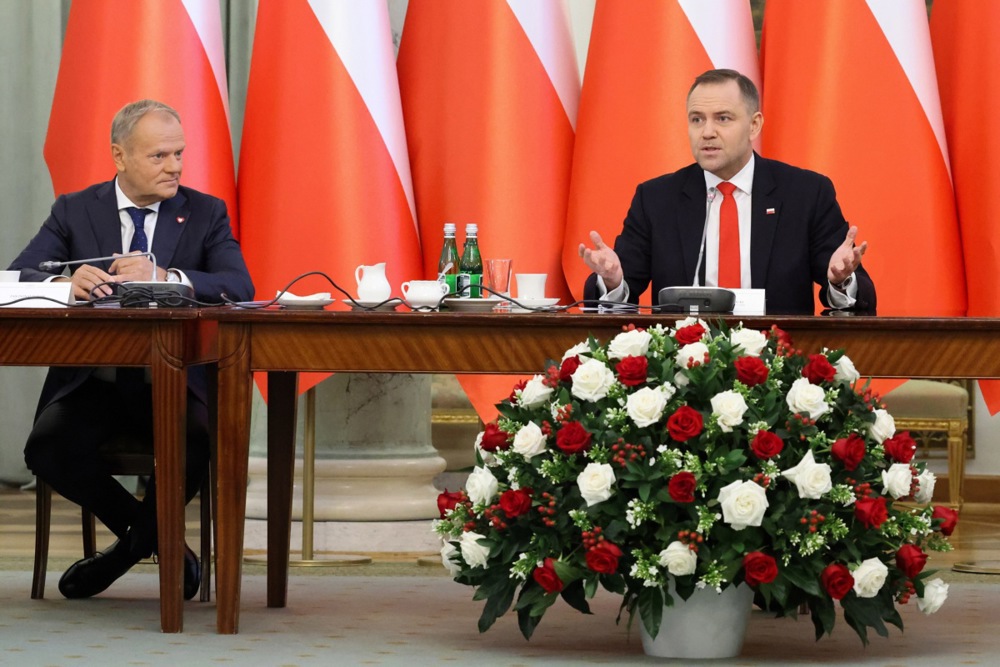
Poland’s ruling centre-left coalition led by Prime Minister Donald Tusk is threatening to cut the budget of President Karol Nawrocki’s Chancellery in protest at his vetoes of government legislation.
The opposition Conservatives (PiS)-aligned Nawrocki on December 13, the second anniversary of the formation of the Tusk government, upped the ante by attacking the administration over its deal with the post-Communist Left.
Tusk’s Civic Coalition (KO) on December 12 tabled an amendment to the State budget to cut the allocation of the Chancellery by €50 million from the €75 million proposed in the first draft submitted to parliament.

The reasoning was that the President’s vetoes of legislation adopting directives of the European Union may lead to fines imposed by the European Court of Justice, therefore the head of state’s office should foot the bill.
The administration has already withheld funding for the PiS, despite a Supreme Court judgment that it should be released, on the grounds that the government majority controlled election regulator had ruled the PiS was guilty of illegally using public funds to aid its election campaign.
The pressure applied on the President relates to the fact that he has vetoed 18 government bills passed by parliament. Among the pieces of legislation blocked are attempts to regulate the crypto-currency market, which the government alleges is being used by Russia to pay its operatives in Poland.
Nawrocki also blocked legislation aimed at easing restrictions on the placement of wind turbines on land.
But the conflict is much broader and includes the President refusing to make judicial, diplomatic and security service appointments the government wants.
The head of state is also angry about having been denied access to the four chiefs of Poland’s security services. He claims that, despite being the head of Poland’s armed forces, he has been denied information about the proposed granting of MiG 29 fighter planes to Ukraine.
Nawrocki, speaking on the 44th anniversary of the introduction of martial law in 1981 by the then Communist regime spoke out against the “continued presence in the highest offices in the land” of people who had supported the crushing of the Solidarity movement and slammed the present Tusk government for promoting such people.
The President was referring to the fact that the centre-left coalition majority in the Polish Parliament led by Tusk in November elected Włodzimierz Czarzasty, the leader of the Left party, which is part of the ruling coalition, to the post of Speaker of Parliament.
The Left has within it members of the former Communist party that was dissolved in 1990 and has traditionally defended some of the policies pursued in Communist times and individuals who were leaders at the time. It has, though, backed Poland’s democratic transformation and membership of both NATO and the EU.
Czarzasty joined the Soviet aligned Polish Communist party in 1983, during the time of martial law introduced by Poland’s last Communist dictator General Wojciech Jaruzelski. That was an attempt to crush the Solidarity movement that had sprung up in 1980 after a wave of workers strikes for better living conditions, trades union rights and civil rights, growing in a matter of months to having around 10 million members.
Martial law, introduced in 1981 on December 13, led to the arrest and internment of thousands of Solidarity and opposition figures and to the deaths of dozens of people in skirmishes with the security forces.
Nawrocki, speaking in front of the monument to Marshall Józef Piłsudski, who led Poles to regain their independence in 1918 after over a century of Russian, German and Austro-Hungarian partition, condemned the Communist regime for having introduced martial law. He rejected the narrative that it had been a lesser evil than a Soviet invasion of the kind that took place in Hungary in 1956 and Czechoslovakia 1968.
“Martial law was not a lesser evil; it was evil in its purest form, a betrayal of the nation by the Communist junta with Wojciech Jaruzelski asking the Soviets to enter our country and extinguish the light of freedom that was shining thanks to Solidarity”, said Nawrocki during the ceremony commemorating the victims of the Jaruzelski coup.
He then drew parallels with the modern-days politics, referring to the composition of the present Tusk government and the fact that it had been sworn in 2023 on December 13.
“It came and returned on December 13, quite recently,” Nawrocki said.
“Post-Communists, with marginal social support [4 per cent to 8 per cent in latest opinion polls] are now receiving the most important positions in the Polish State thanks to political and party arrangements,” he said in a swipe at Czarzasty’s elevation to the position of Speaker of Parliament.
The alleged “soft landing” for former Communists in democratic Poland has been an issue in Polish politics for the past 35 years.
As a result of Communism in Poland ending gradually, members of the Communist Party were able to retain their positions and influence in public administration, judiciary, media and finance while working class activists who opposed them suffered poverty and unemployment.
No former Communist officials were imprisoned for the actions they took during the course of the Communist regime and martial law.
In contrast, Tusk’s government is attempting to convict and send to prison former PiS government officials for alleged abuses of power relating to public funds.
None of the actions of that PiS government, though, has led to mass arrests, the loss of civil liberties or deaths – as was the case during martial law between December 13, 1981 and July 22, 1983.