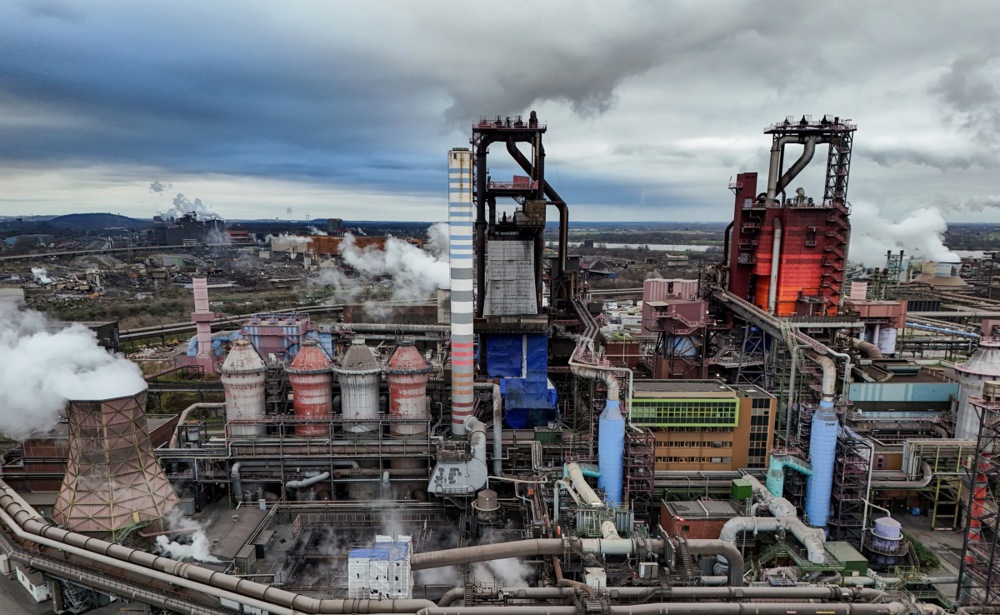
Germany’s steel sector has recorded its bleakest performance in more than 15 years, with crude steel production in 2025 falling to just 34.1 million tonnes.
That is the lowest level since the 2009 global financial crisis, when output stood at 32.7 million tonnes.
According to the German Steel Federation yesterday, the figure represents an 8.6 per cent drop from the already depressed levels of 2024.

For the fourth year running, production has remained well below the 40-million-tonne threshold that the industry views as the minimum required for economically viable capacity utilisation.
Capacity use has now dipped below the critical 70 per cent mark, heightening concerns over the long-term viability of Europe’s largest steel-producing nation.
The federation’s annual report, made available in advance to the German Press Agency (dpa), paints a picture of an industry battered by a confluence of pressures, with it “at recession level”.
Historically weak domestic and export demand, surging energy costs – particularly electricity prices that remain elevated compared with global competitors – and intensifying competition from non-European Union producers, especially in Asia, have all contributed to the slide.
Global overcapacity, unpredictable US trade policies and what are seen as unfair trading practices have further eroded market share.
The decline is especially pronounced in electric steel production, which relies on scrap and is dominated by medium-sized firms.
This segment has been hit hardest, with output levels sinking below those seen even in the depths of the 2009 recession in some categories.
Industry representatives have long warned that without swift and decisive policy interventions, further plant closures and job losses loom large.
Germany’s steelmakers, including major players such as Thyssenkrupp Steel Europe, ArcelorMittal, Salzgitter and Stahl-Holding-Saar, account for a significant portion of EU output and employ tens of thousands in highly skilled roles.
The sector’s struggles come at a time when the bloc is pushing ambitious decarbonisation targets under the Green Deal, with hydrogen-based “green steel” seen by some as a potential lifeline – although the transition demands huge investment amid uncertain demand signals.
The latest news underscores broader anxieties about Europe’s industrial competitiveness.
While the European Steel Association (EUROFER) has repeatedly called for stronger carbon border mechanisms, reduced energy costs and protection against dumped imports, progress has been slow.
Critics point to the combination of high regulatory burdens, elevated energy prices linked to the EU’s energy transition policies and exposure to volatile global markets as key factors driving deindustrialisation risks.
The federation has urged immediate measures to safeguard production sites and reverse the downward trend before irreversible damage sets in.
The steel federation’s managing director Kerstin Maria Rippel said political pressure to act must remain high, adding 2026 “must be the year we secure our business locations”.
The body highlighted that the development in foreign steel trade is particularly alarming, with one third of steel used in the EU being from non-EU countries.
“Under these conditions, the steel economy will hardly be able to recover in 2026,” it warned.
Energy costs were deemed a central issue. “The currently uncompetitive electricity prices are a high burden and at the same time a central obstacle to the transformation of the entire steel industry to climate neutrality,” Rippel said and called for an internationally competitive electricity price for industry.
Luxembourg-based multinational steel manufacturer ArcelorMittal said it was delaying big investment programmes in Europe, citing uncertainties over European Union regulatory directives. https://t.co/hI8SeqR9V6
— Brussels Signal (@brusselssignal) November 26, 2024