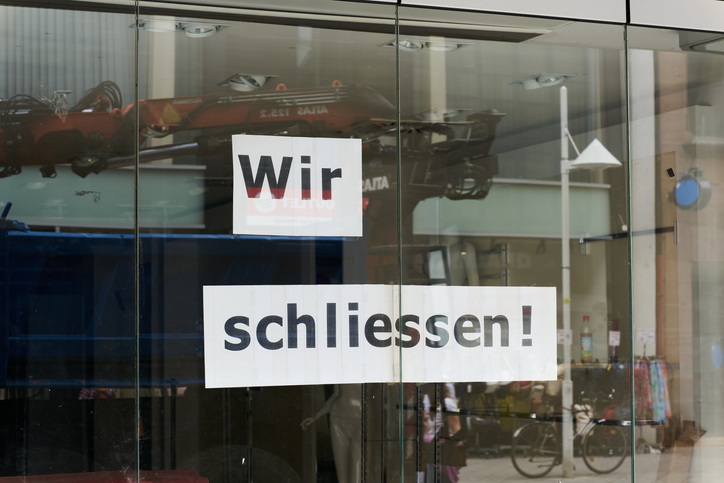
The number of bankruptcy cases involving big companies in Germany sharply rose in 2025.
According to a study by business consultancy Falkensteg, the number of large companies – defined as those with more than €10 million in turnover – going bankrupt has grown by about a quarter to 471 last year.
Compared to 2021 the number of large-scale insolvencies has almost tripled.

“The German economy does not just have a headache anymore, it has caught a fever,” study author Jonas Eckhardt told newspaper Welt today. He added: “For many medium-sized companies this is no longer just a transitory economic slump, but a question of survival. The cyclical downturn is changing into a structural collapse.”
The study attributes the rise in bankruptcies to a mix of factors, such as a structural crisis of the automotive and mechanical engineering sectors, lagging consumption and geopolitical uncertainties.
Positive impulses from Germany’s announced public investments programmes – financed with record-breaking debt issuance – have hardly been noticeable so far.
Metal goods manufacturers accounted for most of the counted bankruptcies in 2025 with 65 cases – a plus of more than a third compared to 2024. Automotive suppliers are also significantly affected with 59 insolvencies.
The biggest rise was seen in the electrical engineering sector where bankruptcies jumped by almost 77 per cent to 53 cases.
The authors said they do not expect a turnaround for the coming year. According to the study: “The German economy will only recover slowly in 2026 because several structural brakes, such as creeping loss of competitiveness, a shortage of skilled workers, excessive bureaucracy and sluggish investment, will overlap.”
In 2026, large-scale insolvencies are expected to rise by another 10 to 20 per cent with the manufacturing industry – once the crown jewel of Germany’s Wirtschaftswunder (economic miracle) – most at risk.
The manufacturing sector is suffering from overcapacity and eroding profit margins. In addition, China’s new five-year-plan, which is expected come out in February and emphasise self-reliance, might put additional competitive pressure on key German industries.