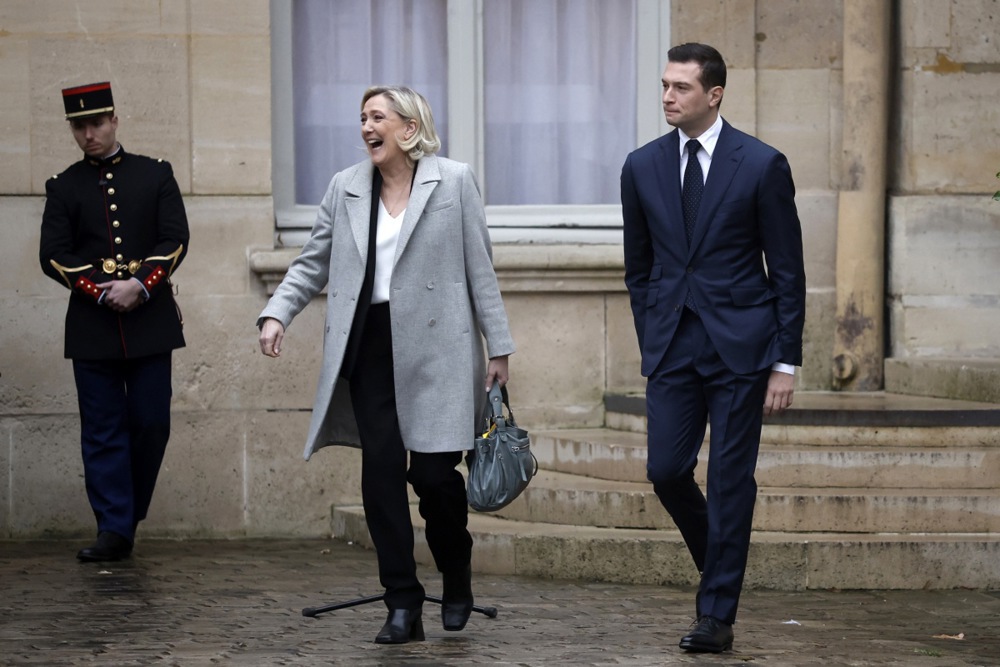
Fears over the safety of France’s National Rally (NR) party have led the party president, Jordan Bardella, to bar all elected party officials from public tributes to the murdered nationalist Quentin Deranque.
The move by Bardella, designed to insulate the party from potential street violence, comes as the 23-year-old student’s death on February 16 continues to ignite fierce debates on political violence, both in France and abroad.
“The organisers of these gatherings are varied, uncertain, and sometimes simply non-existent, as they stem from spontaneous mobilisation on social media. To our knowledge, neither Quentin’s family nor his close friends are behind any of them,” Bardella said.

The NR chief highlighted far-left followers’ desire to confront these gatherings and that they had already called for violence. He said he felt responsible for the security of his elected officials.
Bardella stressed that he and his party have already paid a dignified tribute.
He said NR would now begin a political struggle against the far-left that he said is responsible for an unprecedented degradation of the political climate in France.
Bardella said the far-left had killed a person [Deranque] and that there was a political responsibility with the broader Left that has worked in close collaboration with them.
He also warned that some organisers of certain events may have links to the far-right and that state services are deeply concerned about the risk of serious incidents in this tense context.
"Je suis responsable de la sécurité des élus": Jordan Bardella justifie son appel aux membres du RN à ne pas se rendre aux hommages à Quentin Deranque pic.twitter.com/ECz7zQ9Ppc
— BFM (@BFMTV) February 20, 2026
The main tribute to the student in Lyon tomorrow is set to go ahead. The Greens Mayor of the city, Grégory Doucet, had indicated he was open to ban the event of taking place but interior minister Laurent Nuñez said he did not want a ban and that “he will mobilise a very large police force”.
“Members of the ultra-left are calling for people to come and disrupt this demonstration. Obviously, we will prevent them,” Nuñez said.
Deranque’s family called for “calm and restraint” and condemned “all forms of political violence”.
They do not intend to attend the march in Lyon and said they “hope that, if people wish to take part in this initiative, they will do so calmly, with restraint and without political expression”, according to their lawyer, Fabien Rajon.
Tomorrow’s march theme is: “Justice for Quentin, killed by antifa”.
On the political Left, a split appears to be emerging, with most people now distancing themselves somewhat from the hard-left party La France Insoumise (LFI).
LFI is closely linked to Jeune Garde, a street-fighting militia to which most of the suspects in Deranque’s killing are believed to have belonged.
Several of the people in custody after the killing were parliamentary assistants of the LFI and the Jeune Garde was created by LFI MP Raphael Arnault, who has been in many physical fights.
LFI has not shown any remorse, and on the contrary has been going in a counter-offensive, blaming “the far-right”.
Arélien Taché, an MP for LFI, reacted to a politician who said it was unacceptable to die for one’s idea’s in France that “Quentin was fighting for the superiority of the white race” and that the Left should not defend such ideas.
He said this despite the fact that Deranque was of mixed race, with a Peruvian mother.
The political street violence in France also touched a nerve abroad.
On February 18, Italian Prime Minister Giorgia Meloni posted on X that the killing was shocking and causing grief.
“The death of a boy just over 20 years old, attacked by groups linked to left-wing extremism and overwhelmed by a climate of ideological hatred that is sweeping across several nations, is a wound to the whole of Europe,” she said.
“No political idea, no ideological opposition can justify violence or turn debate into physical aggression. When hatred and violence take the place of dialogue, it is always democracy that loses.”
This triggered a hostile reply from French President Emmanuel Macron, who said foreign leaders should not meddle in French domestic affairs.
“Let everyone stay at home, and the sheep will be well looked after,” Macron said. “I am always struck by the fact that nationalists, who do not want to be disturbed in their own country, are the first to comment on what happens elsewhere.”
In turn, Meloni reacted, stating: “Expressing solidarity with the French people on a matter that clearly concerns everyone is not interference.”
She said she was “sorry that Macron did not understand that”.
“I see a climate that I do not like,” she added. “I see it in Italy, I see it in France, I see it in the United States. I also commented on the murder of Charlie Kirk at the time.”
Kirk was a US right-wing political activist who was assassinated on September 10, 2025.
The Italian PM went on to remind the public that France had granted political asylum “to the cream of the crop of the Red Brigades for several decades”.
Meloni went on to say: “Interference is, for example, when a leader is elected by their own citizens and hears a foreign state say, ‘We will monitor the application of the rule of law.’ That is interference.”
With this, she was referring to controversial comments made by French officials after her election.
The US State Department also reacted to the events in France.
“Violent radical leftism is on the rise and its role in Quentin Deranque’s death demonstrates the threat it poses to public safety. We will continue to monitor the situation and expect to see the perpetrators of violence brought to justice,” it noted.
US Under-Secretary of State Sarah B Rogers added: “Democracy rests on a basic bargain: You get to bring any viewpoint to the public square and nobody gets to kill you for it. This is why we treat political violence — terrorism — so harshly.
“Once you decide to kill people for their opinions instead of persuade them, you’ve opted out of civilisation. We will continue to watch this case.”
A Hungarian court has sentenced a German non-binary Antifa activist to eight years’ imprisonment for her role in a series of violent assaults in Budapest in February 2023. https://t.co/yruTUFkvxi
— Brussels Signal (@brusselssignal) February 4, 2026