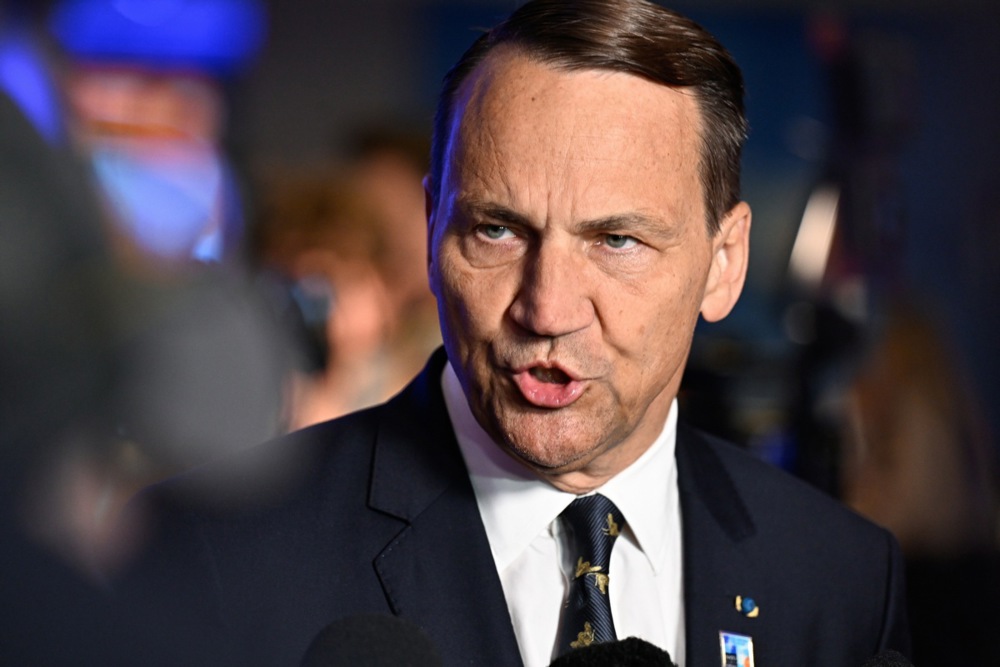
Poland’s foreign minister Radosław Sikorski has lamented that, in his opinion, relations between the US and Europe have deteriorated.
Speaking in his annual address to the Polish parliament yesterday, he also said Poland cannot be a “sucker” in its relationship with Washington.
Sikorski, who serves in the centre-left coalition government led by Prime Minister Donald Tusk, latched onto a recent poll which showed 54 per cent of Poles believed that the US was no longer a reliable ally, with 35 per cent disagreeing.

“This poses a particular challenge for Poland,” said Sikorski but added that “strategic co-operation with the USA is in Poland’s interest”.
“Poland is ready to serve as a regional hub for US forces” on the eastern flank of NATO, he said, and added that Warsaw and would welcome the maintenance “and even an increase in the number of US troops in Poland”.
The Polish foreign minister recalled that “the alliance and close ties with the United States have been a pillar of our foreign policy for decades, regardless of who sat in the White House, which party held the majority in Congress or who governed Poland”.
He also said, though, that the omens in relations with the US were not good.
“We look at the changes in the US with understanding, but also with concern. We have been and will be a loyal ally of America. But we can’t be suckers,” Sikorski said.
He added that the US was clearly thinking that Europe was slipping down the list of its priorities.
Sikorski recalled past US support for Poland from US presidents such as Woodrow Wilson and Ronald Reagan during Poland’s struggles for independence and against Communist rule.
He also invoked the 1945 Yalta Conference, when then-US president Franklin Delano Roosevelt sought then-Soviet leader Josef Stalin’s help in the war against Japan following the defeat of Nazi Germany, which led to Poland ending up on the wrong side of the Iron Curtain.
“He obtained it [Nazi defeat] but at the cost of freedom for this part of Europe,” Sikorski said. “The American national interest was realised. We paid the price.”
Sikorski said that lesson should give pause to those who favour international relations based solely on a narrow pursuit of national interests.
Referring to a recent United Nations vote on Ukraine’s territorial integrity, Poland’s top diplomat noted that the US, like China, abstained and argued that this was concerning for his country.
“We have been and will remain a loyal ally of America, but we cannot be suckers,” Sikorski said.
He told MPs he appreciated the “openness and directness of the US administration” and reflected that western Europe has benefited for too long from a “peace dividend”.
Sikorski agreed with arguments on the other side of the Atlantic that Europe should take greater responsibility for its own security and claimed Europe was ready to do that and that it could deter Putin’s Russia.
“As a populous and wealthy continent, we are capable of doing so. Europe does not need armed forces equal to those of the United States, only forces strong enough to deter Russian President Vladimir Putin,” he said.
The Polish foreign minister criticised voices doubtful about Poland’s membership of the European Union and hit out at EU’s policies he said were unwittingly aiding and abetting Russia.
“In Moscow, they rejoice at every manifestation of anti-European hysteria,” said Sikorski.
In this context, he defended the EU’s Security Action for Europe (SAFE) loan programme, which has been questioned as undermining Polish sovereignty.
Poland is to borrow nearly a third (€44 billion) out of the total €150 billion made available for defence loans by the EU under SAFE at an interest rate of three per cent.
Sikorski claimed that the money from the SAFE programme would give Poland the chance to develop its anti-drone defences, a clear priority since the incursion by two dozen Russian drones in the autumn of 2025.
“If the SAFE instrument is not in place, and in the event of another airstrike next year, we fail to shoot down Russian drones over Poland, those who vote against SAFE will bear joint responsibility,” he warned.
Polish President Karol Nawrocki, who is allied with the opposition Conservatives (PiS) and who attended Sikorski’s speech in parliament, agreed with the foreign minister regarding the threat posed by Russian President Vladimir Putin.
He did, though, criticise the Polish minister for what he. called his alarmist rhetoric with regard to Poland leaving the EU – “Polexit”.
“Minister Sikorski constructed the problem of Polexit and dissected it into its component parts, but such a problem does not exist today,” the President said.
He also disagreed with Sikorski with regard to criticism of the European bodies.
“Criticism of the European Commission and its policies is part of the political discourse, which we have the right to engage in.
“The EU has made many mistakes. I intend to be assertive in relations with the EU to ensure that certain tragedies, which led to the war in Ukraine, do not happen again,” Nawrocki said.
The PiS criticised Sikorski’s address for its what it called its imbalance with regards to defending Polish sovereignty.
Paweł Jabłoński MP and former PiS deputy foreign minister said: “One should not be a sucker at all, including in relations with Germany, and I have the impression that Mr Sikorski is afraid to say a single bad word about Germany.
“He is the first to jump into little wars on social media with Elon Musk or Marco Rubio, but when it comes to saying something negative about the EU or about Germany, then he is afraid.”
Jan Rokita, political commentator for the conservative Sieci magazine, expressed surprise at the what he saw as Sikorski and Tusk persisting in being critical of the US administration.
“I cannot see how it can be in Poland’s interests to attack such a pro-Polish President like [US President] Donald Trump,” he said.
Rokita was referring to the repeated praise Trump and members of his administration have heaped on Poland for its policies on defence, energy and migration and the fact that the US has 10,000 of troops stationed in the country.
The Tusk administration, though, remains a close ally of the German Christian Democratic Union (CDU) in the European People’s Party. The European Parliament’s largest political caucus is angry with Trump over his administration’s criticisms of the EU and what, in the view of Brussels, is a lack of support for Ukraine.