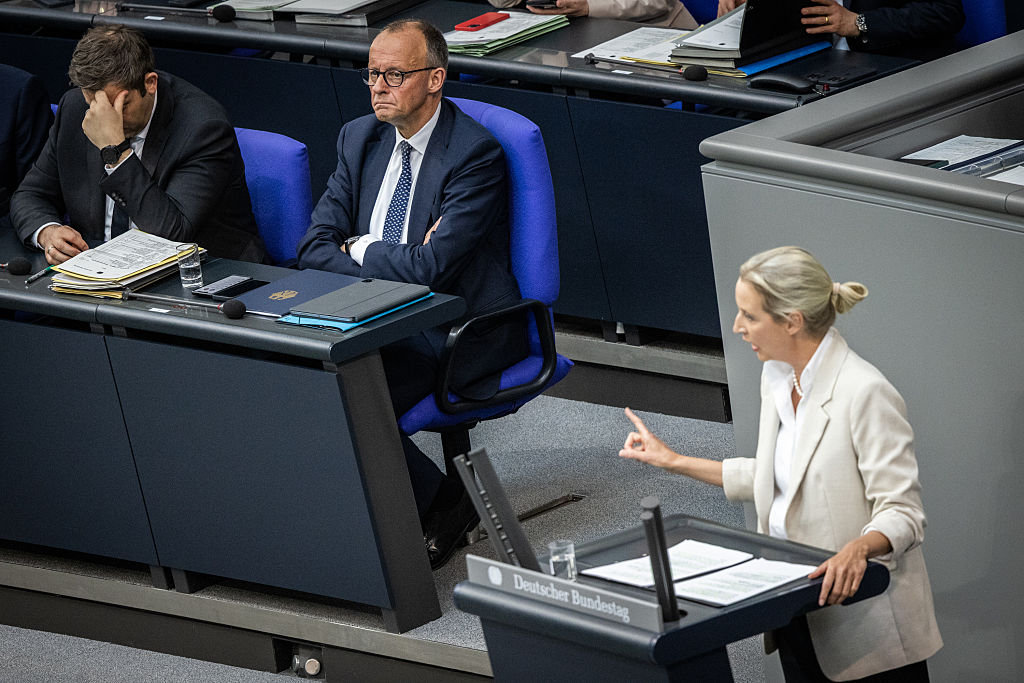
Germany’s Alternative for Germany (AfD) party has slammed the country’s Constitutional Court after it ruled that the party – the second-biggest in parliament (Bundestag) – did not have the right to the second-largest conference room there.
“The decision was predictable on a political level. However, it was still a surprise on a legal level,” AfD deputy chairman Stephan Brandner told Brussels Signal yesterday.
“If you leave ideological contortions aside, common sense tells us that a larger faction also needs more space for internal meetings and discussions,” the lawyer from Thuringia added.

Yesterday, the Constitutional Court published a ruling that said the Bundestag’s Council of Elders – a panel of 28 MPs who deal with administrative matters – had been correct in denying AfD the use of the building’s second-biggest conference room, referred to as Otto Wels Hall, with a floor size of 462 square metres.
Instead, the Council assigned the right-wingers a much smaller room (251m2) that had been used by the 92 MPs of the Liberal Democratic Party (FDP) until the 2025 general election. The bigger room was granted to the Social Democratic Union (SPD) party, that had been using it since 1999.
In the February 2025 elections, AfD came in second and achieved 152 seats, 69 more than before. The SPD tumbled from 206 to 120 seats. The FDP did not make it into parliament.
“The applicant’s [AfD] view that the Otto Wels Hall, as the second-largest hall, corresponds to a silver medal to which it [AfD] is entitled as the runner-up in the federal elections is misguided,” the Court said, adding: “The institutional rights enshrined in the Constitution do not guarantee success bonuses but rather ensure opportunities to participate in the decision-making process within public institutions.”
The smaller room is making parliamentary work considerably more difficult, according to Brandner. “In our current room we only have 1.7m2 per MP, compared to the SPD’s 4m2. Faction meetings can last for hours but under the current space constraints reasonable work or discussion are hardly possible,” he said.
Brandner added that, while the Bundestag’s rules of procedure do not say anything about the allocation of parliamentary rooms, they clearly divvy up many other resources by faction size. That includes the number of committee chairpersons, the number of employees, access to public funds, and speaking times.
“In the past, the rooms were always divided up amicably according to faction size”, Brandner said. “Except for once when the SPD – while having more MPs – gave the CDU [Christian Democratic Union] the larger room but that one was only 1m2 larger than theirs.”
Brandner said he suspects political bias behind the decision. “It is worth noting that the decision was taken by the Second Senate of the Constitutional Court. This Senate is chaired since 2025 by judge Ann-Kathrin Kaufhold, a controversial left-wing ideologue who became a constitutional judge at the behest of the SPD,” he said.
He also bemoaned the fact that – contrary to previous practice – his party was not informed of the Court’s decision in advance. “Normally, parties to proceedings are notified one day in advance that a decision is forthcoming and receive information about the decision approximately one hour before it is published,” he. said.
“This time, the decision was published without prior notification.”
Otto Wels Hall received its informal name from the SPD in honour of Otto Wels, a Social Democrat MP who held a famous speech against the Enabling Act in 1933, which made Adolf Hitler German dictator. Officially, the room is called 3N 039.
Brandner said he thought it was “misleading” that the Constitutional Court adopts the SPD’s name for the room in its decision.
“This designation is not an official name but merely a name that the SPD itself gave to the chamber. They could have taken the sign with them. Otto Wels himself was never in this room,” he said.
“He did not deliver his speech against the Enabling Act of 1933 there, or in the Bundestag at all, but in the Kroll Opera House.”