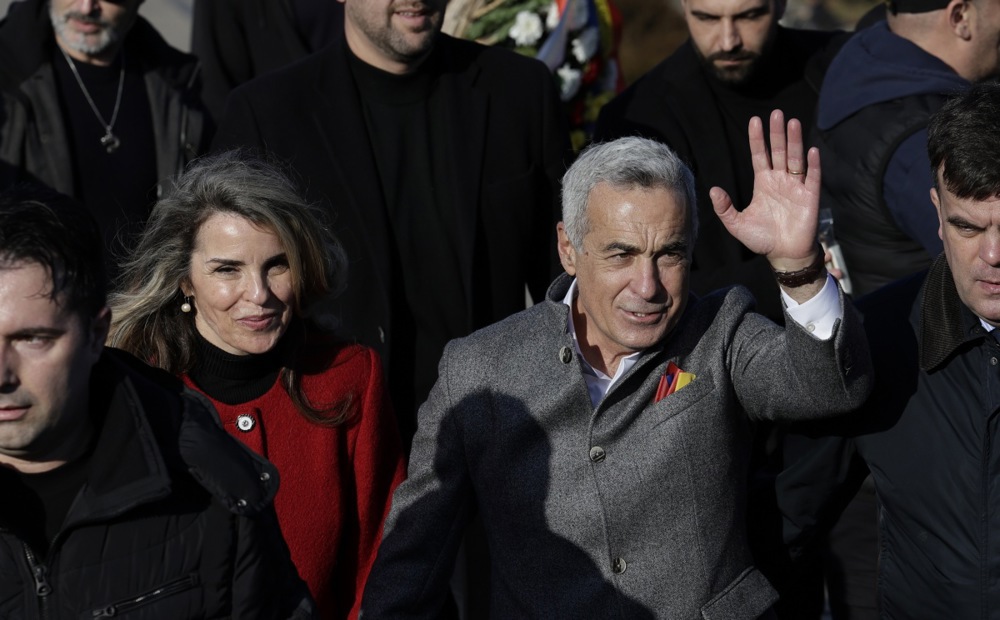
The Bucharest Court of Appeal has ruled that much of the evidence against former presidential candidate Călin Georgescu was obtained unlawfully, effectively undermining the prosecution’s case.
The decision, handed down today, has led to the exclusion of dozens of witness statements and related materials, prompting questions about the integrity of the investigation into the right-wing politician who was barred from running for president, despite being well in the lead after the first round.
Georgescu, a controversial figure known for his nationalist views and criticism of NATO and the European Union, burst onto the political scene in the 2024 Romanian presidential election.

He unexpectedly topped the first round of voting in November that year, only for the Constitutional Court to annul the results amid allegations of Russian interference and illegal campaign financing.
The annulment sparked widespread protests and accusations of electoral manipulation, with Georgescu’s supporters claiming it was a stitch-up by pro-EU establishments in Bucharest and Brussels.
Following the election fiasco, Georgescu faced a series of legal challenges.
In February 2025, Romanian prosecutors opened a criminal investigation into him, leading to his indictment in September 2025 on charges of instigating violence and attempting to overthrow the constitutional order.
These charges stemmed from alleged plots linked to his campaign and post-election activities, including supposed ties to far-right groups and foreign influences.
Central to the accusations was the alleged collaboration between Georgescu and Horațiu Potra, a former French Foreign Legion soldier and mercenary leader.
Potra, often described in media reports as Georgescu’s close associate and security figure, faced charges alongside his son, nephew and around 20 other individuals accused of forming a paramilitary-style group equipped with illegal weapons.
Georgescu was placed under judicial control, barred from running in the May 2025 election rerun,. He has consistently denied the accusations, portraying them as politically motivated harassment.
"The fact that there is no actual evidence about Russian interference is something that is widely recognised now in Romanian media." @GElefteriu talks to @JustinStares about what is going on politically in #Romania. pic.twitter.com/rpdmltDJEN
— Brussels Signal (@brusselssignal) January 22, 2025
The latest ruling centres on procedural irregularities in how evidence was gathered by the General Prosecutor’s Office (PICCJ) via raids linked to Potra.
Judge Mihai Paul Cozma determined that witness statements from individuals who were later charged as co-defendants were inadmissible.
These statements, dated primarily from December 8 and 12, 2024, violated the suspects’ right against self-incrimination under Article 118 of Romania’s Criminal Procedure Code, the court ruled.
It declared these declarations null and ordered their exclusion from the case file, along with audio recordings of the hearings and any references to them in the indictment.
Citing Articles 102 and 282 of the Code, the judge emphasised that evidence obtained illegally cannot be used in proceedings and anything determined to be legally void automatically leads to exclusion.
In the court’s minutes, it stated: “Evidence obtained illegally cannot be used in the criminal process.”
The decision has been hailed by Georgescu’s allies as exposing nearly two years of “judicial harassment”, with investigative journalist Iosefina Pascal describing it as a “sham” on social media.
The case is not fully dismissed, though. The court has given the PICCJ five days to confirm whether it wishes to maintain the indictment or request the case’s return to the prosecutor’s office for further investigation.
This leaves the proceedings in limbo, potentially paving the way for a retrial or possibly acquittal if prosecutors cannot salvage their case.
The ruling comes amid broader scrutiny of Romania’s judicial system and its handling of politically sensitive cases.
Critics, including Georgescu’s supporters, argue that the original election annulment and subsequent prosecutions reflect undue influence from EU institutions keen to suppress anti-establishment voices.
Georgescu, who has framed his ordeal as a battle against “globalist” forces, is likely to see his popularity bolstered among his base.
VIDEO: A new US Judiciary Committee report says there was no evidence of the alleged 25,000-account Russian TikTok network used to justify cancelling Romania’s election.
So if Russia didn’t interfere, why was the second round cancelled? Romanian journalist @iosefinaoficial…
— Brussels Signal (@brusselssignal) February 12, 2026