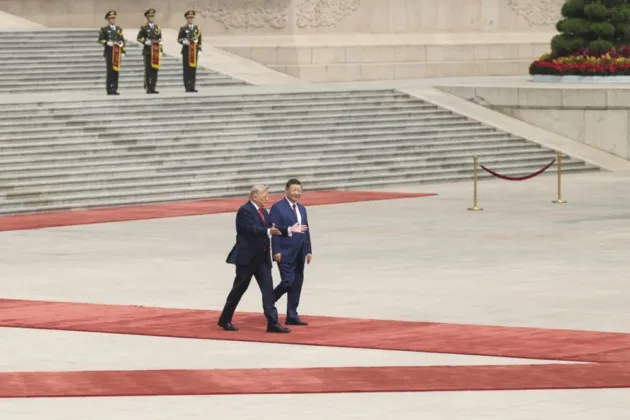



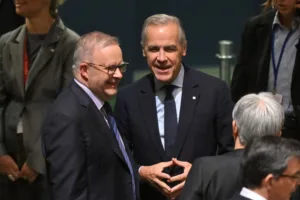


Pedro Sánchez arrived in Beijing on April 14, 2026 to a full military honours reception and left having signed nineteen bilateral agreements with China — covering trade, technology, green energy, infrastructure, and a new Strategic Diplomatic Dialogue Mechanism that formalises regular top-level engagement between Madrid and Beijing. It was his fourth visit in four years. The message was difficult to ignore.
Sánchez is not a Eurosceptic. He leads a government firmly anchored in EU and NATO structures. His visit to Beijing did not represent a departure from Western institutions. It represented something arguably more significant: a growing recognition, visible even within the European mainstream, that those institutions are no longer sufficient on their own to deliver what European economies actually need.
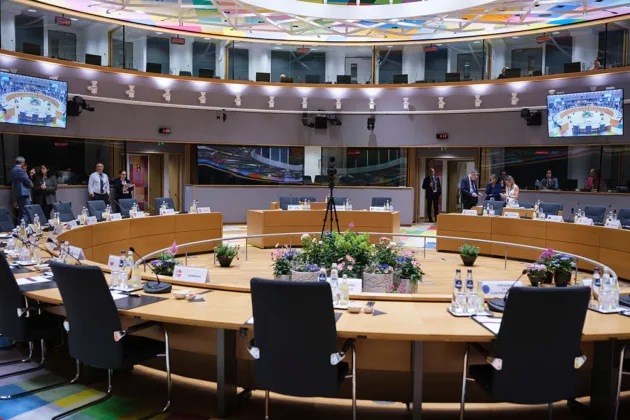
That recognition is increasingly linked in some analyses to developments within Brussels itself.
The European Green Deal was designed as a modernisation programme. In practice, it has, according to critics, coincided with concerns about industrial competitiveness and energy costs. Energy-intensive industries have relocated. Supply chains have been disrupted. Emissions have not decreased — they have been outsourced to jurisdictions with fewer regulatory constraints. European households and businesses have absorbed energy costs that their competitors elsewhere do not pay. The untold billions poured into intermittent renewables did not buy the dispatchable electricity that industrial competitiveness requires. Meanwhile, the regulatory architecture has grown denser, more prescriptive, and increasingly detached from the economic realities it purports to govern.
Sánchez’s visit is a symptom of where this leads. Spain carries a trade deficit with China approaching $50 billion (€42 billion). Madrid’s priority was straightforward: Secure better market access for Spanish exports, attract Chinese industrial investment, and reduce a structural imbalance that EU frameworks have done little to correct. The agreements signed in Beijing achieved more for Spain’s trade position in a single visit than years of EU-level negotiation have managed.
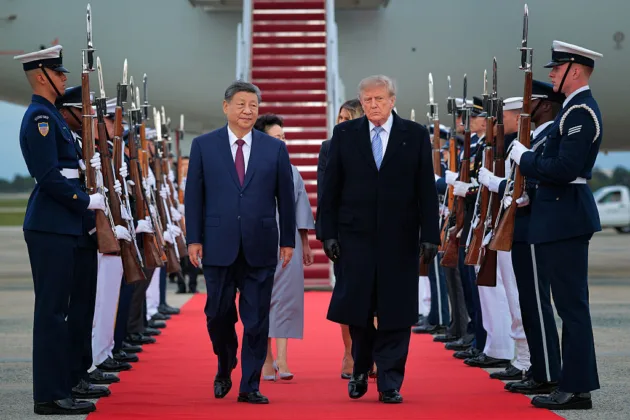
Spain is not alone in drawing this conclusion. In the first months of 2026 alone, the leaders of the United Kingdom, Finland, Ireland, Germany, and Canada all made their way to Beijing. A European Parliament delegation visited China in late March for the first time in eight years. The pattern is consistent enough to constitute a trend rather than a series of isolated decisions.
What unites these visits is not ideological affinity with Beijing. It is the growing cost of alternatives. European industrial policy has systematically narrowed the options available to member states. Where Brussels identified political liabilities, others identified industrial opportunities. Technologies for processing rather than simply burning coal — already deployed at scale in India and South Africa — were not developed in Europe not because they were impossible, but because the regulatory environment made them unwelcome. The result is a continent increasingly dependent on imported technologies, imported energy, and imported capital for its own stated transition objectives.
The irony, for some observers, lies in the fact that Europe’s leaders travel to Beijing to secure the industrial investment and technological cooperation that EU policy has made it difficult to develop domestically. They are not choosing China over Europe. They are choosing economic functionality over regulatory constraints.
Sánchez framed the visit in the language of trade rebalancing and economic partnership. He was careful to position China as a necessary participant in addressing global challenges — from climate to the Middle East — at a moment when Washington’s engagement on both fronts is in visible retreat. Whether one agrees with that framing or not, the underlying logic is hard to dispute: A continent that has made itself structurally dependent on external capital and technology cannot afford to be selective about where that capital and technology comes from.
This is the conversation Brussels is not having. The question is not whether European governments should engage with China — they plainly will, and increasingly are. The question is why that engagement has become necessary in the first place, and what it reveals about the cumulative cost of a decade of regulatory choices that prioritised ideological coherence over industrial survival.
Sánchez’s visit to Beijing is not evidence of a geopolitical realignment. It is evidence of an industrial policy failure. The two things are different. Only one of them is Brussels’ responsibility.